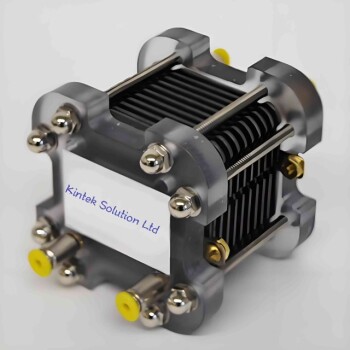
A single-chamber bio-electrochemical reactor functions as a unified platform that integrates electrochemical hydrogen production with biological metabolic conversion. Its primary role is to provide a controlled growth environment where an in-situ hydrogen evolution cathode generates electron donors directly for bacteria, such as Cupriavidus necator H16, under a continuous supply of CO2. By housing these processes in a single vessel, the reactor serves as a critical tool for evaluating catalyst performance during simultaneous electrolytic and biological operations.
The reactor’s defining characteristic is the simultaneity of its processes: it does not separate hydrogen generation from bacterial consumption. Instead, it couples an in-situ hydrogen evolution cathode directly with biological metabolism, streamlining the conversion of CO2 into value-added products.
The Core Integration of Biology and Electrochemistry
Facilitating Simultaneous Conversion
The most critical function of this reactor design is the simultaneous execution of two distinct processes.
It allows electrolytic hydrogen production (physics/chemistry) and biological metabolic conversion (biology) to occur at the exact same time.
This removes the need for intermediate storage or transfer of hydrogen, increasing the immediacy of the reaction.
In-Situ Hydrogen Generation
The reactor features an in-situ hydrogen evolution cathode.
Rather than pumping in external hydrogen gas, the reactor generates hydrogen directly within the liquid medium through electrolysis.
This ensures that the essential electron donor (hydrogen) is immediately available for the biological components.
Supporting Specific Bacterial Growth
The design provides a controlled growth environment tailored for specific microorganisms, such as Cupriavidus necator H16.
The reactor architecture supports the specific metabolic needs of these bacteria, allowing them to thrive while interacting with the electrochemical components.
Operational Mechanics and Evaluation
Continuous Carbon Supply
To facilitate synthesis, the reactor operates under a continuous supply of CO2.
This ensures that while the cathode provides the energy source (hydrogen/electrons), the carbon source is never the limiting factor in the metabolic process.
Catalyst Performance Evaluation
The reactor acts as the primary platform for evaluating catalyst performance.
Because the biological and electrochemical systems are integrated, researchers can assess how well a catalyst supports the overall practical application of microbial electrosynthesis (MES).
It creates a "real-world" testing ground where the efficiency of the catalyst is measured by the success of the biological conversion.
Understanding the Trade-offs
Coupled Optimization Challenges
In a single-chamber system, the operating conditions (pH, temperature, electrolyte composition) must suit both the electrolysis and the bacterial growth.
You cannot optimize the electrochemical environment without considering the biological tolerance.
This often requires finding a "middle ground" that allows both systems to function, even if neither is at its absolute theoretical peak efficiency.
Lack of Separation
Because everything occurs in one chamber, there is no physical barrier between the anode and cathode environments.
This simplifies the design but removes the ability to isolate reaction products that might interfere with the opposing electrode.
Making the Right Choice for Your Goal
If you are designing an MES experiment, consider how this specific reactor architecture aligns with your objectives:
- If your primary focus is System Integration: Choose this reactor to study the direct coupling of renewable energy (electrolysis) and carbon capture (biology) in a simplified, singular unit.
- If your primary focus is Catalyst Testing: Use this platform to rigorously evaluate how a specific catalyst performs under the biological constraints of a working microbial system.
Ultimately, the single-chamber bio-electrochemical reactor is the bridge that transforms separate electrical and biological inputs into a unified synthesis process.
Summary Table:
| Core Function | Description | Key Benefit |
|---|---|---|
| In-Situ H2 Generation | Electrolytic hydrogen produced directly at the cathode. | Immediate electron donor availability for bacteria. |
| Process Integration | Combines electrolysis and biological conversion in one vessel. | Streamlines CO2 conversion into value-added products. |
| Catalyst Evaluation | Platform to test catalysts under biological conditions. | Measures real-world efficiency in microbial systems. |
| Continuous CO2 Supply | Constant influx of carbon source during operation. | Prevents metabolic limitations for microorganisms. |
| Simultaneous Execution | Physics and biology occur at the exact same time. | Eliminates the need for hydrogen storage or transfer. |
Elevate Your Microbial Electrosynthesis Research with KINTEK
Unlock the full potential of your MES experiments with KINTEK’s precision-engineered laboratory solutions. Whether you are optimizing catalyst performance or scaling up carbon capture processes, our specialized range of electrolytic cells, high-performance electrodes, and temperature-controlled reactors provides the reliability your research demands.
From advanced battery research tools to specialized high-temperature furnaces and autoclaves, KINTEK is the trusted partner for researchers seeking to bridge the gap between electrochemistry and biotechnology.
Ready to streamline your lab's workflow? Contact our technical experts today to find the perfect reactor configuration and high-quality consumables for your specific application.
References
- Byeong Cheul Moon, Dong Ki Lee. Biocompatible Cu/NiMo Composite Electrocatalyst for Hydrogen Evolution Reaction in Microbial Electrosynthesis; Unveiling the Self‐Detoxification Effect of Cu. DOI: 10.1002/advs.202309775
This article is also based on technical information from Kintek Solution Knowledge Base .
Related Products
- FS Electrochemical Hydrogen Fuel Cells for Diverse Applications
- Multifunctional Electrolytic Electrochemical Cell Water Bath Single Layer Double Layer
- Mini SS High Pressure Autoclave Reactor for Laboratory Use
- Customizable Laboratory High Temperature High Pressure Reactors for Diverse Scientific Applications
- Customizable High Pressure Reactors for Advanced Scientific and Industrial Applications
People Also Ask
- What is the function of a proton exchange membrane in a PEC cell? Enhancing CO2 Reduction Safety and Efficiency
- What initial steps are required before using a new proton exchange membrane? Ensure Peak Performance and Longevity
- How do the electrochemical cell and three-electrode testing system collaborate? Optimize Zinc Anode Deposition Control
- What is the difference between electrolyte and electrode cell? Master the Fundamentals of Electrochemical Systems
- Why must the electrochemical cell be continuously purged with nitrogen? Ensure Precision in Ni-Cr Corrosion Tests