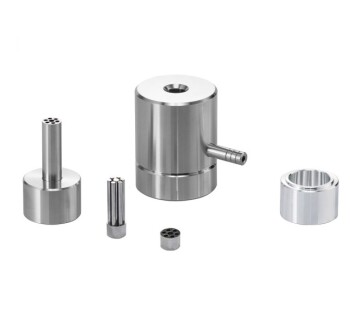
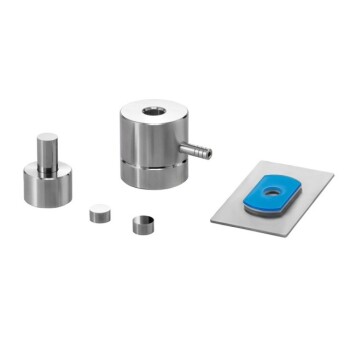
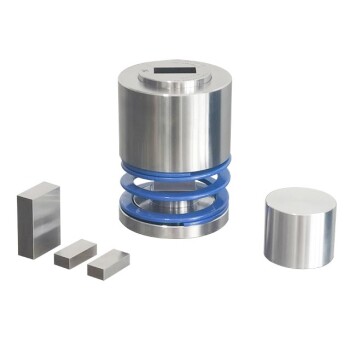
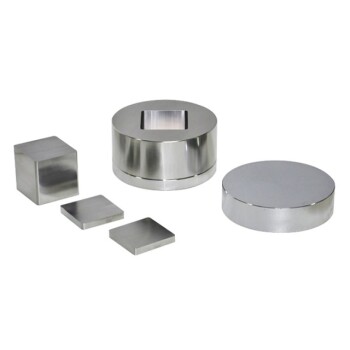
High-strength graphite molds serve as the structural backbone during the hot-pressing sintering of CoSb3 thermoelectric materials. They function simultaneously as a precise shaping container and a high-pressure vessel capable of withstanding temperatures of 823 K and mechanical pressures up to 60 MPa without failure.
Core Insight Beyond simply holding the powder, these molds are critical for process integrity. They enable the densification of CoSb3 nanometer powders by maintaining structural rigidity under immense uniaxial force while remaining chemically inert to prevent contamination of the sensitive thermoelectric material.
The Critical Engineering Roles
Withstanding Extreme Process Conditions
The primary function of the mold is to act as a resilient barrier against the harsh environment of sintering. The process requires heating the material to 823 K while simultaneously applying 60 MPa of pressure.
Standard graphite would likely fracture or deform under this specific combination of thermal and mechanical stress. High-strength graphite is essential to maintain dimensional stability throughout the cycle.
Ensuring Chemical Purity
In thermoelectric applications, material purity is paramount for performance. A critical function of these molds is to remain chemically inert when in contact with skutterudite (CoSb3) powder.
The mold ensures that no chemical reaction occurs between the container walls and the powder. This preservation of chemical integrity ensures the final sintered product retains the specific electronic and thermal properties required for thermoelectric efficiency.
Facilitating Uniform Densification
The mold acts as a pressure transmission medium. It does not merely contain the powder; it translates the force from the hydraulic rams directly to the CoSb3 nanometer powder.
By maintaining high structural strength, the mold restricts lateral movement. This forces particle-to-particle contact and expels internal gases, resulting in a high-density, void-free final component.
Understanding the Trade-offs
The Consumable Nature of Graphite
Despite its "high strength" designation, graphite remains a brittle material compared to metals. In this process, the mold is considered the central consumable.
Repeated cycling at high pressures and temperatures eventually degrades the mold. This necessitates regular replacement to ensure surface finish quality and geometric accuracy are not compromised over time.
Thermal Expansion Mismatch Risks
While graphite has excellent thermal stability, it must be matched carefully with the cooling phase of the sintered material.
If the thermal contraction of the CoSb3 differs significantly from the mold, mechanical stresses can lock the part inside or cause cracking. The mold design must account for these expansion coefficients to allow for successful ejection of the sintered billet.
Making the Right Choice for Your Goal
When selecting mold materials for CoSb3 sintering, consider your specific processing priorities:
- If your primary focus is Material Purity: Prioritize graphite grades with certified low-ash content and proven chemical inertness to CoSb3 at 823 K.
- If your primary focus is High Density: Ensure the mold's compressive strength rating exceeds your target pressure (e.g., >60 MPa) to prevent deformation during the peak densification phase.
High-strength graphite is the non-negotiable enabler of high-performance CoSb3 production, bridging the gap between loose powder and a dense, functional thermoelectric component.
Summary Table:
| Function | Description | Key Performance Benefit |
|---|---|---|
| Structural Backbone | Withstands 60 MPa pressure at 823 K | Prevents mold fracture or deformation |
| Chemical Inertness | Prevents reaction with CoSb3 powder | Maintains thermoelectric material purity |
| Pressure Transmission | Directs uniaxial force to nanometer powder | Ensures high density and void-free results |
| Thermal Stability | Manages expansion/contraction cycles | Protects geometric accuracy of the final part |
Elevate Your Thermoelectric Research with KINTEK Precision
Unlock the full potential of your CoSb3 skutterudite materials with high-performance sintering solutions. KINTEK specializes in advanced laboratory equipment designed for extreme conditions, providing the high-strength graphite molds, vacuum hot presses, and crushing and milling systems necessary to achieve superior densification and material purity.
From high-temperature furnaces and isostatic hydraulic presses to specialized ceramics and crucibles, our comprehensive portfolio supports every stage of your material science workflow. Don't compromise on your results—partner with the experts in laboratory precision.
Ready to optimize your sintering process? Contact KINTEK today for a custom consultation!
Related Products
- Double Plate Heating Press Mold for Lab
- Special Shape Press Mold for Lab
- Ultra-High Temperature Graphite Vacuum Graphitization Furnace
- High Purity Pure Graphite Crucible for Evaporation
- Graphite Vacuum Furnace Bottom Discharge Graphitization Furnace for Carbon Materials
People Also Ask
- How to use a press mold? Master the Art of Creating Consistent Ceramic Forms
- What is the process of mold press? A Step-by-Step Guide to Compression Molding
- What is the primary function of mold pressing for LAGP powders? Achieve High-Performance Solid Electrolytes
- Why are pressure molds with non-conductive resin inner walls required for battery testing? Ensure Data Accuracy
- What is the press mould method? A Guide to Consistent, Detailed Ceramic Forms