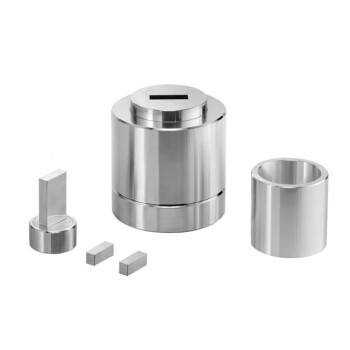
In the context of Spark Plasma Sintering (SPS) for all-solid-state lithium-ion batteries, high-purity graphite molds serve as active process components that simultaneously shape the battery, generate the necessary heat, and apply mechanical pressure. Rather than acting as simple passive containers, they are integral to the energy transfer mechanism that makes SPS effective.
Core Insight: Graphite molds function as the "engine" of the SPS process. By acting as both a resistive heating element and a high-strength pressure vessel, they enable the simultaneous application of thermal energy and mechanical force, resulting in the rapid densification of battery materials.
The Three Primary Functions
During the SPS process, the graphite mold performs three distinct, simultaneous roles that are critical for battery fabrication.
1. The Resistive Heating Element
The most dynamic function of the graphite mold is its role in thermal generation. It acts directly as a resistive heating element.
When pulsed direct current (DC) is passed through the system, the graphite converts this electrical energy into Joule heat. This allows the heat to be generated immediately surrounding the sample, rather than relying on external convection or radiation sources.
2. Axial Pressure Transmission
Densification of solid-state battery layers requires significant mechanical force. The graphite mold serves as the mechanical transmitter for this force.
It relays axial pressure from the SPS machine's rams directly to the battery sample. This pressure is essential for compacting the powder materials into a dense, cohesive solid.
3. Structural Shaping
At the most fundamental level, the mold acts as the shaping container.
It holds the multi-layer structure of the all-solid-state battery in place. This ensures the geometric integrity of the layers is maintained while the materials undergo the stress of heating and compression.
Why Graphite is the Material of Choice
The effectiveness of the graphite mold is dictated by its specific material properties. These characteristics directly enable the "rapid" nature of the SPS process.
High Electrical and Thermal Conductivity
For the mold to function as a heater, it must conduct electricity efficiently.
Graphite’s high electrical conductivity allows for the effective flow of pulsed current. Simultaneously, its high thermal conductivity ensures that the generated heat is distributed rapidly and uniformly to the battery materials inside.
High-Temperature Mechanical Strength
Standard metals often soften or deform under the extreme heat required for sintering.
Graphite retains its mechanical strength at high temperatures. This allows it to withstand the immense pressure required for densification without collapsing or warping, ensuring the final battery maintains precise dimensions.
Understanding the Distinction: Production vs. Testing
It is critical to distinguish between the molds used for manufacturing (Sintering) and those used for testing.
Graphite for Sintering (SPS)
Graphite is optimized for the creation phase. Its open structure allows for rapid heating and pressure application, but it is not typically designed to permanently seal the battery against the environment.
Stainless Steel for Testing
As noted in supplementary contexts, stainless steel molds are often used during the testing phase.
Unlike graphite, stainless steel molds function as encapsulation shells. They isolate the battery from moisture and oxygen and maintain constant stack pressure during electrochemical testing to prevent contact failure.
Making the Right Choice for Your Goal
To achieve optimal results in solid-state battery development, you must match the mold material to the specific stage of your process.
- If your primary focus is Rapid Densification (SPS): Prioritize high-purity graphite molds, as their conductivity and high-temperature strength are required to convert pulsed current into the heat and pressure needed for sintering.
- If your primary focus is Electrochemical Testing: Utilize stainless steel molds, which act as current collectors and hermetic seals to protect the battery interfaces from atmospheric degradation.
The graphite mold is not just a vessel; it is the conductive medium that drives the physics of the sintering process.
Summary Table:
| Function | Role in SPS Process | Key Material Property Required |
|---|---|---|
| Resistive Heating | Converts pulsed DC into Joule heat directly around the sample | High Electrical & Thermal Conductivity |
| Pressure Transmission | Relays axial force from rams to compact battery powders | High-Temperature Mechanical Strength |
| Structural Shaping | Maintains geometric integrity of multi-layer battery structures | Dimensional Stability & Machinability |
| Thermal Management | Ensures rapid and uniform heat distribution | High Thermal Diffusivity |
Elevate Your Battery Research with KINTEK Precision Engineering
Unlock the full potential of your Spark Plasma Sintering (SPS) processes with KINTEK’s high-purity graphite molds and specialized laboratory equipment. Whether you are developing next-generation all-solid-state lithium-ion batteries or advanced ceramics, our expert-engineered solutions ensure maximum density and structural integrity.
Why choose KINTEK?
- Advanced Sintering Support: A comprehensive range of high-temperature furnaces (muffle, vacuum, CVD, and SPS-compatible components).
- Precision Preparation: Leading-edge crushing, milling, and hydraulic presses for flawless sample preparation.
- End-to-End Solutions: From high-temperature high-pressure reactors to specialized battery research tools and consumables like PTFE and ceramics.
Ready to optimize your densification results? Contact KINTEK today for a consultation and let our technical team provide the high-performance tools your laboratory deserves.
Related Products
- Carbon Graphite Plate Manufactured by Isostatic Pressing Method
- High Purity Pure Graphite Crucible for Evaporation
- Graphite Disc Rod and Sheet Electrode Electrochemical Graphite Electrode
- High Purity Pure Graphite Crucible for Electron Beam Evaporation
- Carbon Graphite Boat -Laboratory Tube Furnace with Cover
People Also Ask
- What is the process of isostatic graphite manufacturing? Achieve Unmatched Material Uniformity and Performance
- What is isostatic graphite? The Ultimate Material for High-Tech and High-Temperature Applications
- What is the density of isostatic graphite? Unlock Superior Performance for Demanding Applications
- How big is the isostatic pressing market? A Deep Dive into the $1.2B+ Advanced Manufacturing Enabler
- Why Use an Isostatic or High-Precision Hydraulic Press for Li/LLZO/Li Batteries? Master Solid-State Interfaces