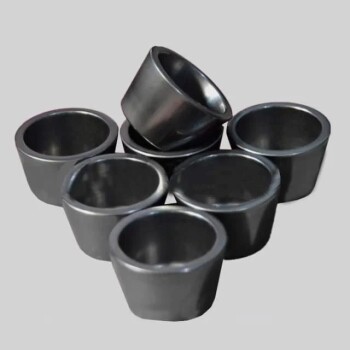
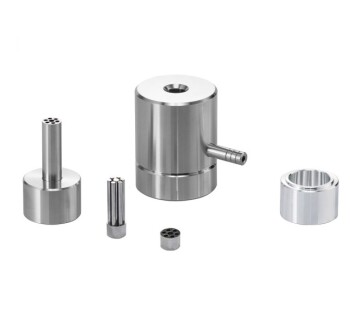
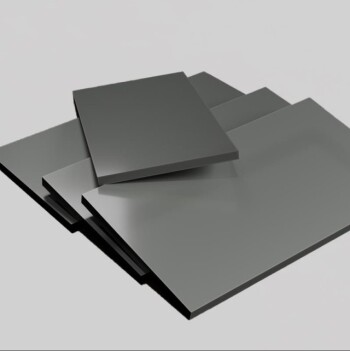
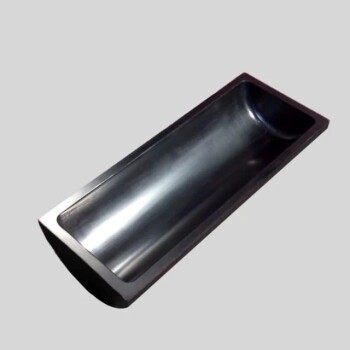
High-strength graphite molds serve as the active mechanical interface between the press and the composite material. Their core function extends beyond simple containment; they act as the primary medium to transmit significant uniaxial pressure (often reaching 100 MPa) from the hydraulic system to the powder. Simultaneously, they must define the precise geometry of the billet while maintaining structural stability and chemical inertness under extreme heat and vacuum conditions.
The graphite mold is not merely a passive vessel; it is a critical transmission tool that converts hydraulic force into the material densification necessary to create a solid, crack-free composite.
The Mechanics of Pressure Transmission
Driving Material Densification
The primary mechanical function of the mold is to transfer axial pressure from the machine punches directly to the composite powder.
By transmitting pressures that can range from 30 MPa to 100 MPa, the mold forces particle contact within the mixture.
This pressure promotes plastic deformation and expels trapped gases, which is the fundamental mechanism for achieving high density in the final sintered material.
Maintaining Rigidity Under Load
To ensure the pressure is applied effectively, the mold itself must remain rigid.
If the mold deforms under the immense hydraulic load, the pressure will not be distributed uniformly to the powder.
High-strength graphite is selected specifically because it retains its mechanical strength at elevated temperatures where other materials might soften or yield.
Defining Geometry and Stability
Exact Shape Retention
The mold acts as the container that defines the final dimensions and geometry of the composite product.
Whether shaping a simple billet or a complex composite substrate, the internal cavity of the mold dictates the final form.
Thermal Stability at High Temperatures
Sintering processes often occur at temperatures exceeding 950°C (1373 K).
The graphite mold must possess superior high-temperature strength to maintain the specified dimensions without warping or expanding significantly.
This stability ensures that the final product meets tight dimensional tolerances despite the extreme thermal environment.
Chemical Inertness and Process Integrity
Preventing Chemical Reactions
A critical requirement for these molds is chemical compatibility with the composite materials, such as Aluminum-Silicon (Al-Si) alloys or Copper-based mixtures.
The graphite must remain chemically inert to avoid reacting with the powder, which could compromise the structural integrity of the composite.
Facilitating Demolding
The inert nature of high-strength graphite prevents the sintered billet from sticking to the mold walls.
This characteristic allows for easy demolding after the process is complete, preserving the surface finish of the composite.
Understanding the Trade-offs
Consumable Nature
Despite their strength, graphite molds are often treated as consumables in the vacuum hot pressing process.
Repeated exposure to high thermal and mechanical cycles will eventually degrade the mold, requiring replacement to maintain precision.
Environmental Sensitivity
Graphite is susceptible to oxidation at high temperatures if exposed to air.
Therefore, these molds rely heavily on the vacuum or reducing atmosphere of the hot press to maintain their structural integrity and prevent degradation.
Making the Right Choice for Your Goal
To maximize the effectiveness of your sintering process, consider these priorities when selecting or designing your mold assembly:
- If your primary focus is Maximum Density: Prioritize graphite grades with the highest compressive strength to withstand pressures up to 100 MPa without deformation.
- If your primary focus is Surface Quality: Ensure the graphite grade is chemically certified as inert regarding your specific alloy (e.g., Al-Si) to guarantee clean demolding.
Success in vacuum hot pressing relies on viewing the graphite mold not just as a container, but as a high-performance component integral to the pressure and thermal dynamics of the system.
Summary Table:
| Core Function | Description | Key Benefit |
|---|---|---|
| Pressure Transmission | Transfers uniaxial pressure (30-100 MPa) to powder | Drives material densification and gas expulsion |
| Geometric Definition | Maintains rigid internal cavity dimensions | Ensures tight dimensional tolerances and shape retention |
| Thermal Stability | Retains mechanical strength at 950°C+ | Prevents mold warping and structural failure under load |
| Chemical Inertness | Resists reaction with Al-Si or Copper alloys | Facilitates easy demolding and maintains material purity |
Maximize Your Material Density with KINTEK Precision
Achieving a crack-free, high-density composite requires the perfect synergy between your vacuum hot press and high-performance tooling. KINTEK specializes in advanced laboratory equipment, offering high-strength graphite molds and premium vacuum hot press systems designed for extreme thermal and mechanical demands.
From high-temperature furnaces and hydraulic presses to specialized consumables like ceramics and graphite crucibles, we provide the end-to-end solutions your research or production line requires. Our team is ready to help you select the ideal grade of graphite to ensure superior surface finish and structural integrity for your composites.
Ready to optimize your sintering process? Contact KINTEK today for expert guidance and high-performance solutions!
Related Products
- High Purity Pure Graphite Crucible for Evaporation
- High Purity Pure Graphite Crucible for Electron Beam Evaporation
- Ultra-High Temperature Graphite Vacuum Graphitization Furnace
- Vertical High Temperature Graphite Vacuum Graphitization Furnace
- Horizontal High Temperature Graphite Vacuum Graphitization Furnace
People Also Ask
- Why are high-purity graphite crucibles preferred for sulfide solid electrolytes? Achieve Superior Material Purity
- Why is a high-purity graphite crucible required for Chromel-TaC composites? Ensure Peak Purity at 1400°C
- What role do high-purity graphite crucibles play in molten salt corrosion research? Ensure Reactor-Grade Precision
- Why are high-purity graphite crucibles used for magnesium distillation? Ensure 3N8 Purity & Thermal Stability
- Why is a high-purity graphite crucible ideal for nitrogen-doped graphene at 1500 °C? Maximize Purity and Stability