A significant complication arises from the carbon solubility of the metal catalysts used in the Chemical Vapor Deposition (CVD) process. While catalysts are necessary to facilitate reactions at lower temperatures, they can absorb dissociated carbon atoms into their bulk structure during the high-temperature phase. As the system cools, these dissolved atoms precipitate back onto the surface, often leading to unwanted, uncontrolled carbon deposition and uneven graphene layers.
Core Insight: Catalysts function as a double-edged sword; they lower the energy barrier required to form graphene but introduce a "memory effect" where dissolved carbon re-emerges during cooling, making precise thickness control significantly more difficult.
The Mechanism of Carbon Solubility
High-Temperature Dissolution
In a typical CVD process, carbon precursors decompose on the catalyst surface. However, depending on the metal chosen (such as nickel), the catalyst may have non-negligible carbon solubility.
At high synthesis temperatures, carbon atoms do not just stay on the surface; they dissolve into the bulk of the metal. This effectively turns the catalyst substrate into a reservoir for carbon atoms.
Precipitation During Cooling
The complication manifests primarily during the cooling phase. As the temperature drops, the metal's capacity to hold dissolved carbon decreases.
Consequently, the carbon atoms are forced out of the bulk metal and precipitate back onto the surface. This occurs after the intended growth phase is technically complete, resulting in additional, often unwanted, carbon deposition from the bottom up.
Impact on Production Quality
Loss of Thickness Control
The precipitation mechanism introduces a variable that is difficult to manage: the "reservoir" of carbon inside the metal.
Because this extra carbon emerges during cooling, it can lead to the formation of multiple layers in areas where only a single layer was intended. This makes the uniformity of the graphene layer highly dependent on the catalyst's specific properties rather than just gas flow rates.
Sensitivity to Cooling Rates
The rate at which the system is cooled becomes a critical process parameter.
If the cooling is too slow or too fast, the rate of carbon precipitation changes. This introduces high sensitivity to process parameters, meaning even minor deviations in the thermal cycle can drastically alter the final thickness and quality of the graphene.
Understanding the Trade-offs
Why Catalysts Remain Essential
Despite these complications, catalysts are virtually unavoidable for efficient production. They serve two vital functions: lowering the energy barrier for breaking down precursors (pyrolysis) and lowering the energy barrier for forming the graphitic structure itself.
Without catalysts, synthesizing graphitic structures would require temperatures near 2500°C. Catalysts allow this to happen at much lower temperatures, avoiding the need for specialized, energy-intensive equipment.
The Separation Challenge
Beyond the chemical growth issues, using a metal catalyst creates a physical manufacturing hurdle.
Once the graphene is grown, it must be separated from the metal substrate. This exfoliation process is challenging; removing the graphene without damaging its atomic structure or degrading its properties remains a significant technical barrier.
Making the Right Choice for Your Goal
To navigate the complexities of catalytic CVD, you must align your process controls with your specific outcome.
- If your primary focus is strict monolayer uniformity: You must strictly control the cooling rate and select catalysts with lower carbon solubility to minimize precipitation effects.
- If your primary focus is energy efficiency: You can leverage high-solubility catalysts to reduce thermal requirements, accepting that post-process thickness sorting may be necessary.
- If your primary focus is process repeatability: You need to standardize gas volumes, pressure, and temperature specifically to account for the "carbon reservoir" effect of your chosen metal.
Success in CVD synthesis lies in balancing the energy benefits of catalysts against the rigorous thermal control required to manage their solubility traits.
Summary Table:
| Aspect | Effect on Graphene Synthesis |
|---|---|
| Mechanism | Carbon dissolves into metal bulk at high temps, precipitates during cooling. |
| Primary Challenge | Uncontrolled thickness and loss of monolayer uniformity. |
| Catalyst Role | Lowers energy barrier for pyrolysis and graphitic formation. |
| Critical Variable | Cooling rate dictates the amount and speed of carbon re-emergence. |
| Post-Process | Physical exfoliation/separation from the substrate is required. |
Precision Control for Your Graphene Synthesis
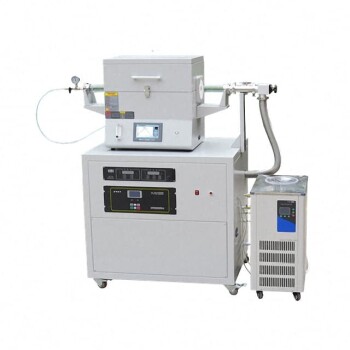
Navigating the complexities of carbon solubility requires high-performance thermal equipment. KINTEK specializes in advanced laboratory solutions designed for precise material science. From our state-of-the-art CVD and PECVD systems to high-temperature furnaces (muffle, tube, vacuum), we provide the tools needed to manage cooling rates and atmospheric conditions with unparalleled accuracy.
Enhance your research with our comprehensive range of high-pressure reactors, crushing systems, and essential consumables like crucibles and ceramics. Whether you are focusing on battery research or 2D materials, our experts are ready to help you achieve perfect uniformity.
Contact KINTEK today to optimize your lab's performance!
Related Products
- Customer Made Versatile CVD Tube Furnace Chemical Vapor Deposition Chamber System Equipment
- Cylindrical Resonator MPCVD Machine System Reactor for Microwave Plasma Chemical Vapor Deposition and Lab Diamond Growth
- Microwave Plasma Chemical Vapor Deposition MPCVD Machine System Reactor for Lab and Diamond Growth
- Split Chamber CVD Tube Furnace with Vacuum Station Chemical Vapor Deposition System Equipment Machine
- Multi Heating Zones CVD Tube Furnace Machine Chemical Vapor Deposition Chamber System Equipment
People Also Ask
- What is a CVD tube furnace? A Complete Guide to Thin-Film Deposition
- What is the function of a high-temperature CVD tube furnace in 3D graphene foam prep? Master 3D Nanomaterial Growth
- What are the technical advantages of using a CVD tube furnace? Optimize Silicon-Carbon Battery Anodes
- How does a CVD tube furnace inhibit the sintering of silver supports? Boost Membrane Durability and Performance
- What is the function of a tube furnace in CVD SiC synthesis? Achieving Ultra-Pure Silicon Carbide Powders