Knowledge What is cycle time as related to autoclaving? Master the Full Process for Effective Sterilization
Author avatar

Tech Team · Kintek Solution

Updated 1 week ago

What is cycle time as related to autoclaving? Master the Full Process for Effective Sterilization


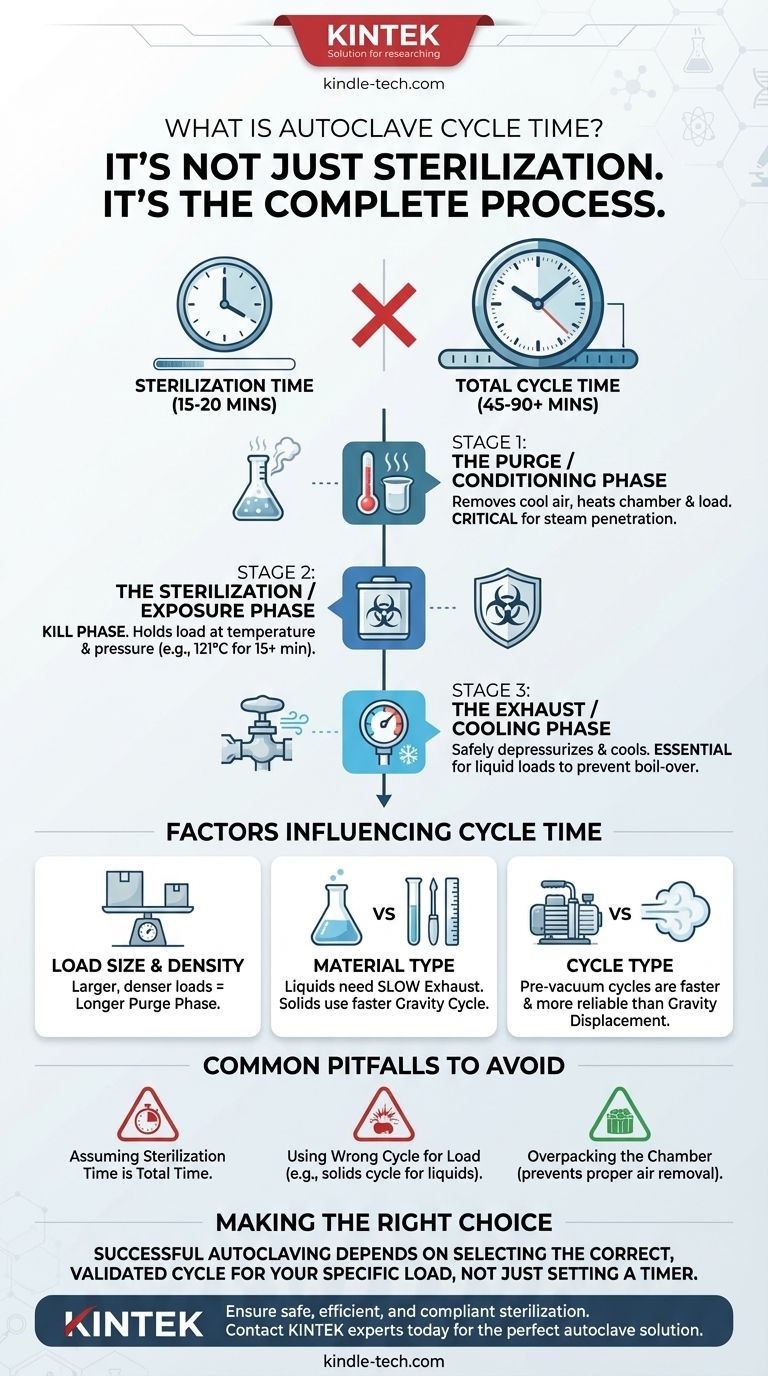
In autoclaving, cycle time is not just the sterilization period. It is the total duration the machine runs from the moment you press "start" to the moment the door can be safely opened. This complete process includes critical heating, air removal, and cooling phases, making the total cycle time significantly longer than the core sterilization time.

The most common mistake is confusing the sterilization time (the 15-20 minutes when microbes are actively killed) with the total cycle time (the 45-90+ minute end-to-end process). Understanding this distinction is fundamental to achieving effective and safe sterilization.
What is cycle time as related to autoclaving? Master the Full Process for Effective Sterilization

The Phases of a Complete Autoclave Cycle

An autoclave doesn't instantly reach sterilizing temperatures. The total cycle time is a programmed sequence of distinct phases, each with a specific purpose. A typical cycle includes three main stages.

Phase 1: The Purge (or Conditioning) Phase

Before sterilization can begin, all cool air must be removed from the chamber and the load. Trapped air acts as an insulator, preventing steam from making direct contact with surfaces and causing sterilization to fail.

This phase heats the chamber and load while purging the air, ensuring the environment is saturated with pure steam.

Phase 2: The Sterilization (or Exposure) Phase

This is the "kill" phase and what most people think of as autoclaving. The autoclave holds the load at a specific temperature and pressure for a set duration to destroy all microorganisms.

A common standard for this phase is 121°C (250°F) at 15 psi for at least 15 minutes. However, this time can vary based on the load.

Phase 3: The Exhaust (or Cooling) Phase

After the sterilization phase is complete, the chamber must be safely depressurized and cooled. Steam is vented from the chamber, and the pressure is slowly returned to ambient levels.

This phase is critical, especially for liquid loads. Releasing pressure too quickly will cause liquids to boil over violently, creating a mess and a safety hazard. This phase alone can take a significant amount of time.

Factors That Influence Cycle Time

A "one-size-fits-all" cycle does not exist. The total time required is highly dependent on what you are sterilizing.

Load Size and Density

A large, dense load takes much longer to heat than a small, sparse one. The purge phase must be long enough to ensure steam penetrates to the very center of the densest item in the load.

Type of Material

Liquids require a much slower exhaust phase than solid goods like glassware or surgical instruments. Therefore, a liquid cycle will always be longer than a gravity (solids) cycle, even if the sterilization time is the same.

Chosen Cycle Type

Different autoclaves offer different cycles. For example, a pre-vacuum cycle actively pumps air out of the chamber, leading to a faster and more reliable purge phase compared to a standard gravity displacement cycle where steam pushes the heavier, cooler air out.

Common Pitfalls to Avoid

Misunderstanding cycle time can lead to failed sterilization or damaged equipment.

Assuming Sterilization Time is Total Time

Setting an autoclave timer for only 15 minutes is incorrect. This only accounts for the exposure phase, completely ignoring the necessary time for purging and exhausting. You must always select a pre-validated, complete cycle.

Using the Wrong Cycle for the Load

Running liquids on a fast "solids" cycle is a common and dangerous mistake. The rapid pressure release will cause the superheated liquid to boil over, resulting in loss of media, a contaminated autoclave, and a potential safety risk.

Overpacking the Chamber

Tightly packing items into an autoclave chamber prevents proper air removal and steam circulation. This creates cool air pockets where microorganisms can survive, invalidating the entire run.

Making the Right Choice for Your Goal

Always refer to your autoclave's manual to select the appropriate pre-programmed cycle for your specific application.

  • If your primary focus is sterilizing solid instruments or glassware: Use a gravity or pre-vacuum cycle designed for dry goods, ensuring items are spaced to allow steam penetration.
  • If your primary focus is sterilizing liquids or media: You must use a dedicated liquid cycle that features a slow, controlled exhaust to prevent boil-over.
  • If your primary focus is decontaminating biohazardous waste: Select a robust waste cycle, which often includes extended sterilization times to handle dense, challenging loads.

Ultimately, successful autoclaving depends on selecting the correct, validated cycle for your specific load, not just setting a timer.

Summary Table:

Phase Purpose Key Detail
Purge/Conditioning Remove air, heat load Ensures steam penetration
Sterilization/Exposure Destroy microorganisms Typically 121°C for 15+ minutes
Exhaust/Cooling Depressurize safely Critical for liquids to prevent boil-over

Ensure your lab's sterilization process is safe, efficient, and compliant. Misunderstanding autoclave cycle times can lead to failed sterilization, damaged equipment, and safety risks. KINTEK specializes in providing reliable lab autoclaves and expert support to help you select the right equipment and cycles for your specific needs—whether you're sterilizing liquids, glassware, or biohazardous waste.

Contact our experts today to find the perfect autoclave solution for your laboratory.

Visual Guide
What is cycle time as related to autoclaving? Master the Full Process for Effective Sterilization Visual Guide

Related Products

People Also Ask

Related Products

Desktop Fast Laboratory Autoclave Sterilizer 35L 50L 90L for Lab Use

Desktop Fast Laboratory Autoclave Sterilizer 35L 50L 90L for Lab Use

The desktop fast steam sterilizer is a compact and reliable device used for rapid sterilization of medical, pharmaceutical, and research items. It efficiently sterilizes surgical instruments, glassware, medicines, and resistant materials, making it suitable for various applications.

Laboratory High Pressure Steam Sterilizer Vertical Autoclave for Lab Department

Laboratory High Pressure Steam Sterilizer Vertical Autoclave for Lab Department

Vertical pressure steam sterilizer is a kind of sterilization equipment with automatic control, which is composed of heating system, microcomputer control system and overheating and overpressure protection system.

Laboratory Sterilizer Lab Autoclave Herbal Powder Sterilization Machine for Plant

Laboratory Sterilizer Lab Autoclave Herbal Powder Sterilization Machine for Plant

The herbal powder sterilization autoclave machine for Chinese medicine uses saturated steam for effective sterilization. It utilizes the heat and penetrative properties of steam, achieves sterilization after heat preservation, and maintains a good drying effect with a dedicated drying system.

Portable High Pressure Laboratory Autoclave Steam Sterilizer for Lab Use

Portable High Pressure Laboratory Autoclave Steam Sterilizer for Lab Use

Portable autoclave sterilization pressure is a device that uses pressure saturated steam to quickly and effectively sterilize items.

Desktop Fast High Pressure Laboratory Autoclave Sterilizer 16L 24L for Lab Use

Desktop Fast High Pressure Laboratory Autoclave Sterilizer 16L 24L for Lab Use

The desktop fast steam sterilizer is a compact and reliable device used for rapid sterilization of medical, pharmaceutical, and research items.

Customizable Laboratory High Temperature High Pressure Reactors for Diverse Scientific Applications

Customizable Laboratory High Temperature High Pressure Reactors for Diverse Scientific Applications

High-pressure lab reactor for precise hydrothermal synthesis. Durable SU304L/316L, PTFE liner, PID control. Customizable volume & materials. Contact us!

Automatic Heated Hydraulic Press Machine with Heated Plates for Laboratory Hot Press 25T 30T 50T

Automatic Heated Hydraulic Press Machine with Heated Plates for Laboratory Hot Press 25T 30T 50T

Efficiently prepare your samples with our Automatic Heated Lab Press. With a pressure range up to 50T and precise control, it's perfect for various industries.

Laboratory Vibratory Sieve Shaker Machine for Dry and Wet Three-Dimensional Sieving

Laboratory Vibratory Sieve Shaker Machine for Dry and Wet Three-Dimensional Sieving

KT-VD200 can be used for sieving tasks of dry and wet samples in the laboratory. The screening quality is 20g-3kg. The product is designed with a unique mechanical structure and an electromagnetic vibrating body with a vibration frequency of 3000 times per minute.

Manual Heated Hydraulic Press Machine with Heated Plates for Laboratory Hot Press

Manual Heated Hydraulic Press Machine with Heated Plates for Laboratory Hot Press

The Manual Heat Press is a versatile piece of equipment suitable for a variety of applications, operated by a manual hydraulic system that applies controlled pressure and heat to the material placed on the piston.

Double Plate Heating Press Mold for Lab

Double Plate Heating Press Mold for Lab

Discover precision in heating with our Double Plate Heating Mold, featuring high-quality steel and uniform temperature control for efficient lab processes. Ideal for various thermal applications.

Inclined Rotary Plasma Enhanced Chemical Vapor Deposition PECVD Equipment Tube Furnace Machine

Inclined Rotary Plasma Enhanced Chemical Vapor Deposition PECVD Equipment Tube Furnace Machine

Introducing our inclined rotary PECVD furnace for precise thin film deposition. Enjoy automatic matching source, PID programmable temperature control, and high accuracy MFC mass flowmeter control. Built-in safety features for peace of mind.

Single Punch Electric Tablet Press Machine TDP Tablet Punching Machine

Single Punch Electric Tablet Press Machine TDP Tablet Punching Machine

The electric tablet punching machine is a laboratory equipment designed for pressing various granular and powdery raw materials into discs and other geometric shapes. It is commonly used in pharmaceutical, healthcare products, food, and other industries for small batch production and processing. The machine is compact, lightweight, and easy to operate, making it suitable for use in clinics, schools, laboratories, and research units.

Small Injection Molding Machine for Lab Use

Small Injection Molding Machine for Lab Use

The small injection molding machinehas fast and stable movements; good controllability and repeatability, super energy saving; the product can be automatically dropped and formed; the machine body is low, convenient for feeding, easy to maintain, and no height restrictions on the installation site.

Single Punch Electric Tablet Press Machine Laboratory Powder Tablet Punching TDP Tablet Press

Single Punch Electric Tablet Press Machine Laboratory Powder Tablet Punching TDP Tablet Press

The single-punch electric tablet press is a laboratory-scale tablet press suitable for corporate laboratories in pharmaceutical, chemical, food, metallurgical and other industries.

Touchscreen Automatic Vacuum Heat Press

Touchscreen Automatic Vacuum Heat Press

Precision vacuum heat press for labs: 800°C, 5-ton pressure, 0.1MPa vacuum. Ideal for composites, solar cells, aerospace.

Manual button battery sealing machine

Manual button battery sealing machine

The manual button battery sealing machine is a high-precision packaging device designed specifically for small button batteries (such as CR2032, LR44 and other models). It is suitable for laboratory research and development, small batch production and teaching demonstrations.

Vibratory Sieve Shaker Machine Dry Three-Dimensional Vibrating Sieve

Vibratory Sieve Shaker Machine Dry Three-Dimensional Vibrating Sieve

The KT-V200 product focuses on solving common sieving tasks in the laboratory. It is suitable for sieving 20g-3kg dry samples.

Single Punch Tablet Press Machine and Mass Production Rotary Tablet Punching Machine for TDP

Single Punch Tablet Press Machine and Mass Production Rotary Tablet Punching Machine for TDP

Rotary tablet punching machine is an automatic rotating and continuous tableting machine. It is mainly used for tablet manufacturing in the pharmaceutical industry, and is also suitable for industrial sectors such as food, chemicals, batteries, electronics, ceramics, etc. to compress granular raw materials into tablets.

Single Punch Manual Tablet Press Machine TDP Tablet Punching Machine

Single Punch Manual Tablet Press Machine TDP Tablet Punching Machine

Single punch manual tablet punching machine can press various granular, crystal or powdery raw materials with good fluidity into disc-shaped, cylindrical, spherical, convex, concave and other various geometric shapes (such as square, triangle, ellipse, capsule shape, etc.), and can also press products with text and patterns.

Laboratory Vibratory Sieve Shaker Machine Slap Vibrating Sieve

Laboratory Vibratory Sieve Shaker Machine Slap Vibrating Sieve

KT-T200TAP is a slapping and oscillating sieving instrument for laboratory desktop use, with 300 rpm horizontal circular motion and 300 vertical slapping motions to simulate manual sieving to help sample particles pass through better.


Leave Your Message