Knowledge What is sieve analysis in construction? Ensure Material Quality & Project Success
Author avatar

Tech Team · Kintek Solution

Updated 6 days ago

What is sieve analysis in construction? Ensure Material Quality & Project Success


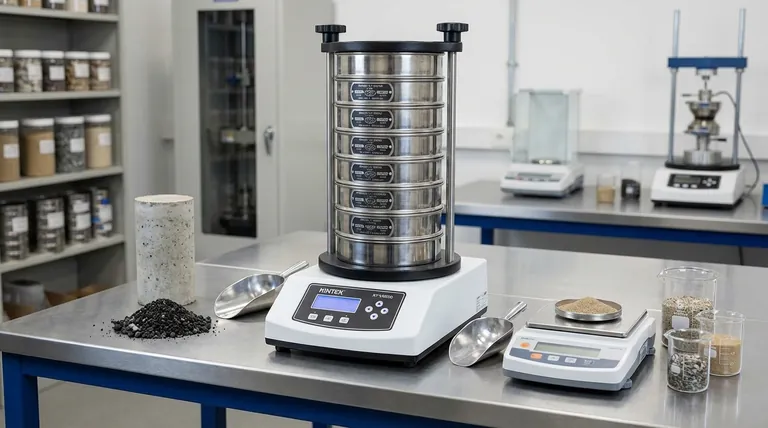
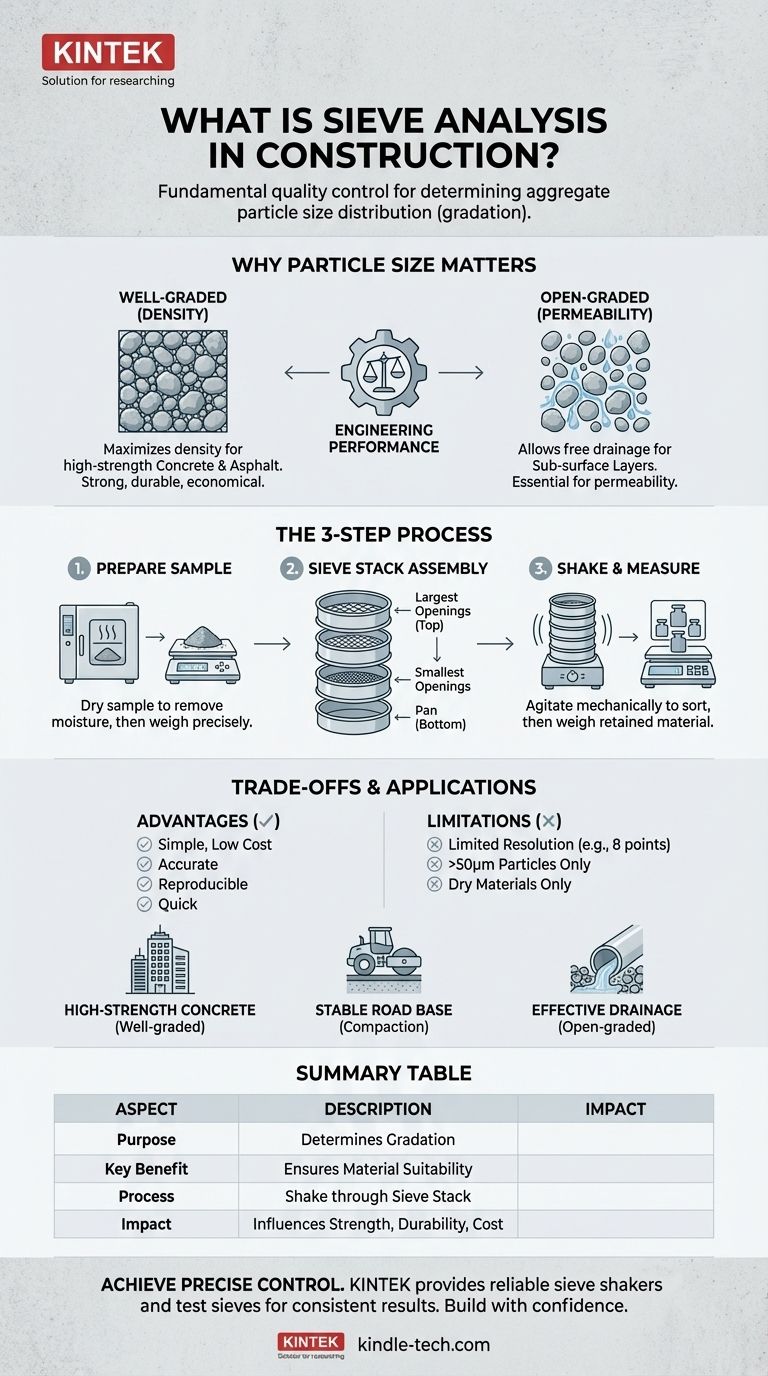
In construction, sieve analysis is the fundamental quality control test used to determine the particle size distribution of granular materials. Also known as a gradation test, this simple process involves passing a sample of aggregate—such as sand, gravel, or crushed rock—through a series of stacked screens with progressively smaller openings to sort the particles by size. The results are critical for ensuring the material's properties are suitable for its intended use, whether in concrete, asphalt, or as a base layer.

Sieve analysis is not simply about sorting materials; it's about engineering the performance of a final product. By controlling the mix of particle sizes (the "gradation"), engineers can precisely manage the strength, durability, workability, and cost-effectiveness of foundational construction materials.
What is sieve analysis in construction? Ensure Material Quality & Project Success

Why Particle Size is Critical in Construction

The distribution of particle sizes within an aggregate sample, known as its gradation, directly influences the physical properties of the final construction material. A project's success often depends on getting this mix right.

The Impact on Concrete and Asphalt

A "well-graded" aggregate contains a balanced mix of particle sizes. Smaller particles fill the voids between larger ones, creating a dense and tightly packed structure.

This density is crucial. It minimizes the amount of empty space that must be filled by expensive cement paste or asphalt binder, leading to a stronger, more durable, and more economical final product.

The Role in Compaction and Drainage

For materials used in foundations or as a road base, gradation determines how well the material can be compacted to create a stable, load-bearing surface.

Furthermore, the gradation dictates the material's permeability. An "open-graded" material with few fine particles allows water to drain freely, which is essential for applications like sub-surface drainage layers.

The Sieve Analysis Process Explained

While the concept is straightforward, the process follows standardized steps to ensure accurate and repeatable results. It is one of the most common and reliable tests performed in the industry.

Preparing the Sample

First, a representative sample of the aggregate is obtained. This sample is typically dried in an oven to remove any moisture, as the test is only effective on dry particles. The dry sample is then weighed precisely.

The Sieve Stack

The core of the test is the sieve stack. This is a set of nesting sieves with wire mesh screens. The sieve at the top has the largest openings, and each subsequent sieve below it has progressively smaller openings. A solid pan is placed at the very bottom to collect the finest particles.

Shaking and Measuring

The prepared sample is poured into the top sieve. The entire stack is then placed in a mechanical shaker, which agitates it for a set period.

This agitation causes the particles to fall through the screens until they are retained on a sieve with openings smaller than their diameter. After shaking, the material retained on each sieve is weighed, and the results are recorded to create a particle size distribution curve.

Understanding the Trade-offs

Like any testing method, sieve analysis has distinct advantages that make it a cornerstone of quality control, as well as limitations that are important to recognize.

Key Advantages

The primary reasons for its widespread use are its simplicity and low cost. The equipment is inexpensive, the procedure is easy to perform, and it provides accurate, reproducible results relatively quickly.

This accessibility makes it an invaluable tool for quality control on virtually any construction site or in any materials lab.

Inherent Limitations

The main limitation is its resolution. A standard test might use only 8 sieves, meaning the entire particle size distribution is described by just eight data points.

Additionally, the method is generally limited to particles larger than about 50 micrometers (µm) and is only suitable for dry, non-cohesive materials.

Applying Gradation Results to Your Project

The ideal gradation depends entirely on the material's purpose. Understanding your goal is key to interpreting the results of a sieve analysis and selecting the right material.

  • If your primary focus is high-strength concrete: You need a "well-graded" aggregate to maximize density and minimize the required amount of cement paste.
  • If your primary focus is a drainage layer: You require a "uniformly-graded" or "open-graded" aggregate with minimal fine particles to ensure high permeability.
  • If your primary focus is a stable road base: You need a specific gradation that allows for maximum compaction, providing a strong and unyielding foundation.

By mastering the principles of sieve analysis, you gain direct control over the quality, performance, and durability of your most essential construction materials.

Summary Table:

Aspect Description
Purpose Determines particle size distribution (gradation) of aggregates like sand and gravel.
Key Benefit Ensures material properties are suitable for concrete, asphalt, or base layers.
Process Dry sample is shaken through a stack of sieves with progressively smaller openings.
Impact Directly influences strength, durability, workability, and cost-effectiveness of materials.

Achieve precise quality control on your construction projects.

Accurate sieve analysis is fundamental to material performance. KINTEK specializes in providing reliable laboratory equipment, including robust sieve shakers and high-quality test sieves, to ensure your aggregate testing is consistent and compliant with industry standards.

Let us help you build with confidence. Contact our experts today to find the right sieving solutions for your lab's specific needs in construction materials testing.

Visual Guide
What is sieve analysis in construction? Ensure Material Quality & Project Success Visual Guide

Related Products

People Also Ask

Related Products

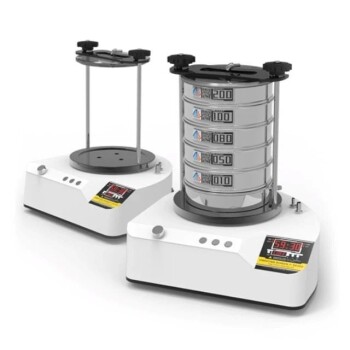
Laboratory Test Sieves and Vibratory Sieve Shaker Machine

Laboratory Test Sieves and Vibratory Sieve Shaker Machine

Efficiently process powders, granules, and small blocks with a high-frequency vibration sieve. Control vibration frequency, screen continuously or intermittently, and achieve accurate particle size determination, separation, and classification.

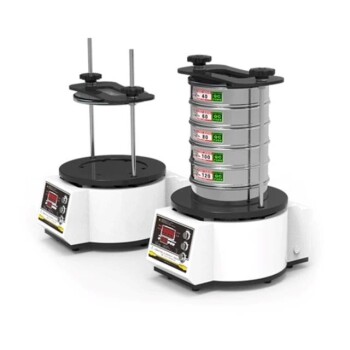
Laboratory Vibratory Sieve Shaker Machine for Dry and Wet Three-Dimensional Sieving

Laboratory Vibratory Sieve Shaker Machine for Dry and Wet Three-Dimensional Sieving

KT-VD200 can be used for sieving tasks of dry and wet samples in the laboratory. The screening quality is 20g-3kg. The product is designed with a unique mechanical structure and an electromagnetic vibrating body with a vibration frequency of 3000 times per minute.

Three-dimensional electromagnetic sieving instrument

Three-dimensional electromagnetic sieving instrument

KT-VT150 is a desktop sample processing instrument for both sieving and grinding. Grinding and sieving can be used both dry and wet. The vibration amplitude is 5mm and the vibration frequency is 3000-3600 times/min.

Laboratory Vibratory Sieve Shaker Machine Slap Vibrating Sieve

Laboratory Vibratory Sieve Shaker Machine Slap Vibrating Sieve

KT-T200TAP is a slapping and oscillating sieving instrument for laboratory desktop use, with 300 rpm horizontal circular motion and 300 vertical slapping motions to simulate manual sieving to help sample particles pass through better.

Laboratory Multifunctional Small Speed-Adjustable Horizontal Mechanical Shaker for Lab

Laboratory Multifunctional Small Speed-Adjustable Horizontal Mechanical Shaker for Lab

The laboratory multifunctional speed-regulating oscillator is a constant-speed experimental equipment specially developed for modern bioengineering production units.

Laboratory Wet Three-Dimensional Vibratory Sieve Shaker Machine

Laboratory Wet Three-Dimensional Vibratory Sieve Shaker Machine

The wet three-dimensional vibrating sieving instrument focuses on solving the sieving tasks of dry and wet samples in the laboratory. It is suitable for sieving 20g - 3kg dry, wet or liquid samples.

Custom PTFE Teflon Parts Manufacturer for PTFE Mesh F4 Sieve

Custom PTFE Teflon Parts Manufacturer for PTFE Mesh F4 Sieve

PTFE mesh sieve is a specialized test sieve designed for particle analysis in various industries, featuring a non-metallic mesh woven from PTFE filament. This synthetic mesh is ideal for applications where metal contamination is a concern . PTFE sieves are crucial for maintaining the integrity of samples in sensitive environments, ensuring accurate and reliable results in particle size distribution analysis.

Small Lab Rubber Calendering Machine

Small Lab Rubber Calendering Machine

Small lab rubber calendering machine is used for producing thin, continuous sheets of plastic or rubber materials. It is commonly employed in laboratories, small-scale production facilities, and prototyping environments to create films, coatings, and laminates with precise thickness and surface finish.

Mini Planetary Ball Mill Machine for Laboratory Milling

Mini Planetary Ball Mill Machine for Laboratory Milling

Discover the KT-P400 desktop planetary ball mill, ideal for grinding and mixing small samples in the lab. Enjoy stable performance, long service life, and practicality. Functions include timing and overload protection.

Lab Internal Rubber Mixer Rubber Kneader Machine for Mixing and Kneading

Lab Internal Rubber Mixer Rubber Kneader Machine for Mixing and Kneading

Lab internal rubber mixer is suitable for mixing, kneading and dispersing various chemical raw materials such as plastics, rubber, synthetic rubber, hot melt adhesive and various low-viscosity materials.

Metallographic Specimen Mounting Machine for Laboratory Materials and Analysis

Metallographic Specimen Mounting Machine for Laboratory Materials and Analysis

Precision metallographic mounting machines for labs—automated, versatile, and efficient. Ideal for sample prep in research and quality control. Contact KINTEK today!

Heated Hydraulic Press Machine with Integrated Manual Heated Plates for Lab Use

Heated Hydraulic Press Machine with Integrated Manual Heated Plates for Lab Use

Efficiently process heat-pressing samples with our Integrated Manual Heated Lab Press. With a heating range up to 500°C, it's perfect for various industries.

Double Plate Heating Press Mold for Lab

Double Plate Heating Press Mold for Lab

Discover precision in heating with our Double Plate Heating Mold, featuring high-quality steel and uniform temperature control for efficient lab processes. Ideal for various thermal applications.

Lab Plastic PVC Calender Stretch Film Casting Machine for Film Testing

Lab Plastic PVC Calender Stretch Film Casting Machine for Film Testing

The cast film machine is designed for the molding of polymer cast film products and has multiple processing functions such as casting, extrusion, stretching, and compounding.

High Energy Planetary Ball Mill Machine for Laboratory Horizontal Tank Type

High Energy Planetary Ball Mill Machine for Laboratory Horizontal Tank Type

The KT-P2000H uses a unique Y-axis planetary trajectory, and utilizes the collision, friction and gravity between the sample and the grinding ball.

Single Punch Electric Tablet Press Machine TDP Tablet Punching Machine

Single Punch Electric Tablet Press Machine TDP Tablet Punching Machine

The electric tablet punching machine is a laboratory equipment designed for pressing various granular and powdery raw materials into discs and other geometric shapes. It is commonly used in pharmaceutical, healthcare products, food, and other industries for small batch production and processing. The machine is compact, lightweight, and easy to operate, making it suitable for use in clinics, schools, laboratories, and research units.

Powerful Plastic Crusher Machine

Powerful Plastic Crusher Machine

KINTEK's powerful plastic crusher machines process 60-1350 KG/H of diverse plastics, ideal for labs and recycling. Durable, efficient, and customizable.

Single Punch Tablet Press Machine and Mass Production Rotary Tablet Punching Machine for TDP

Single Punch Tablet Press Machine and Mass Production Rotary Tablet Punching Machine for TDP

Rotary tablet punching machine is an automatic rotating and continuous tableting machine. It is mainly used for tablet manufacturing in the pharmaceutical industry, and is also suitable for industrial sectors such as food, chemicals, batteries, electronics, ceramics, etc. to compress granular raw materials into tablets.

Desktop Fast Laboratory Autoclave Sterilizer 35L 50L 90L for Lab Use

Desktop Fast Laboratory Autoclave Sterilizer 35L 50L 90L for Lab Use

The desktop fast steam sterilizer is a compact and reliable device used for rapid sterilization of medical, pharmaceutical, and research items. It efficiently sterilizes surgical instruments, glassware, medicines, and resistant materials, making it suitable for various applications.

Single Punch Electric Tablet Press Machine Laboratory Powder Tablet Punching TDP Tablet Press

Single Punch Electric Tablet Press Machine Laboratory Powder Tablet Punching TDP Tablet Press

The single-punch electric tablet press is a laboratory-scale tablet press suitable for corporate laboratories in pharmaceutical, chemical, food, metallurgical and other industries.


Leave Your Message