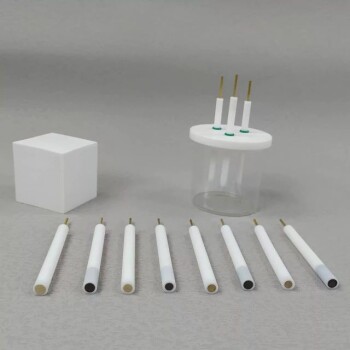
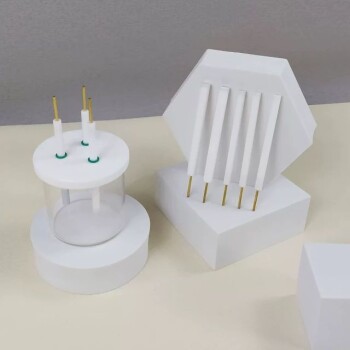
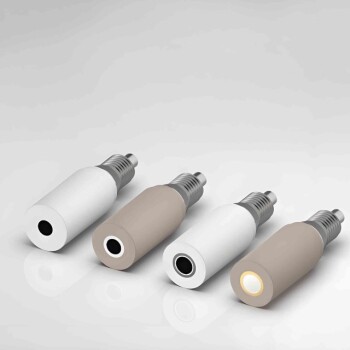
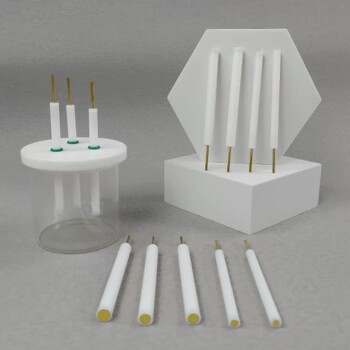
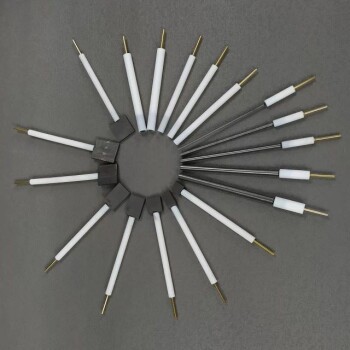
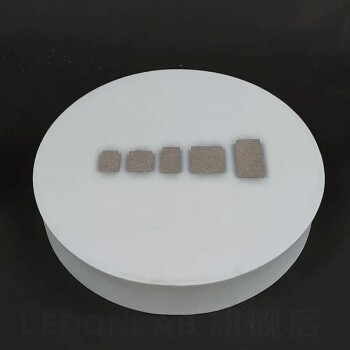
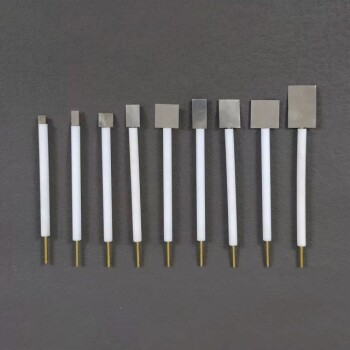
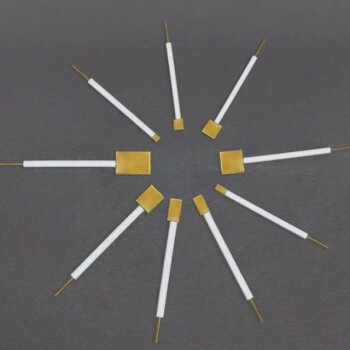
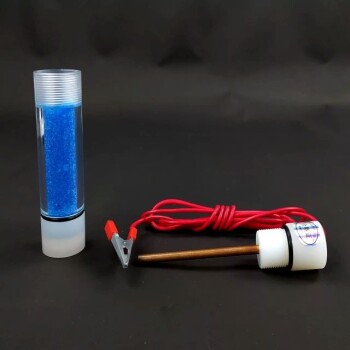
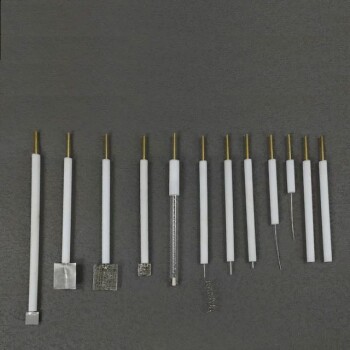
In an electrochemical setup, the most common role for a metal disk electrode is to serve as the working electrode (WE). This is the primary site where the electrochemical reaction of interest—the one you are actively studying—takes place.
The metal disk electrode acts as the focal point of an electrochemical experiment. Its high conductivity and well-defined surface area make it the ideal stage for observing and measuring the specific oxidation or reduction reaction under investigation.

Understanding the Three-Electrode System
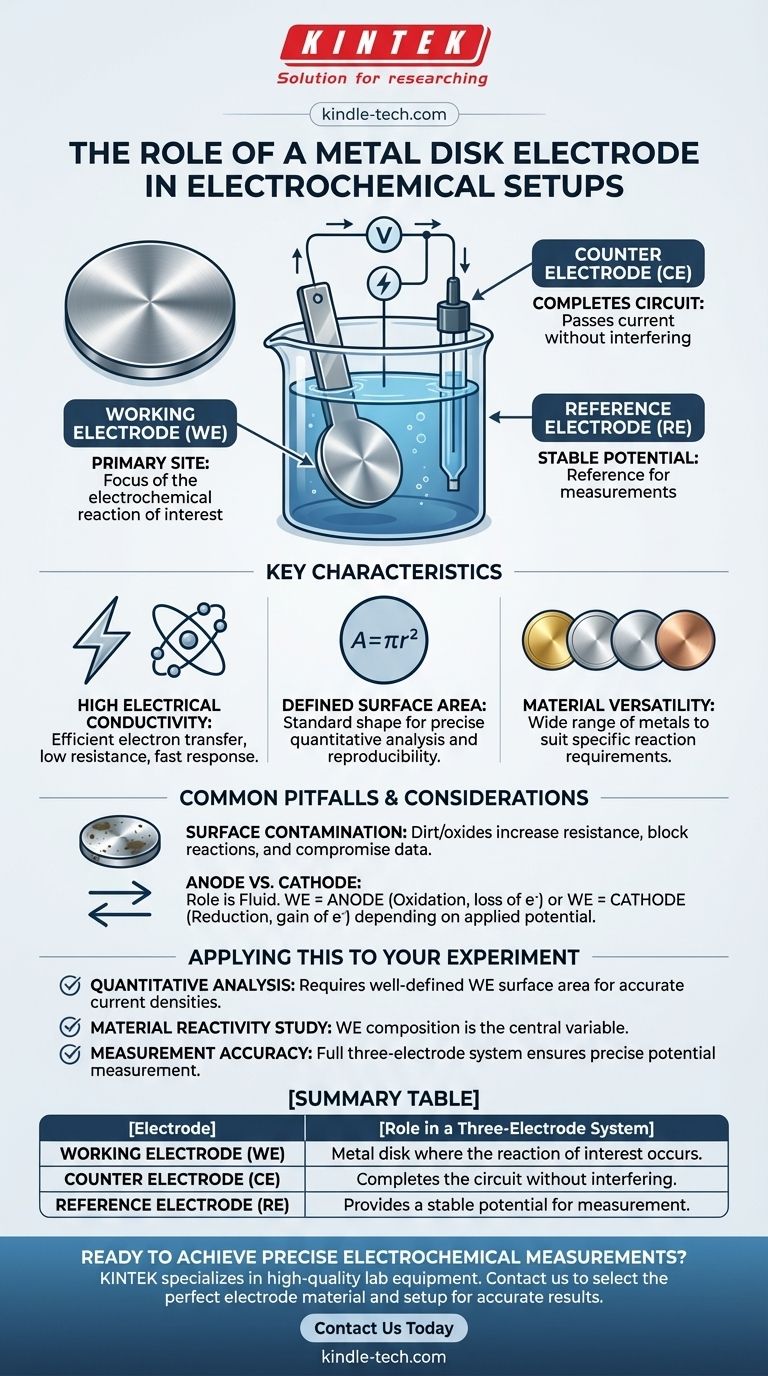
To grasp the role of the working electrode, it's essential to see it within the context of a standard three-electrode electrochemical cell. This setup is designed to isolate and precisely measure the reaction happening at the working electrode.
The Working Electrode (WE)
This is the electrode where your primary experiment occurs. The metal disk is typically chosen as the material of interest, and its potential is carefully controlled to drive a specific chemical reaction.
The Counter Electrode (CE)
The counter electrode, sometimes called the auxiliary electrode, completes the electrical circuit. It passes the necessary current to the working electrode but is intentionally designed so that its own reactions do not interfere with the measurements being taken at the WE.
The Reference Electrode (RE)
This electrode provides a stable, constant potential. The potential of the working electrode is measured against this stable reference, ensuring that any changes you observe are due to the reaction you are studying and not fluctuations elsewhere in the system.
Key Characteristics of a Metal Disk Electrode
A metal disk is not chosen for this critical role by accident. Its physical and electrical properties are precisely what make it so effective for electrochemical analysis.
High Electrical Conductivity
A fundamental property of metals is their ability to conduct electricity efficiently. Materials like gold, platinum, silver, and copper have very high conductivity, which minimizes energy loss and signal interference during electron transfer.
This low internal resistance allows for faster response times and clearer, more accurate signal transmission between the electrode and the measurement instrument.
Defined and Reproducible Surface Area
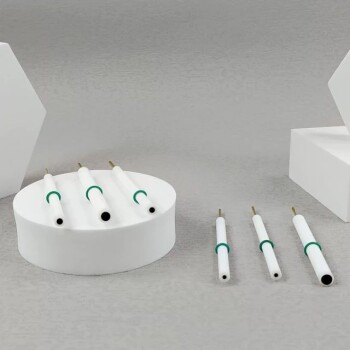
Metal disk electrodes typically have a standard, circular shape (e.g., a 3mm diameter). This provides a well-defined and easily calculable surface area, which is critical for quantitative analysis and ensuring that experimental results are repeatable.
Material Versatility
Different experiments require different electrode materials. Metal disk electrodes are available in a variety of metals, such as gold or platinum, allowing researchers to select the one best suited for the specific chemical system being investigated.
Common Pitfalls and Considerations
While effective, the performance of a metal disk electrode is dependent on its condition and the specific experimental setup.
The Impact of Surface Contamination
The electrode's surface is its most critical feature. If it becomes contaminated with dirt, oils, or even a thin layer of metal oxide, its resistance can increase dramatically.
This contamination can block the desired reaction or introduce unwanted side reactions, compromising the accuracy and reliability of your data. Meticulous cleaning and polishing are therefore essential.
Anode vs. Cathode: A Fluid Role
An electrode is not permanently an anode or a cathode. Its role depends on the direction of electron flow, which is controlled by the applied potential.
The working electrode will act as the anode if oxidation (loss of electrons) is occurring at its surface. It will act as the cathode if reduction (gain of electrons) is occurring.
Applying This to Your Experiment
Understanding these roles is key to designing a meaningful experiment. The choice and setup of your electrodes directly determine the quality of your results.
- If your primary focus is quantitative analysis: The well-defined surface area of a standard metal disk working electrode is non-negotiable for calculating accurate current densities.
- If your primary focus is studying a specific material's reactivity: The working electrode is your material of interest, and its composition (gold, platinum, etc.) is the central variable.
- If your primary focus is measurement accuracy: Using the full three-electrode system ensures that the potential of your metal disk working electrode is measured precisely against a stable reference.
Ultimately, mastering the function of the working electrode is the first step toward achieving reliable and insightful electrochemical measurements.
Summary Table:
| Electrode | Role in a Three-Electrode System |
|---|---|
| Working Electrode (WE) | Metal disk where the reaction of interest occurs. |
| Counter Electrode (CE) | Completes the circuit without interfering. |
| Reference Electrode (RE) | Provides a stable potential for measurement. |
Ready to achieve precise electrochemical measurements? The right working electrode is critical for reliable data. At KINTEK, we specialize in high-quality lab equipment and consumables, including a range of metal disk electrodes for your specific research needs. Our experts can help you select the perfect electrode material and setup to ensure accurate, repeatable results. Contact us today to enhance your laboratory's electrochemical capabilities!
Visual Guide
Related Products
- Metal Disc Electrode Electrochemical Electrode
- Rotating Platinum Disk Electrode for Electrochemical Applications
- RRDE rotating disk (ring disk) electrode / compatible with PINE, Japanese ALS, Swiss Metrohm glassy carbon platinum
- Gold Disc Electrode
- Graphite Disc Rod and Sheet Electrode Electrochemical Graphite Electrode
People Also Ask
- What are the recommended surface protection methods for different types of metal disk electrodes? Essential Guide for Longevity
- What precautions should be taken when using metal disk electrodes? Ensure Accuracy and Longevity
- What is the expected lifespan of a metal disk electrode? Extend Its Life with Proper Care
- How should a metal disk electrode and its corresponding electrolyte be prepared before an experiment? A Step-by-Step Guide
- What methods can be used to verify the performance of a metal disk electrode? Ensure Accurate Electrochemical Results