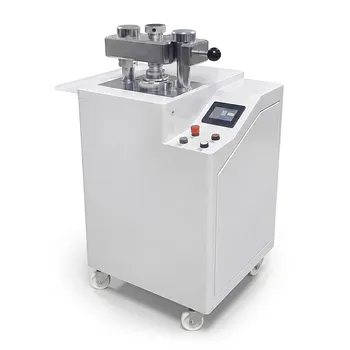
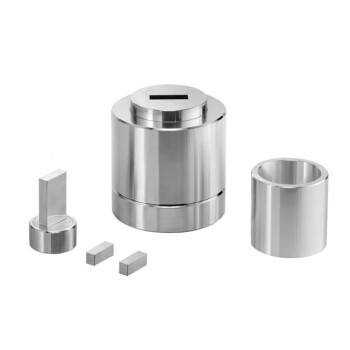
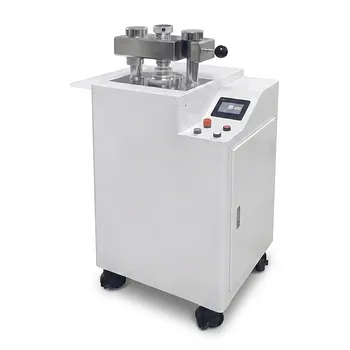
The laboratory hydraulic press serves as the primary mechanism for mechanical densification. Its core function is to apply high, controlled pressure to loose straw powder, transforming it into standardized pellets with defined dimensions and significantly increased energy density. This mechanical compression ensures the material maintains structural integrity and physical strength during subsequent testing, transport, or combustion experiments.
The laboratory hydraulic press bridges the gap between raw biomass waste and usable fuel by providing a controlled environment to study material behavior. It allows researchers to simulate industrial conditions on a small scale to optimize material stability, energy efficiency, and pellet quality.
Achieving Mechanical Densification and Structural Integrity
Overcoming the Elasticity of Straw Fibers
Straw materials possess natural elasticity that causes loose particles to resist compaction. The hydraulic press applies loads—often ranging from 160 MPa to over 500 MPa—to overcome this internal resistance and force the particles into a permanent shape.
Promoting Self-Bonding and Cross-Linking
Under high-pressure conditions, the press facilitates physical cross-linking and self-bonding between straw particles. This process is often aided by the activation of natural binders within the biomass, such as lignin, which helps the pellet maintain a stable geometric shape after ejection.
Increasing Volumetric Energy Density
By compressing low-density straw into a solid cylindrical form, the press dramatically increases the energy density of the material. This transformation is essential for making biomass a viable alternative to coal, as it improves the efficiency of storage and thermal conversion.
Simulating Industrial-Scale Production
Precise Control of Molding Parameters
The laboratory press allows researchers to manipulate specific variables, such as molding pressure, holding time (dwell time), and temperature. By adjusting these factors, scientists can determine the optimal "pressure curve" required to create a durable pellet without wasting energy.
Calculating Specific Energy Consumption (SEC)
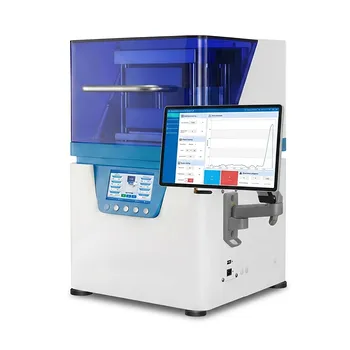
Advanced laboratory presses are equipped with monitoring systems that record compression and ejection curves. This data is critical for calculating the Specific Energy Consumption (SEC), which helps engineers predict the cost-effectiveness of moving to industrial-scale production.
Standardizing Samples for Comparative Research
A hydraulic press produces pellets of uniform mass and dimension, such as the common 15mm diameter standard. This uniformity is vital for scientific accuracy, allowing for precise blending with other fuels like coal and ensuring repeatable results in combustion trials.
Understanding the Trade-offs and Limitations
Batch Processing vs. Continuous Flow
The primary limitation of a laboratory hydraulic press is that it operates as a batch process, typically producing one pellet at a time or "single-hole molding." This differs from industrial pellet mills that use continuous extrusion, meaning the heat generated by friction in a lab setting may not perfectly mirror a high-volume factory environment.
Wall Friction and Pressure Distribution
In a small laboratory die, wall friction can significantly impact the pressure distribution within the pellet. This can lead to variations in density between the top and bottom of the sample, a factor that must be accounted for when scaling up to industrial die designs.
Material Preparation Requirements
The success of the pressing process is highly dependent on the moisture content and particle size of the straw. If the material is too dry or too coarse, even extreme hydraulic pressure may fail to produce a stable pellet, leading to "spring-back" or crumbling upon ejection.
How to Apply This to Your Research
Making the Right Choice for Your Goal
- If your primary focus is optimizing industrial throughput: Use the press to record compression/ejection curves and calculate SEC to minimize energy overhead in your die design.
- If your primary focus is combustion stability: Prioritize the standardization of pellet dimensions and density to ensure consistent mass-percentage blending in your furnace tests.
- If your primary focus is material science and binders: Focus on varying the pressure-holding time and temperature to observe how lignin and other components affect the mechanical strength of the final product.
By mastering the precise control offered by the hydraulic press, you turn raw agricultural waste into a high-performance, scientifically measurable fuel source.
Summary Table:
| Key Function | Impact on Biomass Pellets | Research & Industrial Value |
|---|---|---|
| Mechanical Densification | Increases volumetric energy density | Bridges the gap between waste and usable fuel |
| Pressure Control (160-500+ MPa) | Overcomes fiber elasticity and resistance | Determines the optimal pressure curve for production |
| Binder Activation | Facilitates lignin cross-linking | Ensures structural integrity and stable geometric shape |
| Data Monitoring | Records compression and ejection curves | Calculates Specific Energy Consumption (SEC) for scaling |
| Sample Standardization | Produces uniform mass and dimensions | Ensures repeatable results in combustion and blending trials |
Elevate Your Biomass Research with KINTEK Precision
Transforming raw agricultural waste into high-performance fuel requires precision and reliability. KINTEK specializes in high-quality laboratory equipment designed to meet the rigorous demands of material science. Our range of hydraulic presses (pellet, hot, and isostatic) provides the exact pressure control—up to 500 MPa and beyond—needed to optimize densification and binder activation in biomass research.
Beyond pelletizing, we offer a comprehensive ecosystem for your lab, including:
- Crushing and milling systems for perfect particle size preparation.
- High-temperature furnaces and reactors for combustion and thermal conversion testing.
- Analytical tools and consumables like crucibles and ceramics for high-purity results.
Ready to optimize your fuel production parameters and calculate SEC with confidence? Contact KINTEK today to find the perfect hydraulic press solution for your laboratory!
References
- Saad A. El‐Sayed, Mohamed A. Ismail. Combustion and mass loss behavior and characteristics of a single biomass pellet positioning at different orientations in a fixed bed reactor. DOI: 10.1007/s13399-023-03767-z
This article is also based on technical information from Kintek Solution Knowledge Base .
Related Products
- Automatic Laboratory Hydraulic Press for XRF & KBR Pellet Press
- Laboratory Hydraulic Pellet Press for XRF KBR FTIR Lab Applications
- Automatic Laboratory Hydraulic Pellet Press Machine for Lab Use
- Laboratory Manual Hydraulic Pellet Press for Lab Use
- Laboratory Hydraulic Press Lab Pellet Press Machine for Glove Box
People Also Ask
- What is the significance of applying 200 MPa of pressure with a laboratory hydraulic pellet press for composite ceramics?
- What is the role of a laboratory hydraulic pellet press and stainless steel molds in the fabrication of RuO2/NbC anodes?
- What is the necessity of using a laboratory hydraulic pellet press in the preparation of biomass fuel pellets? Guide
- How does a laboratory hydraulic pellet press contribute to SiCw/2024 aluminum composite preforms? Optimize Densification
- What role does a laboratory hydraulic pellet press play in fly ash utilization? Enhancing Adsorption and Flow Control