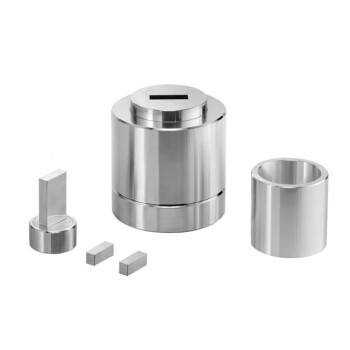
A laboratory hydraulic pellet press serves as the critical bridge between raw fly ash powder and viable industrial application. It functions by compressing fine particulate matter into structured pellets or spheres, endowing them with the specific mechanical strength required for practical use in systems like dynamic adsorption columns.
While raw fly ash possesses chemical potential, its fine, powdery physical form creates significant bottlenecks in processing. The hydraulic press resolves these physical limitations, enabling the material to be used in dynamic environments without causing system failures or material loss.
Overcoming the Physical Limitations of Fly Ash
Addressing the Pressure Drop Issue
Raw fly ash exists as a fine powder. When packed into industrial columns for filtration or adsorption, this fine texture packs too tightly, creating high resistance to flow.
Using a hydraulic press to create larger pellets introduces necessary voids between particles. This structure significantly reduces pressure drop, allowing fluids or gases to pass through the column efficiently.
Preventing Material Loss
Fine powders are easily displaced, leading to "particle loss" in dynamic systems where fluids are moving.
By compressing the ash into spheres or pellets, the hydraulic press ensures the material remains stationary and intact. This stability is essential for maintaining the longevity and consistency of the adsorption process.
The Role of Precision in Resource Utilization
Achieving Optimal Density
The hydraulic press provides the precise pressure control necessary to manipulate the bulk density of the material.
This control allows researchers to transform a low-density waste product into a compact, manageable resource suitable for transport and industrial-scale operations.
Balancing Porosity and Adsorption
The ultimate goal of utilizing fly ash is often its adsorption performance.
The press allows for exact adjustments to ensure the pellet is solid enough to handle but porous enough to be chemically active. This balance maintains high adsorption performance while meeting the rigorous mechanical requirements of industrial equipment.
Critical Operational Trade-offs
Mechanical Strength vs. Active Surface Area
The most critical trade-off in using a hydraulic press is balancing durability with utility.
Applying too much pressure results in a pellet that is mechanically robust but potentially impermeable. Excessive compaction can close off the internal pores of the fly ash, drastically reducing its ability to adsorb contaminants.
Conversely, applying too little pressure preserves porosity but results in a fragile pellet. These weak pellets may crumble under the weight of the column bed, reverting to the original problems of pressure drop and particle loss.
Making the Right Choice for Your Application
To maximize the utility of fly ash, you must tailor the compression process to your specific industrial constraints.
- If your primary focus is flow rate and system longevity: Prioritize higher compression settings to create pellets with high mechanical strength that resist attrition and minimize pressure drop.
- If your primary focus is maximum chemical efficiency: Use the lowest viable pressure setting that maintains pellet integrity, ensuring maximum porosity and adsorption performance.
Success lies in using the hydraulic press not just to shape the material, but to engineer its physical properties for its intended environment.
Summary Table:
| Feature | Impact of Pelletization | Advantage for Resource Utilization |
|---|---|---|
| Physical Form | Powder to structured pellets | Eliminates particle loss and system clogging |
| Pressure Drop | Increases void space between particles | Enables efficient fluid/gas flow through columns |
| Material Density | Precisely controlled compaction | Optimized for transport and industrial handling |
| Mechanical Strength | Endows pellets with structural integrity | Prevents crumbling in dynamic environments |
| Porosity Control | Balanced pressure application | Maintains high surface area for chemical efficiency |
Optimize Your Material Research with KINTEK Precision
Unlock the full potential of your waste-to-resource projects with KINTEK’s high-performance laboratory hydraulic presses. Whether you are developing fly ash pellets or advanced battery materials, our range of pellet, hot, and isostatic presses provides the precise pressure control necessary to balance mechanical durability with chemical reactivity.
At KINTEK, we specialize in comprehensive laboratory solutions—from high-temperature furnaces (muffle, vacuum, CVD) to crushing systems and advanced reactors. Our expert-engineered tools ensure your research translates into viable industrial applications.
Ready to engineer superior materials? Contact us today to find the perfect equipment for your lab’s specific needs!
References
- Waleed Jadaa. Wastewater Treatment Utilizing Industrial Waste Fly Ash as a Low-Cost Adsorbent for Heavy Metal Removal: Literature Review. DOI: 10.3390/cleantechnol6010013
This article is also based on technical information from Kintek Solution Knowledge Base .
Related Products
- Automatic Laboratory Hydraulic Pellet Press Machine for Lab Use
- Laboratory Hydraulic Pellet Press for XRF KBR FTIR Lab Applications
- Laboratory Hydraulic Press Lab Pellet Press Machine for Glove Box
- Automatic Laboratory Hydraulic Press for XRF & KBR Pellet Press
- Laboratory Hydraulic Press Lab Pellet Press for Button Battery
People Also Ask
- What is the role of a laboratory hydraulic pellet press and stainless steel molds in the fabrication of RuO2/NbC anodes?
- What role does a laboratory pellet press play in the enhancement of biomass energy products? Optimize Fuel Efficiency
- What is the purpose of using a laboratory pellet press when evaluating the electronic conductivity of carbon powders? Guide
- How does a laboratory hydraulic pellet press contribute to SiCw/2024 aluminum composite preforms? Optimize Densification
- What is the significance of applying 200 MPa of pressure with a laboratory hydraulic pellet press for composite ceramics?