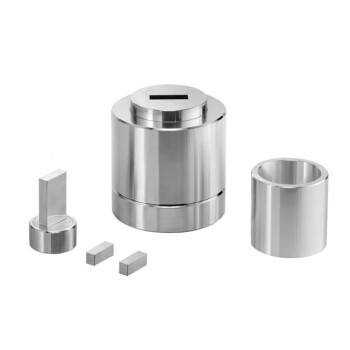
The primary role of a laboratory hydraulic pellet press and stainless steel molds is to transform loose niobium pentoxide powder into a cohesive, structurally stable "green body" prior to sintering. By applying a precise mechanical pressure of 20 MPa, this equipment compacts the powder and binder mixture into disk-shaped units, establishing the essential density and geometry required for the final porous RuO2/NbC anode.
Core Takeaway: This mechanical pressing stage is not merely about shaping; it is the foundational step that dictates the material's internal structure. It bridges the gap between raw chemical powder and a solid component, setting the "porosity foundation" that determines the anode's eventual electrochemical performance.
The Mechanics of Green Body Formation
Compacting the Precursor Material
The fabrication process begins with a mixture of niobium pentoxide powder and a binder.
The hydraulic press is used to force this loose mixture into a solid state. This transition is critical for creating a handleable object out of raw particulate matter.
The Role of Controlled Pressure
The system applies a specific pressure of 20 MPa to the powder mixture.
This exact pressure level is calculated to achieve "preliminary dense packing." It brings particles close enough to bond physically without crushing them so tightly that the material loses its necessary porous potential.
Function of the Specific Equipment
The Hydraulic Pellet Press
The press serves as the force generator, delivering the consistent energy required to compact the powder.
Its reliability ensures that every anode produced is subjected to the exact same 20 MPa of pressure. This consistency is vital for reproducibility in scientific fabrication.
High-Strength Stainless Steel Molds
The molds constrain the powder, defining the physical dimensions of the anode.
They determine the specific diameter and thickness of the resulting white disks. Because they are made of high-strength stainless steel, they can withstand the significant compression forces without deforming, ensuring the anode's geometry remains precise.
Critical Outcomes for the Anode
Establishing Structural Stability
The immediate output of this process is a "green body"—a solid object that has not yet been fired.
The pressing process ensures this green body is stable enough to be handled and moved to a furnace. Without this step, the powder would simply crumble before it could be sintered.
Setting the Porosity Foundation
While the final strength comes from high-temperature sintering, the potential for porosity is defined here.
By controlling the packing density through pressure, the press leaves specific gaps between particles. These gaps evolve into the porous network that allows the RuO2/NbC anode to function effectively.
Understanding Process Variables
Pressure Sensitivity
Applying pressure is a balancing act.
If the pressure significantly exceeds 20 MPa, the particles may pack too tightly, reducing the porosity essential for the anode's operation. Conversely, insufficient pressure will result in a green body that crumbles or fails to sinter into a robust solid.
Material Consistency
The press relies on the uniform distribution of the binder within the niobium pentoxide powder.
If the mixture is inconsistent, the hydraulic force will create uneven density gradients within the disk. This can lead to warping or cracking during the subsequent sintering phase.
Optimizing the Fabrication Process
To ensure the highest quality RuO2/NbC anodes, you must view the pressing stage as a precision operation rather than a brute force step.
- If your primary focus is Structural Integrity: Ensure the hydraulic press maintains a consistent 20 MPa to guarantee the green body is robust enough for handling.
- If your primary focus is Geometric Precision: Rely on high-quality stainless steel molds to strictly define the diameter and thickness of the disks, ensuring uniformity across batches.
The mechanical foundation you lay with the press today dictates the chemical efficiency of the anode tomorrow.
Summary Table:
| Component/Parameter | Role in Fabrication Process | Impact on Final Anode |
|---|---|---|
| Hydraulic Pellet Press | Applies 20 MPa of mechanical force | Ensures consistent density and structural stability |
| Stainless Steel Molds | Constrains powder to specific dimensions | Defines geometric precision (diameter/thickness) |
| Applied Pressure (20 MPa) | Achieves preliminary dense packing | Balances structural integrity with necessary porosity |
| Green Body Formation | Transforms loose powder into a solid disk | Enables handling and preparation for sintering |
Elevate Your Materials Research with KINTEK Precision
Precision in the 'green body' stage is critical for the electrochemical performance of your anodes. KINTEK specializes in high-performance laboratory equipment designed for rigorous scientific fabrication. Whether you need reliable hydraulic pellet presses (pellet, hot, isostatic) or high-strength stainless steel molds, our tools ensure the 20 MPa consistency your research demands.
Our extensive portfolio supports every stage of your workflow, from crushing and milling systems to high-temperature furnaces (vacuum, CVD, sintering) and electrolytic cells.
Ready to optimize your anode fabrication? Contact KINTEK today to discover how our high-precision solutions can enhance your laboratory's efficiency and reproducibility.
References
- Jing Ma, Lei Jiang. Anti-corrosion porous RuO<sub>2</sub>/NbC anodes for the electrochemical oxidation of phenol. DOI: 10.1039/c9ra03353j
This article is also based on technical information from Kintek Solution Knowledge Base .
Related Products
- Laboratory Hydraulic Pellet Press for XRF KBR FTIR Lab Applications
- Automatic Laboratory Hydraulic Pellet Press Machine for Lab Use
- Laboratory Manual Hydraulic Pellet Press for Lab Use
- Automatic Laboratory Hydraulic Press for XRF & KBR Pellet Press
- Laboratory Hydraulic Press Lab Pellet Press for Button Battery
People Also Ask
- What is the necessity of using a laboratory hydraulic pellet press in the preparation of biomass fuel pellets? Guide
- What is the significance of applying 200 MPa of pressure with a laboratory hydraulic pellet press for composite ceramics?
- How does a laboratory hydraulic pellet press contribute to SiCw/2024 aluminum composite preforms? Optimize Densification
- What key role does a laboratory pellet press play in FTIR analysis? Master KBr Sample Preparation Excellence
- What function does a laboratory pellet press or rolling mill serve? Enhance Electrode Density and Performance