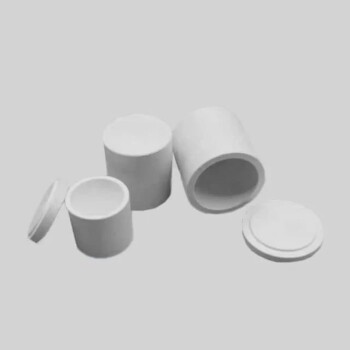
The autoclave serves as a specialized high-pressure reaction vessel. In the context of solvothermal synthesis, it creates a hermetically sealed environment that allows reaction mixtures to be heated significantly above the solvent's standard boiling point. This generates internal pressure, which is the primary driver for dissolving reactants and facilitating the formation of Metal-Organic Frameworks (MOFs).
By trapping solvents and generating autogenous pressure, the autoclave fundamentally alters reaction kinetics. It is the key to overcoming solubility issues and controlling nucleation to produce MOFs with superior crystallinity and high yields.
The Mechanics of Solvothermal Synthesis
Exceeding the Boiling Point
In standard laboratory glassware, a solvent will evaporate once it reaches its boiling point. An autoclave seals the system, preventing this evaporation.
This allows the temperature of the reaction mixture to rise well beyond the solvent’s atmospheric boiling limit without losing volume.
Generating Internal Pressure
As the temperature increases within the constant volume of the sealed autoclave, internal pressure builds naturally.
This pressure is not merely a side effect; it is a critical thermodynamic parameter. It fundamentally changes the properties of the solvent and how it interacts with the reagents.
Impact on Chemical Kinetics and Crystal Quality
Enhancing Ligand Solubility
A major challenge in MOF synthesis is that organic ligands often have poor solubility in common solvents at atmospheric pressure.
The high-pressure environment generated by the autoclave significantly enhances the solubility of these organic ligands. This ensures they are fully dissolved and available to coordinate with metal ions.
Promoting Controlled Nucleation
The sealed, pressurized environment allows for a slower, more regulated reaction rate compared to open-air precipitation.
This regulation promotes controlled crystal nucleation, ensuring that crystals form in an orderly fashion rather than crashing out of the solution as amorphous solids.
Defining Morphology and Yield
The specific conditions maintained by the autoclave are essential for achieving the desired physical structure of the MOF.
This process leads to specific morphologies and higher reaction yields. It is often the only way to achieve the superior crystallinity required for advanced MOF applications.
Operational Trade-offs and Safety
Managing High-Pressure Risks
While necessary for synthesis, high pressure introduces significant safety considerations.
Operators must ensure the autoclave is rated for the specific temperatures and pressures generated by the chosen solvent. Failure to respect these limits can lead to vessel rupture.
Distinction from Sterilization
It is common to see autoclaves used for sterilization in biological contexts, but the operational goal here is distinct.
In MOF synthesis, the objective is chemical transformation, not biological decontamination. The parameters are optimized for crystal growth rather than simply killing microorganisms.
Making the Right Choice for Your Goal
To maximize the quality of your Metal-Organic Frameworks, align your equipment use with your specific synthetic targets:
- If your primary focus is Structural Integrity: Ensure your autoclave maintains consistent temperature stability to promote uniform crystal growth and high crystallinity.
- If your primary focus is Complex Ligands: Utilize higher temperature settings to leverage the pressure required to fully solubilize difficult organic components.
The autoclave is not merely a container; it is an active thermodynamic tool that enables the creation of complex, high-quality porous materials.
Summary Table:
| Key Feature | Role in MOF Synthesis | Impact on Outcome |
|---|---|---|
| Hermetic Sealing | Prevents solvent evaporation above boiling point | Enables high-temperature liquid phase reactions |
| Autogenous Pressure | Increases solvent solubility and kinetic energy | Facilitates dissolution of complex organic ligands |
| Controlled Nucleation | Maintains stable, closed-system environment | Promotes superior crystallinity and specific morphology |
| Thermal Stability | Provides uniform heating over extended periods | Ensures high reaction yields and structural integrity |
Elevate Your Materials Research with KINTEK’s High-Pressure Solutions
Precision is the backbone of successful Metal-Organic Framework (MOF) synthesis. At KINTEK, we specialize in providing researchers and industrial labs with high-performance high-temperature high-pressure reactors and autoclaves designed to withstand the rigorous demands of solvothermal chemistry.
Whether you are working with complex ligands or requiring precise crystal morphology, our equipment ensures the safety, durability, and temperature stability needed for high-yield results. From crushing and milling systems to PTFE-lined vessels and advanced ceramics, we offer a comprehensive portfolio for your entire workflow.
Ready to achieve superior crystallinity? Contact us today to find the perfect autoclave for your laboratory!
References
- Shuxian Tang, Gang Wei. Recent Advances in Metal–Organic Framework (MOF)-Based Composites for Organic Effluent Remediation. DOI: 10.3390/ma17112660
This article is also based on technical information from Kintek Solution Knowledge Base .
Related Products
- High Pressure Laboratory Autoclave Reactor for Hydrothermal Synthesis
- Mini SS High Pressure Autoclave Reactor for Laboratory Use
- Desktop Fast High Pressure Laboratory Autoclave Sterilizer 16L 24L for Lab Use
- Laboratory High Pressure Steam Sterilizer Vertical Autoclave for Lab Department
- Laboratory Sterilizer Lab Autoclave Vertical Pressure Steam Sterilizer for Liquid Crystal Display Automatic Type
People Also Ask
- What role does a high-pressure reactor (autoclave) play in the synthesis of NiCuFe-LDH? Master Hydrothermal Growth
- What Role Does a High-Pressure Reactor or Autoclave Play in HA Catalyst Synthesis? Achieve High Surface Area Materials
- What equipment is required for hydrothermal synthesis of Ga0.25Zn4.67S5.08? Optimize Your Semiconductor Production
- What is the function of a high-pressure reactor in the hydrothermal synthesis of boehmite? Expert Process Insights
- What role does an autoclave play in the synthesis of MnO2 nanofibers? Mastering Hydrothermal Growth