Knowledge laboratory mill What is the difference between a grinding mill and a hammer mill? Choose the Right Mill for Your Material
Author avatar

Tech Team · Kintek Solution

Updated 2 months ago

What is the difference between a grinding mill and a hammer mill? Choose the Right Mill for Your Material


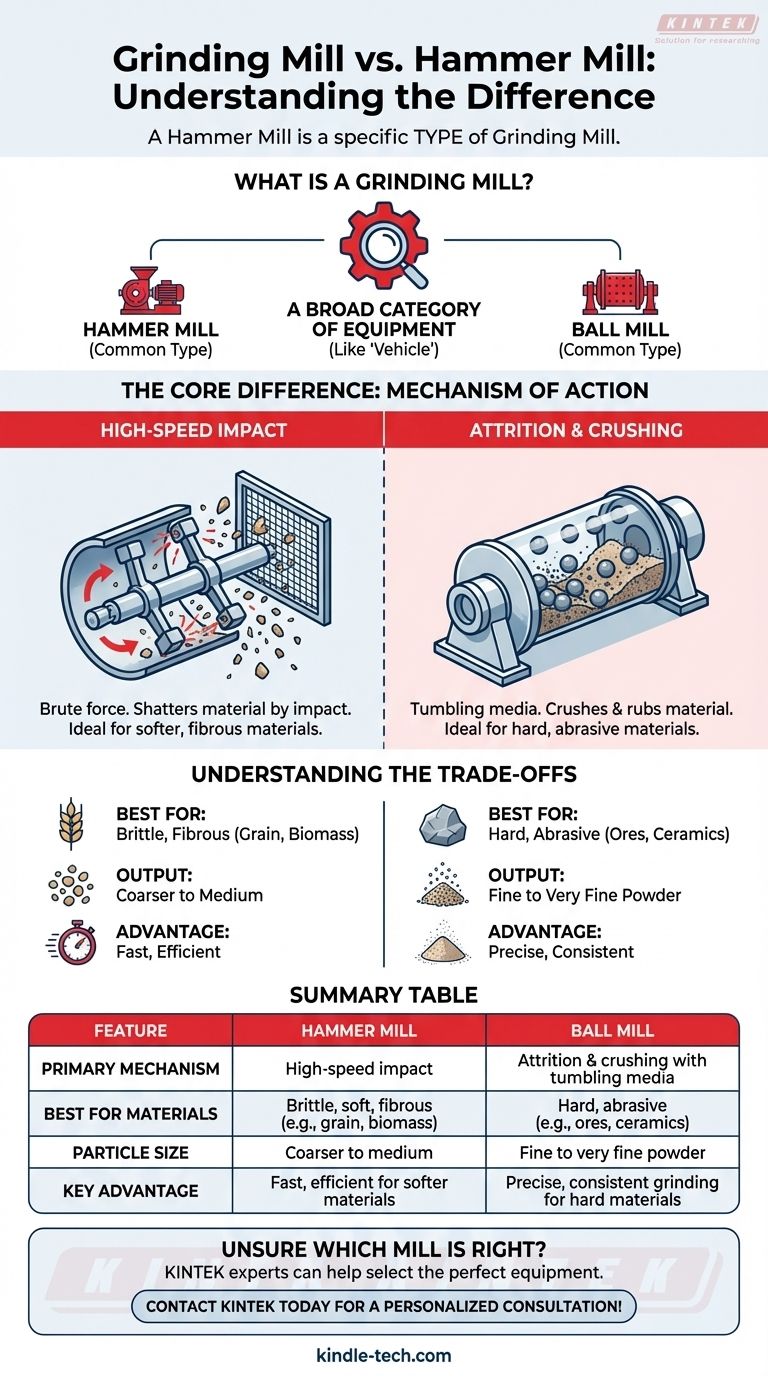
The primary difference is that a hammer mill is a specific type of grinding mill. The term "grinding mill" is a broad category for equipment that breaks down solid material, and the two most common types are hammer mills and ball mills. The key distinction lies in how they reduce particle size: hammer mills use high-speed impact, while ball mills use a combination of impact and attrition.

The core distinction is not "grinding mill vs. hammer mill," but understanding the different mechanisms within the grinding mill family. Hammer mills shatter material with brute force impact, making them ideal for softer materials, whereas ball mills use tumbling media to crush and grind, excelling with harder materials and finer outputs.
What is the difference between a grinding mill and a hammer mill? Choose the Right Mill for Your Material

What is a Grinding Mill?

A grinding mill is not a single machine but a class of equipment designed for size reduction. The goal is to break down large particles into smaller ones, creating powders or granules.

A Broad Category of Equipment

Think of "grinding mill" as the overarching category, similar to the term "vehicle." Just as vehicles can be cars, trucks, or motorcycles, grinding mills can be hammer mills, ball mills, or other designs, each suited for a different task.

The Two Common Types

As the references indicate, the two most common types of grinding mills you will encounter are ball mills and hammer mills. Understanding the functional difference between these two archetypes will cover the vast majority of industrial and laboratory applications.

The Core Difference: Mechanism of Action

The most important distinction between a hammer mill and a ball mill is the physical principle they use to break down material. This fundamental difference dictates what materials they can process and the characteristics of the final product.

Hammer Mills: High-Speed Impact

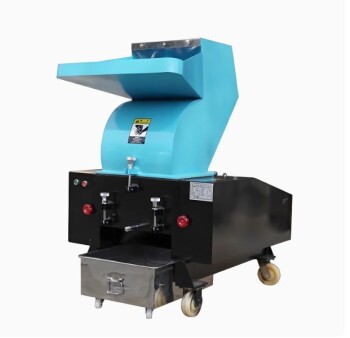
A hammer mill operates on the principle of brute force. It uses a rotating shaft with swinging hammers that strike material at high speeds. The particles are shattered upon impact with these hammers, as well as by colliding with the walls of the chamber, until they are small enough to pass through a screen.

Ball Mills: Attrition and Crushing

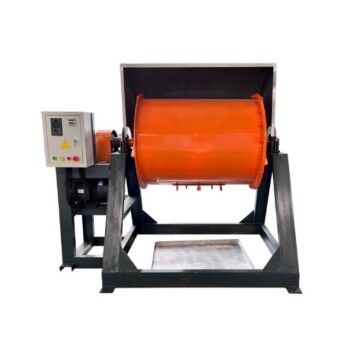
A ball mill uses a completely different method. It is a rotating cylinder filled with grinding media, typically steel or ceramic balls. As the cylinder tumbles, the balls cascade from the top of the mill, crushing and grinding the material trapped between them. This process involves both impact (from the falling balls) and attrition (rubbing and shearing forces).

The references mention several variations, such as planetary, mixer, and horizontal rolling ball mills, which all use this same core principle of tumbling media but vary in their motion and capacity.

Understanding the Trade-offs

Choosing the wrong type of mill for your material can lead to inefficiency, excessive wear, or an inability to achieve the desired particle size.

When to Choose a Hammer Mill

Hammer mills excel at processing materials that are brittle or fibrous. Their high-impact action is perfect for quickly shattering things like grain, biomass, or softer minerals. They are generally less effective on very hard, abrasive materials, which can cause rapid wear on the hammers.

When to Choose a Ball Mill

Ball mills are the standard for grinding hard, abrasive materials down to a very fine powder. The constant crushing and grinding action is highly effective for things like ores, cement clinker, and ceramics. The process can be slower than a hammer mill but allows for much finer and more consistent particle sizes.

Scaling and Testing

As noted in the references, mill design affects its use. The length of a ball mill primarily affects its capacity (throughput), while its diameter dictates grinding performance. This is why smaller versions, like "Slice Mills," can be used to test formulations and processes with little concern for scale-up.

How to Apply This to Your Project

Your choice depends entirely on your starting material and your desired final product.

  • If your primary focus is processing softer, brittle, or fibrous materials: A hammer mill is likely the correct and more efficient choice.
  • If your primary focus is grinding hard, abrasive materials to a fine, uniform powder: A ball mill is the industry standard and the superior tool for the job.
  • If your primary focus is initial R&D or testing a formulation: You can use a smaller laboratory-scale mill, such as a slice mill or planetary ball mill, to validate your process before investing in larger equipment.

Ultimately, selecting the right mill begins with a clear understanding of your material's properties and the specific particle size you need to achieve.

Summary Table:

Feature Hammer Mill Ball Mill
Primary Mechanism High-speed impact Attrition and crushing with tumbling media
Best For Materials Brittle, soft, fibrous (e.g., grain, biomass) Hard, abrasive (e.g., ores, ceramics)
Particle Size Coarser to medium Fine to very fine powder
Key Advantage Fast, efficient for softer materials Precise, consistent grinding for hard materials

Unsure which mill is right for your lab's materials? The experts at KINTEK can help you select the perfect equipment—from hammer mills to ball mills—to achieve your specific particle size goals efficiently. Let's optimize your grinding process together.

Contact KINTELK today for a personalized consultation!

Visual Guide
What is the difference between a grinding mill and a hammer mill? Choose the Right Mill for Your Material Visual Guide

Related Products

People Also Ask

Related Products

Laboratory Hybrid Tissue Grinding Mill

Laboratory Hybrid Tissue Grinding Mill

KT-MT20 is a versatile laboratory device used for rapid grinding or mixing of small samples, whether dry, wet, or frozen. It comes with two 50ml ball mill jars and various cell wall breaking adapters for biological applications such as DNA/RNA and protein extraction.

Laboratory High Throughput Tissue Grinding Mill Grinder

Laboratory High Throughput Tissue Grinding Mill Grinder

KT-MT is a high-quality, small, and versatile tissue grinder used for crushing, grinding, mixing, and cell wall breaking in various fields, including food, medical, and environmental protection. It is equipped with 24 or 48 2ml adapters and ball grinding tanks and is widely employed for DNA, RNA, and protein extraction.

Laboratory Micro Tissue Grinding Mill Grinder

Laboratory Micro Tissue Grinding Mill Grinder

KT-MT10 is a miniature ball mill with a compact structure design. The width and depth are only 15X21 cm, and the total weight is only 8 kg. It can be used with a minimum 0.2ml centrifuge tube or a maximum 15ml ball mill jar.

Laboratory Grinding Mill Mortar Grinder for Sample Preparation

Laboratory Grinding Mill Mortar Grinder for Sample Preparation

KT-MG200 mortar grinder can be used for mixing and homogenizing powder, suspension, paste and even viscous samples. It can help users realize the ideal operation of sample preparation with more regularization and higher repeatability.

Vibrating Disc Mill Small Laboratory Grinding Machine

Vibrating Disc Mill Small Laboratory Grinding Machine

Discover the versatile Vibrating Disc Mill for efficient laboratory grinding. Ideal for geology, metallurgy, biology, and more. Explore now!

Laboratory Ball Mill Jar Mill with Metal Alloy Grinding Jar and Balls

Laboratory Ball Mill Jar Mill with Metal Alloy Grinding Jar and Balls

Grind and mill with ease using metal alloy grinding jars with balls. Choose from 304/316L stainless steel or tungsten carbide and optional liner materials. Compatible with various mills and features optional functions.

Laboratory Jar Mill with Agate Grinding Jar and Balls

Laboratory Jar Mill with Agate Grinding Jar and Balls

Grind your materials with ease using Agate Grinding Jars with Balls. Sizes from 50ml to 3000ml, perfect for planetary and vibration mills.

Laboratory Disc Cup Vibratory Mill for Sample Grinding

Laboratory Disc Cup Vibratory Mill for Sample Grinding

The vibrating disc mill is suitable for non-destructive crushing and fine grinding of samples with large particle sizes, and can quickly prepare samples with analytical fineness and purity.

High Energy Vibratory Laboratory Ball Mill Grinding Mill Single Tank Type

High Energy Vibratory Laboratory Ball Mill Grinding Mill Single Tank Type

High-energy vibration ball mill is a small desktop laboratory grinding instrument.It can be ball-milled or mixed with different particle sizes and materials by dry and wet methods.

High Energy Planetary Ball Mill Milling Machine for Laboratory

High Energy Planetary Ball Mill Milling Machine for Laboratory

The biggest feature is that the high energy planetary ball mill can not only perform fast and effective grinding, but also has good crushing ability

High Energy Planetary Ball Mill Milling Machine for Laboratory

High Energy Planetary Ball Mill Milling Machine for Laboratory

Experience fast and effective sample processing with the F-P2000 high-energy planetary ball mill. This versatile equipment offers precise control and excellent grinding capabilities. Perfect for laboratories, it features multiple grinding bowls for simultaneous testing and high output. Achieve optimal results with its ergonomic design, compact structure, and advanced features. Ideal for a wide range of materials, it ensures consistent particle size reduction and low maintenance.

Lab Vibration Mill

Lab Vibration Mill

Vibration Mill for Efficient Sample Preparation, Suitable for Crushing and Grinding a Variety of Materials with Analytical Precision. Supports Dry / Wet / Cryogenic Grinding and Vacuum/Inert Gas Protection.

Powerful Plastic Crusher Machine

Powerful Plastic Crusher Machine

KINTEK's powerful plastic crusher machines process 60-1350 KG/H of diverse plastics, ideal for labs and recycling. Durable, efficient, and customizable.

High-Energy Omnidirectional Planetary Ball Mill Milling Machine for Laboratory

High-Energy Omnidirectional Planetary Ball Mill Milling Machine for Laboratory

The KT-P4000E is a new product derived from the vertical high-energy planetary ball mill with a 360° swivel function. Experience faster, uniform, and smaller sample output results with 4 ≤1000ml ball mill jars.

Laboratory Horizontal Planetary Ball Mill Milling Machine

Laboratory Horizontal Planetary Ball Mill Milling Machine

Improve sample uniformity with our Horizontal Planetary Ball Mills. KT-P400H reduces sample deposition and KT-P400E has multi-directional capabilities. Safe, convenient and efficient with overload protection.

Mini Planetary Ball Mill Machine for Laboratory Milling

Mini Planetary Ball Mill Machine for Laboratory Milling

Discover the KT-P400 desktop planetary ball mill, ideal for grinding and mixing small samples in the lab. Enjoy stable performance, long service life, and practicality. Functions include timing and overload protection.

Stainless Steel Laboratory Ball Mill for Dry Powder and Liquid with Ceramic Polyurethane Lining

Stainless Steel Laboratory Ball Mill for Dry Powder and Liquid with Ceramic Polyurethane Lining

Discover the versatile stainless steel dry powder/liquid horizontal ball mill with ceramic/polyurethane lining. Ideal for ceramic, chemical, metallurgical, and building materials industries. High grinding efficiency and uniform particle size.

Laboratory Planetary Ball Mill Cabinet Planetary Ball Milling Machine

Laboratory Planetary Ball Mill Cabinet Planetary Ball Milling Machine

The vertical cabinet structure combined with ergonomic design enables users to obtain the best comfortable experience in standing operation. The maximum processing capacity is 2000ml, and the speed is 1200 revolutions per minute.

Laboratory Planetary Ball Mill Rotating Ball Milling Machine

Laboratory Planetary Ball Mill Rotating Ball Milling Machine

KT-P400E is a desktop multi-directional planetary ball mill with unique grinding and mixing capabilities. It offers continuous and intermittent operation, timing, and overload protection, making it ideal for various applications.

Nature Agate Mortar and Pestle for Grinding and Mixing

Nature Agate Mortar and Pestle for Grinding and Mixing

Get high-quality grinding results with Nature Agate Mortar and Pestle. Available in various sizes with shining polished grinding surfaces.


Leave Your Message