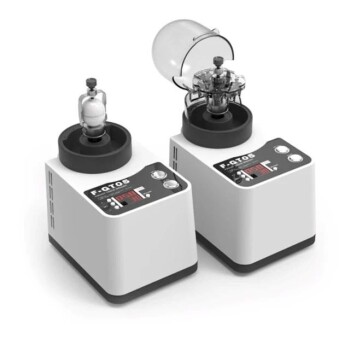
The primary function of a ball mill in the preparation of Lithium Aluminum Titanium Phosphate (LATP) is to mechanically grind and refine calcined coarse powder into a uniform, micron-sized state. This step is essential for eliminating particle agglomeration, which directly determines the final density and structural integrity of the ceramic pellets after sintering.
Core Insight While ball milling is often used to mix raw ingredients, its most critical role in LATP synthesis is the post-calcination refinement of the crystal structure. By reducing particle size and breaking up clumps formed during heating, the ball mill creates the necessary surface conditions for the material to densify into a highly conductive solid electrolyte.
The Critical Role of Particle Refinement
To understand the ball mill's function, one must look beyond simple "mixing." In LATP synthesis, the ball mill acts as a precision tool for controlling the microstructure of the material.
Eliminating Agglomeration
During the calcination process (heating), LATP powder particles often fuse together to form large, irregular clumps known as agglomerates.
The ball mill applies mechanical shear and impact forces to shatter these agglomerates. This ensures the powder returns to a loose, fine state rather than remaining as hard, fused chunks.
Optimizing for Sintering Density
The ultimate goal of LATP synthesis is usually to create a dense ceramic pellet.
The ball mill reduces the powder to a micron-sized scale with a uniform distribution. Small, uniform particles pack together much more efficiently than large, irregular ones. This tight packing is the physical prerequisite for eliminating porosity during the final sintering stage.
Increasing Specific Surface Area
By refining the coarse powder, the ball mill significantly increases the specific surface area of the material.
A larger surface area increases the reactivity of the powder during the final sintering phase. This promotes atomic diffusion and grain boundary bonding, leading to a denser and more mechanically robust electrolyte.
The Role in Raw Material Preparation
While the primary reference highlights the refining of calcined powder, supplementary context reveals that ball mills play a vital role earlier in the process as well.
Homogenizing Precursors
Before any heating occurs, the ball mill is used to mix raw materials (such as Lithium Carbonate, Aluminum Oxide, and Titanium Dioxide).
This process typically utilizes a liquid medium (like isopropanol or ethanol) and grinding media (like zirconia balls) to ensure the ingredients are mixed at a microscopic scale.
Facilitating Solid-State Reactions
Mere mixing is not enough; the ingredients must be in intimate contact to react chemically.
By grinding the raw materials together, the ball mill reduces their particle size and increases the reaction contact area. This ensures that when the mixture is heated, the solid-state reaction proceeds thoroughly, resulting in a pure-phase LATP crystal structure without unreacted impurities.
Understanding the Trade-offs
While ball milling is indispensable, it introduces specific variables that must be managed to avoid compromising the material.
Processing Time vs. Contamination
Extended milling times are excellent for reducing particle size, which improves density. However, excessive milling can introduce impurities from the grinding media (e.g., zirconia) or the jar lining into the LATP powder. These impurities can negatively affect the ionic conductivity of the final electrolyte.
Particle Size vs. Handling
Reducing particle size improves sintering activity, but ultra-fine powders can be difficult to handle during the molding process. They may flow poorly or trap air, potentially leading to microscopic defects in the final green body (the pressed pellet before sintering) if not managed correctly.
Making the Right Choice for Your Goal
The way you utilize the ball mill should depend on the specific stage of your LATP development and your performance targets.
- If your primary focus is Phase Purity: Prioritize the pre-calcination milling step. Ensure raw materials are milled long enough (e.g., 6+ hours) to maximize the contact area between Lithium, Aluminum, and Titanium sources for a complete reaction.
- If your primary focus is High Density & Conductivity: Focus on the post-calcination milling step. Ensure the calcined powder is refined to a uniform micron size to eliminate porosity during the final sintering of the ceramic pellets.
Ultimately, the ball mill acts as the bridge between raw chemical potential and physical performance, transforming coarse ingredients into a microstructure capable of high ionic conductivity.
Summary Table:
| Process Stage | Primary Function | Impact on LATP Performance |
|---|---|---|
| Pre-Calcination | Homogenizing raw precursors | Ensures phase purity and complete solid-state reaction |
| Milling Media | Reducing particle size (Micron-scale) | Increases specific surface area for higher reactivity |
| Post-Calcination | Breaking up fused agglomerates | Enables tight particle packing for maximum sintering density |
| Quality Control | Mechanical shear & impact | Determines final ceramic structural integrity and conductivity |
Elevate Your Battery Research with KINTEK Precision
Achieving the perfect micron-sized LATP powder requires more than just grinding—it requires precision equipment that minimizes contamination and maximizes uniformity. KINTEK specializes in high-performance laboratory solutions, offering professional crushing and milling systems, zirconia grinding media, and high-temperature furnaces designed for the rigorous demands of solid-state electrolyte synthesis.
From planetary ball mills to vacuum sintering furnaces and hydraulic pellet presses, our comprehensive range of equipment and consumables (including PTFE and ceramic crucibles) ensures your LATP research moves from the lab to the lead.
Ready to optimize your powder refinement process? Contact our technical experts today to find the ideal equipment for your laboratory.
Related Products
- Stainless Steel Laboratory Ball Mill for Dry Powder and Liquid with Ceramic Polyurethane Lining
- Mini Planetary Ball Mill Machine for Laboratory Milling
- High Energy Planetary Ball Mill Milling Machine for Laboratory
- High Energy Planetary Ball Mill for Laboratory Horizontal Tank Type Milling Machine
- High Energy Planetary Ball Mill Milling Machine for Laboratory
People Also Ask
- How do laboratory ball mills facilitate the mechanochemical synthesis of ZIF-8? Solvent-Free Synthesis Explained
- What is the primary function of a laboratory ball mill in the modification of sulfide-based solid electrolytes with LiPO2F2?
- How does a laboratory ball mill ensure the mixing quality of Mn3Zn0.8Sn0.2N and Ti? Achieve Perfect Homogeneity
- What is the function of a laboratory ball mill in the preparation of AMMCs? Optimize Dispersion & Grain Refinement
- In what way does a laboratory ball mill affect material properties when modifying PHBV/pulp fiber composites?