A benchtop constant temperature shaker serves as the kinetic control center for experiments evaluating acid mine drainage (AMD) treatment. Its primary function is to maintain a precise rotational speed, such as 150 rpm, which keeps immobilized particles continuously suspended and in motion within the solution.
Core Takeaway The shaker is not merely a mixing device; it is a tool for optimizing mass transfer. By keeping particles in motion, it eliminates the stagnant liquid barriers that naturally form around them, ensuring that the treatment process mimics real-world fluid dynamics rather than static laboratory conditions.
The Mechanics of Mass Transfer
Maintaining Particle Suspension
For immobilized particles to treat AMD effectively, they cannot be allowed to settle at the bottom of a flask.
The shaker ensures these particles remain uniformly distributed throughout the liquid. This maximizes the surface area available for chemical reactions at any given moment.
Enhancing Ion Diffusion
The core objective of these experiments is the removal of specific contaminants: sulfate (SO4 2-), ferrous iron (Fe2+), and manganese (Mn2+).
The constant motion drives these ions from the bulk solution into the immobilized particles. Without this kinetic energy, the movement of ions would rely solely on passive diffusion, which is far too slow for practical treatment evaluation.
Overcoming Physical Barriers
Eliminating Liquid Film Resistance
In a static liquid, a thin, stagnant layer of fluid—known as the liquid film—naturally forms around solid particles.
This film acts as a shield, resisting the entry of contaminants into the particle. The rotational force of the shaker disrupts this boundary layer, effectively eliminating liquid film resistance and allowing direct contact between the AMD and the treatment agent.
Simulating Real-World Kinetics
Real-world AMD flows through environments; it does not sit stagnant in a beaker.
By creating a controlled kinetic environment, the shaker replicates the fluid flow found in actual treatment scenarios. This ensures that the data collected regarding diffusion and treatment efficiency is scientifically reliable and scalable.
Common Pitfalls to Avoid
Inconsistent Rotational Speeds
The reliability of your data depends entirely on the constancy of the motion.
If the shaker speed fluctuates, the thickness of the liquid film changes, altering the rate of mass transfer. This introduces variables that make it impossible to accurately measure the true efficiency of the immobilized particles.
Ignoring Shear Forces
While the primary reference highlights the need to eliminate resistance, there is a balance to be struck.
If the rotational speed is too aggressive, the shear forces may physically degrade the immobilized particles. The goal is to maximize suspension and diffusion without compromising the structural integrity of the treatment medium.
Making the Right Choice for Your Goal
To get the most out of your experimental setup, align your shaker settings with your specific objectives:
- If your primary focus is determining maximum treatment capacity: Ensure the rotational speed is high enough (e.g., 150 rpm) to fully eliminate liquid film resistance so that diffusion is the only limiting factor.
- If your primary focus is modeling real-world environmental flows: Calibrate the shaker to mimic the specific hydraulic retention times and flow dynamics expected in the actual remediation site.
Ultimately, the shaker transforms a static chemical mixture into a dynamic, realistic simulation of environmental treatment.
Summary Table:
| Function | Benefit in AMD Treatment | Impact on Experiment |
|---|---|---|
| Particle Suspension | Maximizes surface area contact | Prevents settling and ensures uniform reaction rates |
| Kinetic Control | Disrupts liquid film boundary layers | Eliminates diffusion resistance for faster ion removal |
| Uniform Heat/Motion | Maintains constant 150 rpm & temp | Ensures data reproducibility and scalable results |
| Flow Simulation | Replicates real-world fluid dynamics | Provides reliable models for actual environmental remediation |
Elevate Your Environmental Research with KINTEK Precision
Precision in kinetic control is the difference between a successful simulation and unreliable data. KINTEK specializes in high-performance laboratory equipment designed to meet the rigorous demands of environmental science and material research.
Whether you are optimizing acid mine drainage treatment or developing new immobilized particles, our comprehensive range of benchtop constant temperature shakers, homogenizers, and cooling solutions provides the stability and control your experiments require. From high-temperature furnaces and crushing systems for material synthesis to PTFE consumables and ceramic crucibles for chemical resistance, we offer a complete ecosystem for your lab.
Ready to achieve superior mass transfer and scientific reliability? Contact KINTEK today to discover how our advanced laboratory solutions can enhance your research efficiency and accuracy.
References
- Xuying Guo, Ying Li. Study of the preparation of Maifan stone and SRB immobilized particles and their effect on treatment of acid mine drainage. DOI: 10.1039/d1ra08709f
This article is also based on technical information from Kintek Solution Knowledge Base .
Related Products
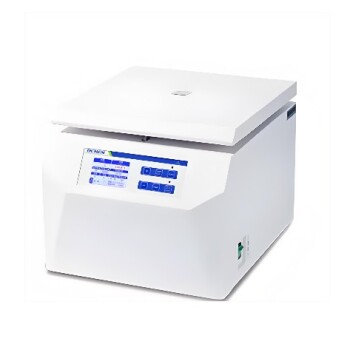
- Benchtop High Speed Small Lab Centrifuge for Serum Separation and Low Temperature Dehydration
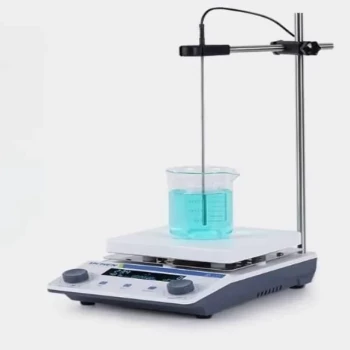
- Laboratory Small Constant Temperature Heated Magnetic Stirrer Heater and Stirrer
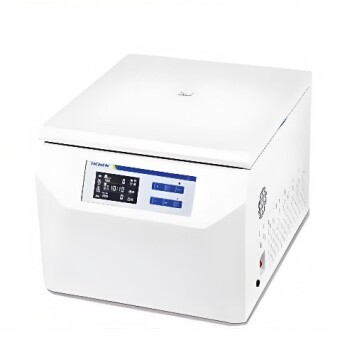
- Laboratory Benchtop High Speed Small Centrifuge for Low Temp Serum Separation Dehydration Research
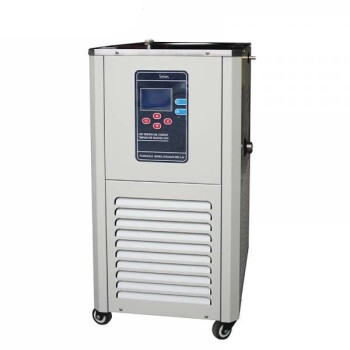
- 50L Chiller Water Bath Cooling Circulator Low Temperature Constant Temperature Reaction Bath
- High Temperature Constant Temperature Heating Circulator Water Bath Chiller Circulator for Reaction Bath
People Also Ask
- How is a benchtop laboratory centrifuge used in the desorption and regeneration of composite adsorbent beads?
- What is the primary function of a laboratory centrifuge? Master PAAMP-b-PVK Block Copolymer Purification
- What role does a Laboratory Centrifuge play in the production of succinic acid? Critical Solid-Liquid Separation Guide
- What are the advantages and disadvantages of a centrifuge? Weighing Speed Against Cost and Risk
- How does a centrifuge work and for what purpose? Unlock the Power of Rapid Sample Separation