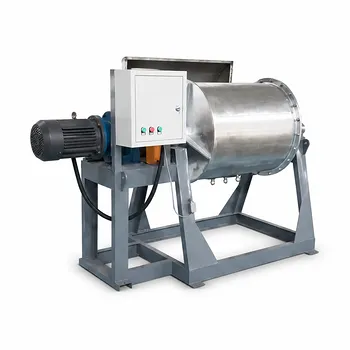
The primary function of a planetary ball mill in this specific context is to achieve atomic-level mixing and mechanical activation of the precursor powders. Utilizing high-speed rotation to generate intense impact and shear forces, the mill processes rare earth oxide (RE2O3) and silicon dioxide (SiO2) powders. This high-energy environment is required to uniformly blend six or more distinct components while significantly reducing particle size to facilitate subsequent chemical reactions.
Core Takeaway By delivering high-energy mechanical impact, the planetary ball mill transcends simple mixing to force atomic-level homogeneity across complex multi-component systems. This mechanical activation is the critical precursor that provides the necessary reactivity for successful high-temperature solid-phase synthesis and densification sintering.
The Mechanism of High-Energy Milling
Generating Impact and Shear Forces
The planetary ball mill operates on a principle distinct from standard tumble milling. It utilizes high-speed rotation to generate complex movement patterns.
These movements create significant impact and shear forces within the milling jar. This physical environment is aggressive enough to fracture hard ceramic powders like rare earth oxides and silicon dioxide.
Achieving Atomic-Level Homogeneity
High-entropy ceramics are defined by their complexity, often containing six or more components. Standard mixing cannot prevent segregation in such diverse mixtures.
The planetary mill drives these components together until they achieve atomic-level uniform mixing. This ensures that the final ceramic structure is consistent throughout the matrix, rather than having isolated pockets of specific elements.
Driving Chemical Reactivity
Mechanical Activation
The process acts as a mechanochemical tool, not just a physical crusher. The high-energy milling imparts energy into the powder, a process known as mechanical activation.
This activation increases the internal energy of the materials. It prepares the reactants (RE2O3 and SiO2) to bond more easily during the next stage of processing.
Reducing Particle Size
The milling process progressively pulverizes particles, breaking down agglomerations and reducing the powder to extremely fine sizes.
This reduction drastically increases the specific surface area of the powder. A larger surface area means more contact points between different particles, which is essential for reaction efficiency.
Preconditioning for Sintering
The ultimate goal of this preparation is to enable densification sintering.
By creating a highly reactive, uniformly mixed powder with fine particle sizes, the mill lowers the energy barriers for solid-phase reactions. This ensures the final ceramic achieves high density and structural integrity during high-temperature treatment.
Critical Considerations and Constraints
Laboratory Scale Limitations
It is important to note that planetary ball mills are generally smaller than common industrial ball mills.
They are primarily optimized for laboratory environments or preparing sample materials. While they offer superior energy density and mixing quality, their throughput is typically limited to smaller batches compared to large-scale production mills.
Energy Intensity
The process relies on high-energy ball milling.
Ideally, the process must be aggressive enough to induce physical and chemical changes. Insufficient energy input will fail to achieve the required "atomic-level" mixing, leading to phase separation in the final high-entropy ceramic.
Making the Right Choice for Your Goal
To maximize the effectiveness of the planetary ball mill for your specific ceramic project, consider the following strategic priorities:
- If your primary focus is Phase Stability: Ensure the milling duration and speed are sufficient to achieve atomic-level mixing, as component segregation will lead to structural failure in high-entropy systems.
- If your primary focus is Sintering Density: Prioritize mechanical activation parameters to maximize specific surface area, which provides the driving force needed for full densification during heat treatment.
The planetary ball mill is not merely a mixer; it is a reactor that uses mechanical force to bridge the gap between raw powder and high-performance ceramic structure.
Summary Table:
| Feature | Function in High-Entropy Ceramics | Impact on Final Product |
|---|---|---|
| High-Speed Rotation | Generates intense impact and shear forces | Fractures hard RE2O3 and SiO2 powders |
| High-Energy Milling | Induces mechanical activation | Lowers energy barriers for chemical reactions |
| Fine Pulverization | Increases specific surface area | Enhances reaction efficiency and sintering density |
| Atomic-Level Mixing | Eliminates component segregation | Ensures phase stability in 6+ component systems |
Elevate Your Material Research with KINTEK Precision
Achieving atomic-level homogeneity in complex high-entropy systems requires equipment that delivers uncompromising energy and precision. KINTEK specializes in advanced laboratory solutions designed to bridge the gap between raw powders and high-performance ceramics.
Our comprehensive portfolio features high-performance crushing and milling systems, including planetary ball mills, alongside high-temperature furnaces (muffle, vacuum, CVD) and hydraulic presses for perfect densification. Whether you are developing rare earth silicates or next-generation battery materials, our experts provide the tools and consumables—like high-purity ceramics and crucibles—to ensure your research is reproducible and scalable.
Ready to optimize your ceramic synthesis? Contact KINTEK today to discover how our laboratory equipment can accelerate your innovation.
References
- Zeyu Chen, Yi Zeng. Investigation on improving the comprehensive performance of environmental barrier coating materials by high-entropy multiphase design. DOI: 10.1038/s41529-024-00455-9
This article is also based on technical information from Kintek Solution Knowledge Base .
Related Products
- High Energy Planetary Ball Mill for Laboratory Horizontal Tank Type Milling Machine
- High-Energy Omnidirectional Planetary Ball Mill Milling Machine for Laboratory
- Laboratory Planetary Ball Mill Rotating Ball Milling Machine
- High Energy Planetary Ball Mill Milling Machine for Laboratory
- High Energy Planetary Ball Mill Machine for Laboratory Horizontal Tank Type
People Also Ask
- What is the role of a planetary ball mill in sulfide-based solid-state batteries? Engineer High-Performance Cathodes
- What are the parameters of a planetary ball mill? Master Speed, Time, and Media for Perfect Grinding
- What is the function of a planetary ball mill for nanostructured eutectic steel? Essential Prep for High-Strength Alloys
- What role does a planetary ball mill play in the preparation of NASICON-type solid electrolytes like LATP and LAGP?
- What is the function of a planetary ball mill in solid-state electrolyte prep? Milling vs. SDS Methods Explained