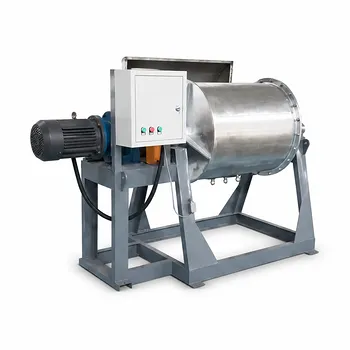
The planetary high-energy ball mill functions as the primary engine for mechanical alloying in the preparation of Ni-Co-Al superalloy powders. Through high-speed rotation, it generates intense centrifugal and shear forces that subject the powder mixture to a continuous cycle of fracturing and cold welding. This process refines the particles to a micron level (less than 10 micrometers) and forces Cobalt and Aluminum to dissolve into the Nickel matrix, achieving a uniform, pre-alloyed solid solution without the need for melting.
Core Insight: The planetary ball mill is not merely a grinder; it is a solid-state reactor. Its primary value lies in forcing elemental powders to mix at the atomic level, transforming a simple physical mixture into a homogenous solid solution that dictates the final material's performance.
The Mechanism of Mechanical Alloying
Generating Kinetic Energy
The device utilizes a unique planetary motion that creates powerful centrifugal and shear forces. These forces are significantly higher than those found in conventional mixers, providing the energy required to disrupt the crystalline structure of the metal powders.
The Cycle of Cold Welding and Fracturing
Under these intense forces, the powder particles undergo a repetitive process of deformation. The particles are repeatedly flattened and cold-welded together, then fractured apart by the impact of the grinding media.
Achieving Homogeneity
This continuous cycle effectively "kneads" the elemental layers together. Over time, this mechanical mixing eliminates compositional gradients, ensuring that every micron of the powder contains the correct ratio of Nickel, Cobalt, and Aluminum.
Atomic-Level Transformations
Particle Refinement
The high-energy impact drastically reduces the particle size of the raw materials. The process refines the powder to a micron level, specifically reaching sizes less than 10 micrometers, which significantly increases the surface area available for reaction.
Solid Solution Formation
The most critical function of the mill is enabling pre-alloying. The mechanical energy drives the Cobalt and Aluminum atoms into the Nickel lattice structure.
Creating a Supersaturated Matrix
This process results in the Cobalt and Aluminum entering the Nickel matrix as a solid solution. This atomic-level integration creates a chemically uniform precursor, which is essential for uniform microstructure development during subsequent processing steps.
Understanding the Trade-offs
Process Duration
Achieving a true solid solution is not instantaneous. The primary reference indicates this requires long-term mechanical alloying, meaning the process is time-intensive compared to simple mixing.
Energy Intensity
The generation of high shear and impact forces consumes significant energy. While necessary for atomic mixing, this high-energy input must be managed to prevent excessive heat buildup that could oxidize the fine metal powders.
Making the Right Choice for Your Goal
To maximize the effectiveness of the planetary ball mill for your specific application, consider your primary objective:
- If your primary focus is Uniform Microstructure: Prioritize milling duration to ensure the complete entry of Co and Al into the Ni matrix, guaranteeing a fully pre-alloyed solid solution.
- If your primary focus is Sintering Activity: Focus on the intensity of the shear forces to drive particle refinement below 10 micrometers, maximizing the surface area for subsequent densification.
The planetary ball mill is the bridge between raw elemental ingredients and the sophisticated, atomic-level architecture required for high-performance superalloys.
Summary Table:
| Feature | Function in Ni-Co-Al Preparation | Impact on Material |
|---|---|---|
| Kinetic Energy | High centrifugal & shear forces | Fractures and cold-welds powders |
| Particle Refinement | Reduction to <10 micrometers | Increases surface area for sintering |
| Mechanical Alloying | Atomic-level kneading | Forces Co and Al into Ni matrix |
| Solid Solution | Homogeneous pre-alloying | Ensures uniform microstructure without melting |
| Process Duration | Long-term milling | Achieves true supersaturated solid solution |
Elevate Your Superalloy Research with KINTEK
Precision in material science starts with the right equipment. KINTEK specializes in high-performance planetary high-energy ball mills and crushing systems designed to meet the rigorous demands of mechanical alloying and solid-state synthesis. Whether you are developing advanced Ni-Co-Al superalloys or exploring innovative battery materials, our robust milling solutions ensure particle refinement to the micron level and atomic-level homogeneity.
Why choose KINTEK?
- Comprehensive Equipment Portfolio: From high-temperature furnaces and vacuum systems to advanced hydraulic presses and crushing systems.
- Research-Grade Consumables: We provide essential high-purity ceramics, crucibles, and PTFE products to prevent contamination during high-energy processes.
- Tailored Solutions: Our tools are engineered to help researchers achieve superior sintering activity and uniform microstructures.
Ready to optimize your powder preparation? Contact our experts today to find the perfect laboratory equipment for your next breakthrough!
Related Products
- High Energy Planetary Ball Mill for Laboratory Horizontal Tank Type Milling Machine
- High Energy Planetary Ball Mill Milling Machine for Laboratory
- High Energy Planetary Ball Mill Milling Machine for Laboratory
- High Energy Planetary Ball Mill Machine for Laboratory Horizontal Tank Type
- High-Energy Omnidirectional Planetary Ball Mill Milling Machine for Laboratory
People Also Ask
- What is the role of a planetary ball mill in sulfide-based solid-state batteries? Engineer High-Performance Cathodes
- What are the parameters of a planetary ball mill? Master Speed, Time, and Media for Perfect Grinding
- What is the function of a planetary ball mill for nanostructured eutectic steel? Essential Prep for High-Strength Alloys
- What role does a planetary ball mill play in the preparation of NASICON-type solid electrolytes like LATP and LAGP?
- What is the function of a planetary ball mill in solid-state electrolyte prep? Milling vs. SDS Methods Explained