Knowledge What is the function of a planetary ball mill in Al2O3-TiCN/Co-Ni composites? Achieve Perfect Material Homogenization
Author avatar

Tech Team · Kintek Solution

Updated 3 days ago

What is the function of a planetary ball mill in Al2O3-TiCN/Co-Ni composites? Achieve Perfect Material Homogenization


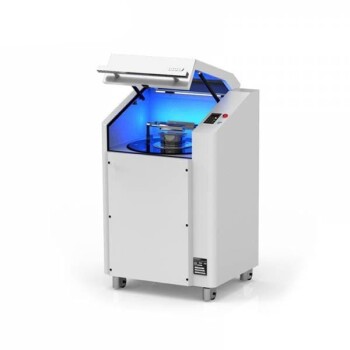
High-energy mechanical dispersion is the primary function of a planetary ball mill in this specific context. It is utilized to thoroughly mix and disperse nano-scale alumina (Al2O3), sub-micron titanium carbonitride (TiCN), and metallic cobalt-nickel (Co-Ni) powders within an anhydrous ethanol medium, typically over a duration of roughly 12 hours.

The planetary ball mill does not merely mix ingredients; it solves the critical problem of particle agglomeration. By applying intense mechanical force, it ensures the metallic binder phase is uniformly distributed among the ceramic particles, which is a prerequisite for a defect-free microstructure after sintering.

The Mechanics of the Pretreatment Process

Breaking Down Agglomerates

The introduction of nano-scale alumina presents a significant challenge: these fine particles naturally clump together due to high surface energy. Simple stirring cannot separate them.

The planetary ball mill uses high-energy impact to physically shatter these agglomerates. This exposes the individual particle surfaces, allowing them to be fully integrated into the composite matrix.

Homogenizing Diverse Phases

This composite material combines distinct classes of materials: hard ceramics (Al2O3, TiCN) and ductile metallic binders (Co, Ni). These have vastly different densities and particle sizes.

Ball milling forces these disparate materials into a uniform distribution. This ensures that the metallic Co-Ni binder effectively surrounds the hard ceramic particles, preventing segregation that would lead to structural weakness.

The Role of High-Energy Forces

Impact and Shear Action

As implied by the mechanical nature of planetary milling, the process relies on the complex movement of grinding jars and media. This generates simultaneous impact and shear forces.

These forces do more than mix; they refine the particle sizes further and increase the specific surface area of the reactants. This mechanical activation promotes "intimate contact" between the ceramic reinforcement and the metal binder.

Preparing for Sintering

The ultimate goal of this pretreatment is to facilitate the subsequent sintering process. A poorly mixed powder results in a porous or brittle final product.

By creating a homogeneous mixture during the milling stage, the process ensures a uniform microstructure develops during heating. This is critical for achieving the desired mechanical properties of the Al2O3-TiCN/Co-Ni composite.

Understanding the Trade-offs

Risk of Impurity Contamination

High-energy milling involves abrasive friction between the grinding balls and the jar lining. Over extended periods (such as 12 hours), this can introduce debris from the grinding media into your powder mixture.

Structural Integrity vs. Agglomeration

While the goal is to break agglomerates, excessive milling energy can physically damage the crystal structure of the raw materials. It is a balance between sufficient dispersion and preserving the integrity of the original phases.

Making the Right Choice for Your Goal

To optimize the pretreatment of your Al2O3-TiCN/Co-Ni composite, consider the following:

  • If your primary focus is Microstructural Uniformity: Prioritize a milling duration (e.g., 12 hours) sufficient to fully break down nano-alumina agglomerates and disperse the Co-Ni binder.
  • If your primary focus is Process Efficiency: Monitor particle size distribution during milling to identify the earliest point where agglomerates are eliminated, avoiding unnecessary energy expenditure.

Success in this composite system relies not just on the ingredients, but on using the ball mill to force them into a truly homogeneous state.

Summary Table:

Process Phase Primary Function Key Outcome
De-agglomeration High-energy impact Breaks nano-scale Al2O3 clusters
Homogenization Shear & centrifugal force Uniform distribution of Co-Ni metallic binder
Mechanical Activation Surface area refinement Enhances reactivity for subsequent sintering
Phase Integration Intensive mixing Prevents material segregation and structural defects

Elevate Your Composite Material Research with KINTEK

Precision in raw material pretreatment is the foundation of high-performance ceramics and alloys. KINTEK specializes in advanced laboratory equipment designed to meet the rigorous demands of material science. Our high-energy planetary ball mills and comprehensive crushing and milling systems ensure your Al2O3, TiCN, and metallic binders achieve the perfect homogeneous state required for defect-free sintering.

Beyond milling, we provide a full suite of solutions including:

  • High-Temperature Furnaces (Muffle, Vacuum, CVD/PECVD) for precise sintering.
  • Hydraulic Presses (Pellet, Hot, Isostatic) for superior sample preparation.
  • Sieving Equipment and essential Ceramic Crucibles.

Ready to optimize your lab's efficiency and material integrity? Contact KINTEK today to discuss our tailored solutions for your research goals.

Related Products

People Also Ask

Related Products

High Energy Planetary Ball Mill Milling Machine for Laboratory

High Energy Planetary Ball Mill Milling Machine for Laboratory

The biggest feature is that the high energy planetary ball mill can not only perform fast and effective grinding, but also has good crushing ability

High Energy Planetary Ball Mill Milling Machine for Laboratory

High Energy Planetary Ball Mill Milling Machine for Laboratory

Experience fast and effective sample processing with the F-P2000 high-energy planetary ball mill. This versatile equipment offers precise control and excellent grinding capabilities. Perfect for laboratories, it features multiple grinding bowls for simultaneous testing and high output. Achieve optimal results with its ergonomic design, compact structure, and advanced features. Ideal for a wide range of materials, it ensures consistent particle size reduction and low maintenance.

High-Energy Omnidirectional Planetary Ball Mill Machine for Laboratory

High-Energy Omnidirectional Planetary Ball Mill Machine for Laboratory

The KT-P2000E is a new product derived from the vertical high-energy planetary ball mill with a 360°rotation function. The product not only has the characteristics of the vertical high-energy ball mill, but also has a unique 360°rotation function for the planetary body.

High Energy Planetary Ball Mill for Laboratory Horizontal Tank Type Milling Machine

High Energy Planetary Ball Mill for Laboratory Horizontal Tank Type Milling Machine

KT-P4000H uses the unique Y-axis planetary motion trajectory, and utilizes the collision, friction and gravity between the sample and the grinding ball to have a certain anti-sinking ability, which can obtain better grinding or mixing effects and further improve the sample output.

Mini Planetary Ball Mill Machine for Laboratory Milling

Mini Planetary Ball Mill Machine for Laboratory Milling

Discover the KT-P400 desktop planetary ball mill, ideal for grinding and mixing small samples in the lab. Enjoy stable performance, long service life, and practicality. Functions include timing and overload protection.

Laboratory Planetary Ball Mill Rotating Ball Milling Machine

Laboratory Planetary Ball Mill Rotating Ball Milling Machine

KT-P400E is a desktop multi-directional planetary ball mill with unique grinding and mixing capabilities. It offers continuous and intermittent operation, timing, and overload protection, making it ideal for various applications.

Laboratory Horizontal Planetary Ball Mill Milling Machine

Laboratory Horizontal Planetary Ball Mill Milling Machine

Improve sample uniformity with our Horizontal Planetary Ball Mills. KT-P400H reduces sample deposition and KT-P400E has multi-directional capabilities. Safe, convenient and efficient with overload protection.

High Energy Planetary Ball Mill Machine for Laboratory Horizontal Tank Type

High Energy Planetary Ball Mill Machine for Laboratory Horizontal Tank Type

The KT-P2000H uses a unique Y-axis planetary trajectory, and utilizes the collision, friction and gravity between the sample and the grinding ball.

High-Energy Omnidirectional Planetary Ball Mill Milling Machine for Laboratory

High-Energy Omnidirectional Planetary Ball Mill Milling Machine for Laboratory

The KT-P4000E is a new product derived from the vertical high-energy planetary ball mill with a 360° swivel function. Experience faster, uniform, and smaller sample output results with 4 ≤1000ml ball mill jars.

Laboratory Jar Mill with Agate Grinding Jar and Balls

Laboratory Jar Mill with Agate Grinding Jar and Balls

Grind your materials with ease using Agate Grinding Jars with Balls. Sizes from 50ml to 3000ml, perfect for planetary and vibration mills.

Laboratory Single Horizontal Jar Mill

Laboratory Single Horizontal Jar Mill

KT-JM3000 is a mixing and grinding instrument for placing a ball milling tank with a volume of 3000ml or less. It adopts frequency conversion control to realize timing, constant speed, direction change, overload protection and other functions.

High Energy Vibratory Laboratory Ball Mill Grinding Mill Single Tank Type

High Energy Vibratory Laboratory Ball Mill Grinding Mill Single Tank Type

High-energy vibration ball mill is a small desktop laboratory grinding instrument.It can be ball-milled or mixed with different particle sizes and materials by dry and wet methods.

Hybrid High Energy Vibratory Ball Mill for Lab Use

Hybrid High Energy Vibratory Ball Mill for Lab Use

KT-BM400 is used for rapid grinding or mixing of dry, wet and frozen small amount of samples in the laboratory. It can be configured with two 50ml ball mill jars

Laboratory Ten-Body Horizontal Jar Mill for Lab Use

Laboratory Ten-Body Horizontal Jar Mill for Lab Use

The Ten-body horizontal jar mill is for 10 ball mill pots (3000ml or less). It has frequency conversion control, rubber roller movement, and PE protective cover.

Lab Vibration Mill

Lab Vibration Mill

Vibration Mill for Efficient Sample Preparation, Suitable for Crushing and Grinding a Variety of Materials with Analytical Precision. Supports Dry / Wet / Cryogenic Grinding and Vacuum/Inert Gas Protection.

High Energy Vibratory Ball Mill for Lab Use

High Energy Vibratory Ball Mill for Lab Use

The high-energy vibrating ball mill is a high-energy oscillating and impacting multifunctional laboratory ball mill. The table-top type is easy to operate, small in size, comfortable and safe.

Precision Machined Zirconia Ceramic Ball for Engineering Advanced Fine Ceramics

Precision Machined Zirconia Ceramic Ball for Engineering Advanced Fine Ceramics

zirconia ceramic ball have the characteristics of high strength, high hardness, PPM wear level, high fracture toughness, good wear resistance, and high specific gravity.

CVD Diamond Cutting Tool Blanks for Precision Machining

CVD Diamond Cutting Tool Blanks for Precision Machining

CVD Diamond Cutting Tools: Superior Wear Resistance, Low Friction, High Thermal Conductivity for Non-Ferrous Materials, Ceramics, Composites Machining

Lab Blown Film Extrusion Three Layer Co-Extrusion Film Blowing Machine

Lab Blown Film Extrusion Three Layer Co-Extrusion Film Blowing Machine

Lab blown film extrusion is mainly used to detect the feasibility of film blowing of polymer materials and the colloid condition in the materials, as well as the dispersion of colored dispersions, controlled mixtures, and extrudates;

Electric button battery sealing machine

Electric button battery sealing machine

The electric button battery sealing machine is a high-performance packaging equipment designed for mass production of button batteries (such as CR series, LR series, SR series, etc.), suitable for electronic manufacturing, new energy research and development, and industrial automation production lines.


Leave Your Message