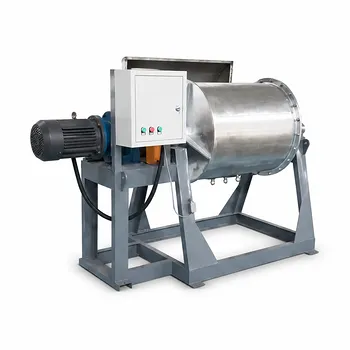
The primary function of a roller ball mill in this context is to achieve molecular-level homogenization. Specifically, it is used to mix platinum-on-carbon (Pt/C) particles with proton exchange resins (ionomers) through a long-duration, low-energy process that ensures uniform distribution without relying on aggressive high-shear forces.
Core Takeaway While many milling processes prioritize high impact to break down materials, the roller ball mill for Pt/C slurries focuses on gentle, sustained mixing. Its goal is to establish continuous transport channels for electrons and protons, which is critical for maximizing the catalytic activity of the cathode.
The Mechanism of Low-Energy Mixing
Prioritizing Uniformity Over Force
Unlike planetary ball mills or three-roll mills which often utilize high mechanical shear to break apart agglomerates, the roller ball mill in this application operates on a low-energy principle.
The Role of Duration
To compensate for the lower energy input, the process relies on long-duration mixing.
This extended timeframe allows the Pt/C particles and the ionomer to integrate thoroughly at a molecular level, rather than simply being macroscopically blended.
Handling Delicate Components
The "soft" nature of this mixing is essential for the specific chemistry of Pt/C and ionomers.
It facilitates dispersion without potentially damaging the delicate carbon structure or degrading the polymer chains of the resin, ensuring the material properties remain intact.
Why This Process Matters
Establishing Transport Channels
The ultimate physical goal of this milling process is the creation of continuous transport channels.
For a fuel cell or electrolysis cathode to function, it requires two distinct pathways: one for electrons (via the carbon network) and one for protons (via the ionomer network).
Ensuring Network Continuity
If the mixing is too aggressive or too brief, these networks may become fragmented.
The roller ball mill ensures the ionomer coats the catalyst particles uniformly, creating an unbroken "highway" for protons while maintaining the electrical contact points between carbon particles.
Enhancing Reaction Activity
The direct outcome of this structural continuity is improved performance.
By optimizing the distribution of the catalyst and the transport media, the mill enhances the activity of the cathode hydrogen evolution reaction, allowing the device to operate more efficiently.
Understanding the Trade-offs
Process Efficiency vs. Quality
The most significant trade-off with a roller ball mill is time.
While supplementary methods (like high-shear planetary milling used for NCM811 cathodes) might mix materials faster through intense force, the roller ball mill requires a significant time investment to achieve the same degree of homogeneity through low-energy tumbling.
Throughput Limitations
Due to the "long-duration" requirement, this method creates a bottleneck in manufacturing speed.
It is a process designed for quality and precision, not for high-speed throughput.
Making the Right Choice for Your Goal
When selecting a mixing technology for cathode slurries, the choice depends heavily on the sensitivity of your materials and the transport mechanisms you need to facilitate.
- If your primary focus is maximizing catalytic activity: Prioritize the roller ball mill to ensure molecular-level distribution and continuous proton/electron channels, even at the cost of processing time.
- If your primary focus is breaking down hard agglomerates: You may need to investigate higher-shear alternatives (like planetary milling), bearing in mind the risk of damaging softer ionomer chains.
Select the milling method that builds the most robust transport network for your specific electrochemical reaction.
Summary Table:
| Feature | Roller Ball Mill Performance |
|---|---|
| Mixing Principle | Low-energy, long-duration tumbling |
| Primary Goal | Molecular-level homogenization & channel continuity |
| Material Impact | Gentle; preserves delicate carbon & ionomer structures |
| Key Outcome | Enhanced catalytic activity for hydrogen evolution |
| Process Trade-off | Longer processing time for higher quality dispersion |
Elevate Your Battery and Fuel Cell Research with KINTEK
Precision in cathode slurry preparation is the key to maximizing electrochemical performance. At KINTEK, we specialize in providing the high-quality laboratory equipment needed to build robust transport networks for your materials.
Whether you are developing Pt/C catalysts or advanced battery chemistries, our comprehensive portfolio is designed to meet your most rigorous lab requirements:
- Milling & Crushing: Precise roller ball mills, planetary systems, and sieving equipment for perfect homogenization.
- Sample Preparation: Advanced hydraulic presses (pellet, hot, isostatic) and high-temperature furnaces (muffle, vacuum, CVD).
- Specialized Research Tools: High-pressure reactors, autoclaves, electrolytic cells, and dedicated battery research consumables.
- Lab Essentials: ULT freezers, freeze dryers, and high-purity ceramics or PTFE products.
Ready to optimize your catalytic activity? Contact KINTEK today to discover how our specialized equipment and technical expertise can streamline your research and development workflow.
References
- Sebastian Möhle, Peter Strasser. Iridium Oxide Inverse Opal Anodes with Tailored Porosity for Efficient PEM Electrolysis. DOI: 10.1002/adfm.202501261
This article is also based on technical information from Kintek Solution Knowledge Base .
Related Products
- Laboratory Planetary Ball Mill Rotating Ball Milling Machine
- Stainless Steel Laboratory Ball Mill for Dry Powder and Liquid with Ceramic Polyurethane Lining
- Laboratory Ball Mill Jar Mill with Metal Alloy Grinding Jar and Balls
- Mini Planetary Ball Mill Machine for Laboratory Milling
- High-Energy Omnidirectional Planetary Ball Mill Milling Machine for Laboratory
People Also Ask
- In what way does a laboratory ball mill affect material properties when modifying PHBV/pulp fiber composites?
- Why is a laboratory ball mill required for ultra-fine fly ash? Unlock Nano-Scale Adsorption Power
- Why is a laboratory ball mill used in Co-Ni catalyst research? Optimize CO2 Conversion with Precise Milling
- How does a laboratory ball mill ensure the mixing quality of Mn3Zn0.8Sn0.2N and Ti? Achieve Perfect Homogeneity
- What is the function of a laboratory ball mill in the preparation of AMMCs? Optimize Dispersion & Grain Refinement