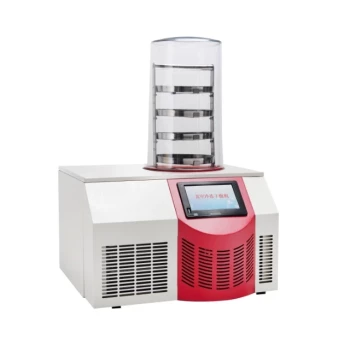
The primary function of a vacuum drying oven in the preparation of succinimide anion-based ionic liquids is to achieve high purity by removing residual moisture and organic solvents. By creating a vacuum, the oven lowers the boiling point of these impurities, allowing them to evaporate at relatively low temperatures without subjecting the heat-sensitive ionic liquid to thermal degradation.
The vacuum drying process is critical for quality assurance, not just drying. It enables the thorough removal of volatile contaminants while preventing the thermal decomposition and darkening that destroys the catalyst's effectiveness.
The Criticality of Purity
Ensuring Catalytic Activity
Succinimide anion-based ionic liquids are frequently used as catalysts. Their chemical performance is directly linked to their purity.
Even trace amounts of contaminants can inhibit the active sites of the catalyst. Vacuum drying ensures these sites remain accessible and active.
Eliminating Residual Solvents
During synthesis, organic solvents are often used as reaction media or washing agents. These must be removed completely to finalize the product.
Standard drying methods may leave trapped solvent molecules. The vacuum environment forces these volatiles out of the liquid matrix.
Removing Moisture
Water is a pervasive impurity that can interfere with ionic liquid properties. A vacuum oven effectively strips moisture that might otherwise remain bonded to the anions.
The Role of Temperature Control
Lowering Boiling Points
The defining physical principle of this process is the relationship between pressure and boiling points.
By reducing the pressure inside the chamber, the boiling points of water and organic solvents drop significantly.
This allows evaporation to occur rapidly at temperatures far below the solvents' standard boiling points.
Preventing Thermal Decomposition
Ionic liquids can be sensitive to high heat. Excessive temperatures often lead to thermal decomposition.
If dried in a standard oven at high heat, these liquids may suffer from chemical breakdown, rendering them useless.
Avoiding Discoloration
A clear indicator of degradation in ionic liquids is "darkening."
Vacuum drying at lower temperatures preserves the optical quality and original color of the liquid, which is a visual proxy for its chemical integrity.
Common Pitfalls to Avoid
Relying on Standard Ovens
Using a non-vacuum oven is a common error that forces a choice between two bad outcomes: incomplete drying or overheated product.
Without a vacuum, you must raise the temperature to drive off solvents, which risks oxidizing or burning the ionic liquid.
Underestimating Vacuum Levels
Insufficient vacuum pressure will fail to lower the boiling points enough to protect the sample.
To ensure the "low temperature" benefit is realized, the vacuum system must be capable of maintaining a consistent, low-pressure environment throughout the cycle.
Making the Right Choice for Your Goal
When setting up your preparation protocol for succinimide anion-based ionic liquids, prioritize the following based on your specific needs:
- If your primary focus is Catalytic Performance: Prioritize vacuum consistency to ensure 100% removal of moisture, as this directly impacts activity.
- If your primary focus is Product Stability: strictly limit the drying temperature and rely on the vacuum to do the heavy lifting to prevent darkening.
By utilizing a vacuum drying oven, you effectively decouple the drying process from the damaging effects of high heat, ensuring a pristine and highly active final product.
Summary Table:
| Feature | Impact on Ionic Liquid Preparation |
|---|---|
| Vacuum Environment | Lowers solvent boiling points, allowing low-temp evaporation. |
| Moisture Removal | Eliminates water that inhibits catalytic active sites. |
| Temperature Control | Prevents thermal decomposition and product darkening. |
| Purity Assurance | Ensures 100% removal of residual solvents and volatile contaminants. |
| Product Quality | Maintains the chemical integrity and optical clarity of the catalyst. |
Elevate Your Chemical Synthesis with KINTEK Precision
Don't compromise the purity and catalytic activity of your ionic liquids with substandard drying methods. KINTEK specializes in advanced laboratory solutions designed to meet the rigorous demands of material science and chemical research.
Our high-performance vacuum drying ovens provide the precise temperature control and stable vacuum environments necessary to prevent thermal degradation and ensure complete solvent removal. Beyond drying, KINTEK offers a comprehensive range of equipment, including:
- High-Temperature High-Pressure Reactors & Autoclaves for complex synthesis.
- Crushing, Milling, and Sieving Systems for material preparation.
- Hydraulic Presses & Isostatic Presses for advanced material processing.
- Electrolytic Cells & Battery Research Tools for electrochemical applications.
- Cooling Solutions & ULT Freezers to preserve heat-sensitive samples.
Ready to optimize your lab's performance? Contact our experts today to find the perfect equipment tailored to your research goals and experience the KINTEK advantage in quality and reliability.
References
- Fengtian Wu, Zhimin Liu. Upcycling poly(succinates) with amines to N-substituted succinimides over succinimide anion-based ionic liquids. DOI: 10.1038/s41467-024-44892-1
This article is also based on technical information from Kintek Solution Knowledge Base .
Related Products
- 56L Vertical Laboratory Vacuum Drying Oven
- 23L Laboratory Vacuum Drying Oven
- Laboratory Scientific Electric Heating Blast Drying Oven
- Benchtop Laboratory Vacuum Freeze Dryer
- Vacuum Heat Treat Sintering Brazing Furnace
People Also Ask
- Why is a laboratory vacuum drying oven recommended for rice straw residues? Protect Your Biomass Integrity
- What role does a laboratory vacuum drying oven play in the preparation of modified multi-walled carbon nanotubes?
- What is the importance of using a laboratory vacuum drying oven? Preserving Slow-Release Microcapsule Integrity
- Why is a Laboratory Vacuum Drying Oven recommended for PBAT microspheres? Protect Sensitive Polymer Integrity
- What role does a laboratory vacuum drying oven play in processing nanoparticle powder samples? Protect Sample Integrity