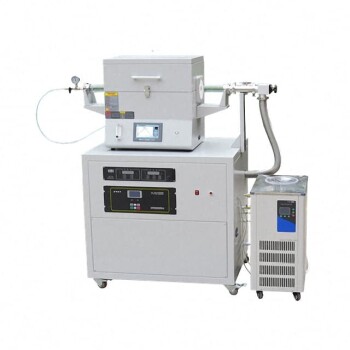
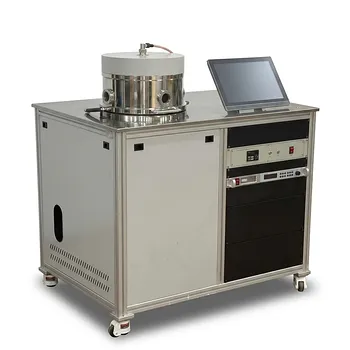
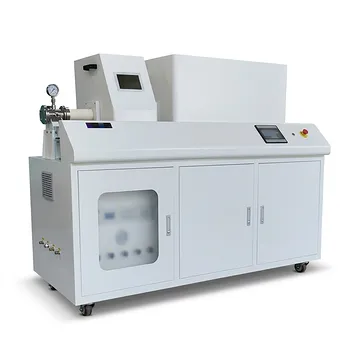
The electronically controlled tube furnace serves as the primary engine for material synthesis in Chemical Vapor Transport (CVT). For the growth of $MnTa_3S_6$ single crystals, the furnace establishes a precise, stable temperature gradient across a vacuum-sealed reaction tube, typically maintaining $1100^\circ C$ at the source end and $1000^\circ C$ at the growth end. This thermal differential provides the essential thermodynamic driving force that allows a transport agent to carry gaseous precursors to the cooler end, where they nucleate into high-quality hexagonal single crystals.
Core Takeaway: The tube furnace is the critical tool for controlling the thermodynamics of the CVT process; by maintaining a specific temperature gradient, it regulates the rate of chemical transport and ensures the structural integrity and morphology of the resulting $MnTa_3S_6$ crystals.
The Role of Temperature Gradients in CVT
Establishing the Thermodynamic Driving Force
The furnace creates a high-temperature "source" zone and a lower-temperature "growth" zone. This temperature difference generates a concentration gradient of vapor molecules within the sealed quartz tube.
In the case of $MnTa_3S_6$, the $100^\circ C$ delta between the ends of the tube forces the chemical equilibrium to shift. This shift compels the gaseous precursors to move from the hot zone toward the cooler zone to reach stability.
Facilitating Chemical Transport
At the source end ($1100^\circ C$), the raw materials react with a transport agent (such as iodine) to form volatile intermediate species. These species diffuse through the gas phase toward the growth end.
Upon reaching the $1000^\circ C$ zone, the intermediate species become unstable and decompose. This reaction releases the precursor components, which then deposit and crystallize onto the tube wall or a seed crystal.
Technical Precision and Process Control
Independent Zone Management
Modern electronically controlled furnaces often utilize multiple heating zones (dual-zone or three-zone) to manage the thermal profile. This allows researchers to independently tune the source and growth temperatures to optimize the gas-phase transport rate.
Precise electronic control ensures that the transition between these zones is sharp and predictable. This level of control is necessary to produce crystals with specific hexagonal morphology and uniform dimensions.
Stability Over Extended Periods
Single crystal growth is a slow process that can take anywhere from several days to weeks. The furnace must maintain thermal stability without fluctuation throughout this duration.
Even minor temperature swings can disrupt the crystallization process. Inconsistent heat can lead to defects in the crystal lattice or the formation of multiple small "parasitic" crystals rather than a single, large-sized crystal.
Understanding the Trade-offs and Pitfalls
Gradient Steepness vs. Crystal Quality
If the temperature gradient established by the furnace is too steep, the transport rate becomes too rapid. This often results in uncontrolled nucleation, leading to a cluster of small poly-crystals rather than a high-quality single crystal.
Conversely, if the gradient is too shallow, the driving force may be insufficient to move the precursors. This leads to extremely slow growth rates or a total failure of the crystallization process.
Contamination and Thermal Stress
Operating at high temperatures like $1100^\circ C$ puts significant stress on the reaction vessel (usually quartz). If the furnace cooling is not managed correctly, or if the temperature ramp-down is too fast, the resulting crystals may suffer from thermal cracking.
Furthermore, precise electronic calibration is required to prevent the "overshoot" of temperatures. Exceeding the target temperature can lead to unwanted secondary phases or the volatilization of impurities from the tube walls.
How to Optimize Furnace Settings for Your Project
The success of $MnTa_3S_6$ growth depends on aligning the furnace parameters with your specific research objectives.
- If your primary focus is crystal size: Maintain a slightly shallower temperature gradient and extend the reaction time to allow for slow, steady deposition on fewer nucleation sites.
- If your primary focus is crystalline purity: Use a multi-zone furnace to ensure a highly uniform temperature field in the growth zone, preventing the precipitation of secondary phases.
- If your primary focus is rapid screening: Utilize a steeper gradient to increase the transport rate, acknowledging that this may result in smaller or more defect-prone crystals.
Precise electronic regulation of the thermal environment remains the most decisive factor in transitioning from raw precursors to high-performance single crystals.
Summary Table:
| Key Feature | Role in CVT Process | Impact on MnTa3S6 Crystals |
|---|---|---|
| Temperature Gradient | Creates thermodynamic driving force | Transports precursors from source to growth zone |
| Multi-zone Control | Independently tunes thermal zones | Optimizes hexagonal morphology and crystal size |
| Thermal Stability | Maintains steady heat for days/weeks | Prevents lattice defects and parasitic nucleation |
| Electronic Precision | Regulates gas-phase transport rates | Ensures chemical purity and structural integrity |
Elevate Your Material Synthesis with KINTEK Precision
Achieving high-quality $MnTa_3S_6$ single crystals requires absolute thermal control. KINTEK specializes in advanced laboratory solutions, offering a comprehensive range of multi-zone tube furnaces, vacuum furnaces, and CVD/PECVD systems designed to maintain the rigorous temperature gradients essential for Chemical Vapor Transport (CVT).
Our expertise extends across the entire research workflow—from crushing and milling systems for precursor preparation to high-pressure reactors and essential consumables like crucibles and ceramics. Whether you are focused on crystal morphology or crystalline purity, KINTEK provides the reliability and precision your research demands.
Ready to optimize your growth process? Contact our technical experts today to find the perfect furnace solution for your laboratory.
References
- Yusei Miyagi, Yoshihiko Togawa. Presence of a chiral soliton lattice in the chiral helimagnet MnTa3S6. DOI: 10.1063/5.0171790
This article is also based on technical information from Kintek Solution Knowledge Base .
Related Products
- Customer Made Versatile CVD Tube Furnace Chemical Vapor Deposition Chamber System Equipment
- Split Chamber CVD Tube Furnace with Vacuum Station Chemical Vapor Deposition System Equipment Machine
- Multi Heating Zones CVD Tube Furnace Machine Chemical Vapor Deposition Chamber System Equipment
- Vertical Laboratory Tube Furnace
- Inclined Rotary Plasma Enhanced Chemical Vapor Deposition PECVD Equipment Tube Furnace Machine
People Also Ask
- What is a CVD tube furnace? A Complete Guide to Thin-Film Deposition
- What is the function of a high-temperature CVD tube furnace in 3D graphene foam prep? Master 3D Nanomaterial Growth
- How does a CVD tube furnace inhibit the sintering of silver supports? Boost Membrane Durability and Performance
- What is the function of a tube furnace in CVD SiC synthesis? Achieving Ultra-Pure Silicon Carbide Powders
- What is the difference between hot wall CVD and cold wall CVD? Choose the Right System for Your Process