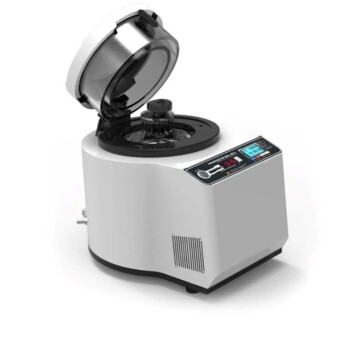
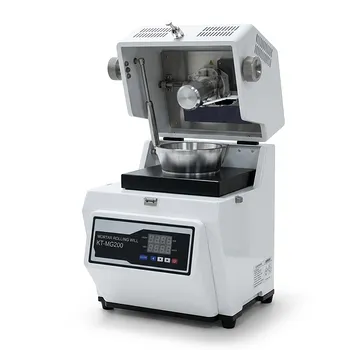
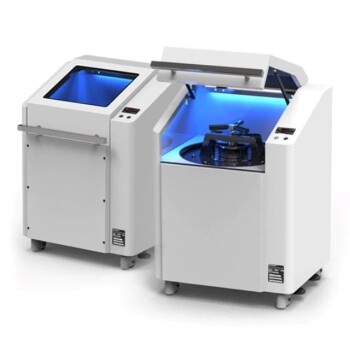
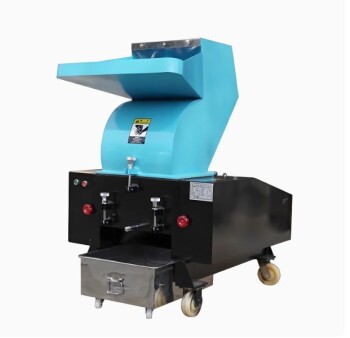
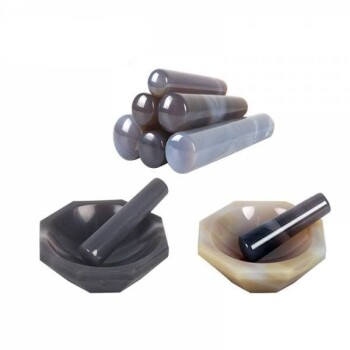
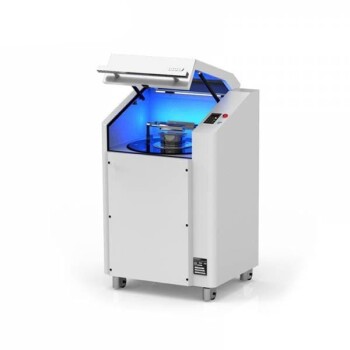
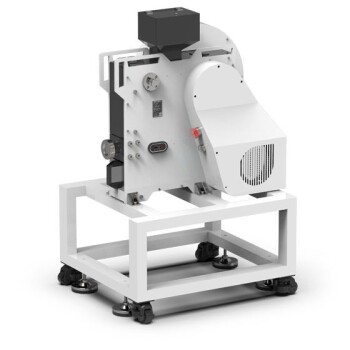
Grinding equipment functions as the critical physical preparation stage for lean coal and spent cathode carbon blocks (SCCBs), utilizing mechanical shear and impact forces to reduce raw materials to the micron level (specifically smaller than 0.125 mm). This precise reduction is not merely about size; it serves to drastically increase the specific surface area of the particles to ensure chemical homogeneity.
The ultimate goal of this grinding process is to create a physical foundation that guarantees the complete release of moisture and volatiles, thereby ensuring the accuracy and repeatability of subsequent combustion experimental data.
The Mechanics of Size Reduction
Achieving Micron-Level Fineness
The equipment employs mechanical shear and impact mechanisms to break down the physical structure of lean coal and SCCBs.
This aggressive mechanical processing reduces the materials from their raw state into fine particles. The target threshold for this process is specific: particles must be reduced to sizes smaller than 0.125 mm.
Increasing Specific Surface Area
The direct result of reducing particle size to the micron level is a significant increase in specific surface area.
By exposing more surface area per unit of mass, the material becomes more physically accessible for subsequent processing steps. This surface area expansion is the catalyst for effective chemical interaction and thermal response.
Enhancing Experimental Integrity
Facilitating Uniform Mixing
Lean coal and SCCBs are distinct materials that must act as a cohesive unit during experimentation.
The micron-level particles created by the grinding equipment allow for uniform mixing of these two components. Without this fine grinding, the mixture would remain heterogeneous, leading to inconsistent experimental results.
Ensuring Volatile Release
For accurate combustion analysis, the internal components of the material must be fully accessible.
Fine grinding ensures the complete release of moisture and volatiles trapped within the carbon matrix during combustion. Large particles often trap these elements, causing incomplete combustion and skewed data.
Improving Data Reliability
The cumulative effect of uniform mixing and complete volatile release is the stabilization of experimental outcomes.
By eliminating physical inconsistencies in the sample, the grinding process directly enhances the accuracy and repeatability of experimental data.
Understanding the Trade-offs
The Precision vs. Throughput Balance
While achieving a particle size smaller than 0.125 mm is essential for data accuracy, it requires significant mechanical energy.
Operators must recognize that achieving this level of fineness often demands lower throughput rates compared to coarser grinding (such as the 1 mm standard used for general waste like tire rubber).
The Risk of Inadequate Grinding
If the grinding equipment fails to reach the sub-0.125 mm threshold, the specific surface area will remain insufficient.
This failure leads to poor interfacial bonding and incomplete volatile release, rendering the resulting experimental data unreliable. There is no shortcut; the physical requirements for combustion accuracy are non-negotiable.
Making the Right Choice for Your Goal
To ensure your pre-treatment process yields valid scientific data, consider the following recommendations based on your specific objectives:
- If your primary focus is Experimental Accuracy: Ensure your equipment is calibrated to consistently produce particles smaller than 0.125 mm to guarantee data repeatability.
- If your primary focus is Mixture Homogeneity: Prioritize high-impact grinding to maximize specific surface area, which is the primary driver for uniform blending of coal and SCCBs.
Proper mechanical pre-treatment is the invisible variable that determines the validity of all subsequent combustion analysis.
Summary Table:
| Feature | Specification/Benefit | Impact on Pre-treatment |
|---|---|---|
| Target Particle Size | < 0.125 mm (Micron-level) | Ensures complete release of moisture and volatiles. |
| Mechanical Force | Shear and Impact | Efficiently breaks down dense carbon structures. |
| Surface Area | High Specific Surface Area | Enhances chemical homogeneity and interfacial bonding. |
| Mixing Quality | Uniform Homogeneity | Eliminates data skewing caused by heterogeneous samples. |
| Data Integrity | Repeatable Results | Provides the physical foundation for stable combustion data. |
Elevate Your Lab's Analytical Accuracy with KINTEK
Don't let inconsistent sample preparation compromise your research integrity. KINTEK specializes in precision laboratory equipment, offering high-performance crushing and milling systems and sieving equipment designed to meet the rigorous <0.125 mm standards required for lean coal and SCCB analysis.
From our robust high-temperature furnaces and vacuum reactors for combustion studies to our advanced pellet presses and homogenizers, we provide the end-to-end solutions your laboratory needs for success. Partner with KINTEK today to ensure every sample is perfectly prepared for repeatable, world-class data.
Contact KINTEK Today for a Tailored Equipment Consultation
References
- Jigang Zhang, Kuihua Han. Study on Slagging Characteristics of Co-Combustion of Meager Coal and Spent Cathode Carbon Block. DOI: 10.3390/en16020736
This article is also based on technical information from Kintek Solution Knowledge Base .
Related Products
- Three-dimensional electromagnetic sieving instrument
- Laboratory High Throughput Tissue Grinding Mill Grinder
- Vibrating Disc Mill Small Laboratory Grinding Machine
- Laboratory Grinding Mill Mortar Grinder for Sample Preparation
- Laboratory Ball Mill Jar Mill with Metal Alloy Grinding Jar and Balls
People Also Ask
- Why is sieving equipment essential for the classification of processed bio-activated carbon? Optimize Performance
- What are the limitations of sieving? Understanding the Constraints of Particle Size Analysis
- What are advantages and disadvantages of sieving method? A Guide to Reliable & Cost-Effective Particle Sizing
- How is sieving important? The Critical Role of Particle Size Analysis in Quality Control
- What is sieving and how does it work? A Guide to Accurate Particle Size Analysis