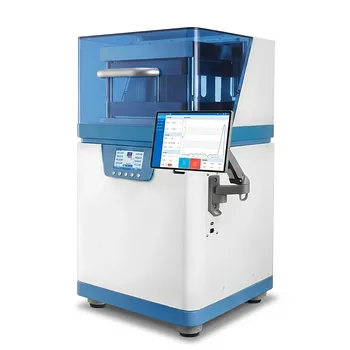
High-pressure reactors act as the critical thermodynamic engine in hydrothermal synthesis. These specialized vessels create a sealed, high-temperature environment that elevates internal pressure, allowing aqueous solutions to reach temperatures far exceeding their normal boiling points. This specific state is essential for increasing the solubility of precursors like zinc nitrate and nickel nitrate, driving the oriented growth necessary to form uniform Ni-doped ZnO nanowire arrays with controllable aspect ratios.
The high-pressure reactor enables precise control over solubility and crystal growth kinetics, transforming chemical precursors into highly ordered, doped nanowire structures that would be impossible to achieve under ambient atmospheric conditions.
Creating a Supercritical Reaction Environment
Elevating Boiling Points and Solubility
By providing a hermetically sealed environment, the reactor prevents solvent evaporation as temperatures rise. This allows the precursor solution to remain in a liquid state well above 100°C, significantly increasing the solubility and reactivity of the metallic salts.
Accelerating Reaction Kinetics
The combination of high pressure and temperature dramatically accelerates the chemical reaction rates within the aqueous medium. This kinetic boost ensures that the nickel dopants are effectively integrated into the zinc oxide crystal lattice, resulting in a homogeneous distribution of elements throughout the nanowire array.
Maintaining Stable Supersaturation
In systems using agents like hexamethylenetetramine (HMTA), the sealed reactor ensures the slow, steady decomposition of precursors. This creates a state of stable supersaturation, which provides a constant supply of nutrients to the growing nanostructures without the risk of solvent loss.
Mechanisms of Structural Control
Facilitating Oriented Growth
The pressurized environment is vital for directing the growth of crystals along specific crystallographic axes. In the case of ZnO, this facilitates oriented growth on substrates, allowing for the in-situ construction of vertical arrays that are firmly attached to the underlying material.
Ensuring High Crystallinity
The hydrothermal process promotes the formation of materials with a high degree of structural perfection. The controlled pressure environment minimizes defects during the nucleation phase, ensuring that the resulting Ni-doped ZnO nanowires possess high crystallinity and high specific surface areas.
Morphological Tailoring
Reactors allow researchers to manipulate the final shape of the nanomaterial, whether it be nanowires, nanopillars, or 2D nanosheets. By adjusting the internal temperature regimes and pressure levels, the aspect ratio and density of the nanowire arrays can be precisely tuned for specific applications like electrocatalysis.
Understanding the Trade-offs and Technical Constraints
The "Black Box" Limitation
One of the primary challenges of using high-pressure reactors is the inability to observe the reaction in real-time. Because the vessel must be thick-walled and opaque to withstand high pressures, researchers must rely on post-synthesis analysis to determine if the reaction parameters were optimal.
Safety and Pressure Management
Operating at high temperatures creates significant internal stress on the reactor hardware. Failure to properly calculate the filling degree of the solution can lead to over-pressurization, making rigorous safety protocols and pressure-relief mechanisms non-negotiable.
Scalability vs. Uniformity
While high-pressure reactors produce high-quality materials at a laboratory scale, maintaining thermal gradients and uniform stirring in larger vessels is difficult. Achieving the same level of nanowire uniformity in mass production remains a significant engineering hurdle.
Applying Reactor Control to Your Synthesis Goals
To achieve the best results in your hydrothermal synthesis project, you must align your reactor parameters with your specific material requirements.
- If your primary focus is high aspect ratio nanowires: Maintain a constant, lower temperature (e.g., 90°C) for a longer duration to ensure slow, steady oriented growth.
- If your primary focus is maximum dopant integration: Utilize higher temperatures within the reactor to increase the solubility and kinetic energy of the nickel precursors.
- If your primary focus is substrate adhesion: Ensure the reactor reaches pressure quickly to facilitate the direct and firm "self-assembly" of the precursor onto the substrate surface.
Mastering the high-pressure environment is the definitive step toward unlocking the full potential of advanced functional nanomaterials.
Summary Table:
| Function | Impact on Synthesis | Key Benefit |
|---|---|---|
| Solubility Enhancement | Increases reactivity of Ni and Zn salts | Homogeneous dopant distribution |
| Kinetic Acceleration | Speeds up chemical reaction rates | High crystallinity & structural perfection |
| Structural Orientation | Directs growth along crystallographic axes | Uniform vertical nanowire arrays |
| Morphological Tuning | Manipulates internal temperature regimes | Controllable aspect ratios & density |
Master Your Nanomaterial Synthesis with KINTEK Precision
Achieving the perfect Ni-doped ZnO nanowire array requires absolute control over your reaction environment. KINTEK specializes in high-performance laboratory equipment, offering a robust range of high-temperature high-pressure reactors and autoclaves designed to meet the rigorous demands of hydrothermal synthesis.
Our equipment ensures the stable supersaturation and precise thermodynamic control necessary for oriented crystal growth. Beyond reactors, KINTEK provides a comprehensive portfolio to support your entire workflow:
- Material Preparation: Crushing and milling systems for precursor uniformity.
- Thermal Processing: Muffle, vacuum, and tube furnaces for post-synthesis annealing.
- Essential Consumables: High-purity ceramics, crucibles, and PTFE products.
Ready to elevate your research outcomes? Contact our experts today to find the ideal reactor solution for your specific synthesis goals and experience the KINTEK advantage in laboratory reliability.
References
- Shaoyu Liu, Yingkai Liu. Enhanced H<sub>2</sub>S Gas-Sensing Performance of Ni-Doped ZnO Nanowire Arrays. DOI: 10.1021/acsomega.2c07092
This article is also based on technical information from Kintek Solution Knowledge Base .
Related Products
- Customizable Laboratory High Temperature High Pressure Reactors for Diverse Scientific Applications
- Customizable High Pressure Reactors for Advanced Scientific and Industrial Applications
- Stainless High Pressure Autoclave Reactor Laboratory Pressure Reactor
- Visual High-Pressure Reactor for In-Situ Observation
- Mini SS High Pressure Autoclave Reactor for Laboratory Use
People Also Ask
- How do high-pressure and high-temperature reactors ensure the effective treatment of lignocellulosic wastewater in WAO?
- What equipment is required for high-pressure high-temperature reactions? Master Extreme Chemistry Safely
- How do you control high pressure in a reactor? A Guide to Safe & Stable Operation
- How does initial oxygen pressure affect the wet oxidation of pharmaceutical sludge? Master Your Oxidation Depth
- Why is argon better than nitrogen for inert atmosphere? Ensure Absolute Reactivity & Stability