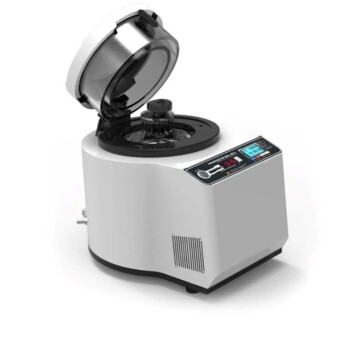
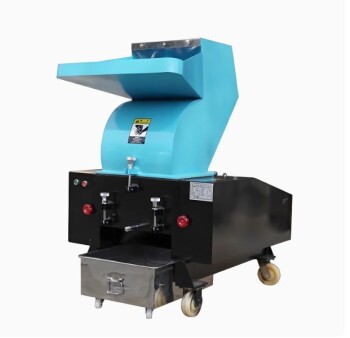
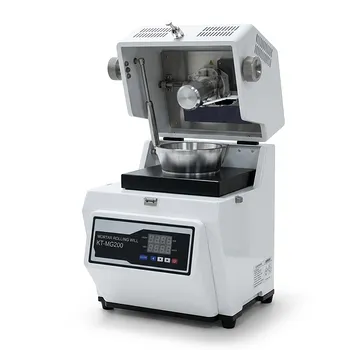
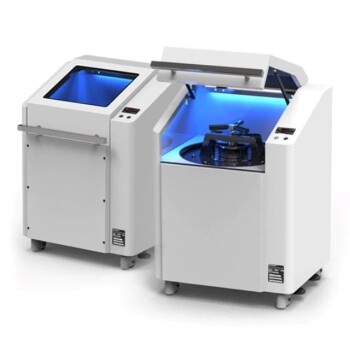
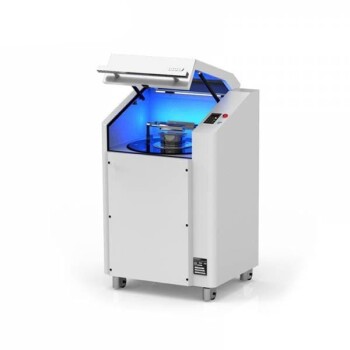
High-rate grinding equipment is the critical engine for surface area optimization in biomass processing. It pulverizes raw biomass into ultrafine powders to maximize the specific surface area, shorten ion diffusion paths, and ensure the deep penetration of chemical activators. This mechanical refinement is the foundational step that dictates the electrochemical capacity and structural uniformity of the final functionalized porous carbon.
By transforming macro-scale biomass into micron-level powders, high-rate grinding ensures that subsequent chemical and thermal treatments occur uniformly throughout the material matrix. This maximizes the internal accessibility of the carbon framework, leading to superior porosity and performance in energy storage or filtration applications.
Maximizing Chemical and Thermal Efficiency
Enhancing Specific Surface Area
Grinding breaks down the macroscopic physical structure of biomass, creating a massive increase in geometric surface area. This physical modification provides a necessary prerequisite for effective solvent penetration and uniform chemical bond breaking during subsequent reactions.
Ensuring Synchronous Chemical Activation
Finely ground powders ensure optimal physical contact and uniform mixing with activators such as potassium hydroxide (KOH). This allows chemical activation reactions to occur synchronously throughout the entire carbon framework, preventing localized under-activation.
Improving Heat Transfer During Pyrolysis
Smaller particles facilitate more uniform heat transfer when the material is heated in a furnace. By refining the particle size, the equipment ensures uniform carbonization of the biomass and prevents the formation of inconsistent carbon cores.
Optimizing Performance for End-Use Applications
Shortening Ion Diffusion Paths
In supercapacitor applications, ultrafine particles significantly reduce the distance ions must travel to reach active sites. This improvement leads to better ion accessibility and higher electrochemical capacity in the resulting electrodes.
Disrupting Recalcitrant Biomass Structures
Mechanical shear and impact forces lower the crystallinity of cellulose and disrupt the tight coating structure between lignin and hemicellulose. This physical pretreatment increases the reactivity of the substrate, making it more susceptible to chemical reagents or enzymes.
Enhancing Adsorption Rates
For environmental applications, such as wastewater treatment, grinding ensures the final adsorbent has a higher geometric specific surface area. This directly increases the capture rate of dye molecules, such as methylene blue, by providing more immediate contact sites.
Understanding the Trade-offs
Energy Intensity vs. Performance Gains
Achieving ultrafine particle sizes requires significant mechanical energy, which can increase the operational cost of production. Producers must balance the desired electrochemical performance against the energy overhead required for extended grinding cycles.
Risk of Particle Aggregation
While finer particles generally improve reactivity, extremely small powders can sometimes aggregate due to surface charge or moisture. This clumping can paradoxically hinder uniform mixing if the material is not stored or processed with appropriate anti-caking measures.
How to Apply This to Your Project
Guidelines for Process Selection
- If your primary focus is Supercapacitor Electrodes: Utilize high-rate grinding to achieve the smallest possible particle size to minimize ion diffusion resistance and maximize power density.
- If your primary focus is Industrial Adsorbents: Focus on achieving a uniform particle size (e.g., <0.12 mm) to ensure structural consistency and high capture rates in flow-through systems.
- If your primary focus is Scaling Production: Integrate grinding with selective screening and sieving to ensure only the necessary fraction is processed, thereby optimizing energy efficiency.
Mastering the mechanical refinement of biomass is the first and most vital step in unlocking the high-performance potential of functionalized porous carbons.
Summary Table:
| Key Function | Mechanism | Impact on Porous Carbon |
|---|---|---|
| Surface Area Optimization | Micron-level pulverization | Increases geometric area for faster solvent penetration |
| Chemical Activation | Uniform activator mixing | Ensures synchronous reactions and prevents under-activation |
| Thermal Efficiency | Refined particle sizing | Promotes uniform heat transfer and consistent carbonization |
| Electrochemical Gain | Shortened diffusion paths | Enhances ion accessibility and storage capacity |
Optimize Your Biomass Research with KINTEK
Unlock the full potential of your materials with KINTEK’s high-precision laboratory equipment. We offer a comprehensive range of crushing and milling systems to achieve perfect particle refinement, paired with advanced high-temperature furnaces (muffle, vacuum, CVD, and atmosphere) for precise carbonization and activation.
Whether you are developing next-generation supercapacitors or high-efficiency adsorbents, KINTEK provides the tools you need for structural uniformity and superior performance. Contact us today to find the ideal equipment solution for your lab!
References
- Dibyashree Shrestha. Applications of functionalized porous carbon from bio-waste of Alnus nepalensis in energy storage devices and industrial wastewater treatment. DOI: 10.1016/j.heliyon.2023.e21804
This article is also based on technical information from Kintek Solution Knowledge Base .
Related Products
- Laboratory High Throughput Tissue Grinding Mill Grinder
- High Energy Planetary Ball Mill Milling Machine for Laboratory
- High Energy Vibratory Laboratory Ball Mill Grinding Mill Single Tank Type
- High Energy Planetary Ball Mill Milling Machine for Laboratory
- High-Energy Omnidirectional Planetary Ball Mill Milling Machine for Laboratory
People Also Ask
- What is the purpose of using a laboratory grinder and standard sieves? Unlock Precise Rice Husk Pretreatment
- What is the purpose of using a laboratory grinder with specific mesh sieves for oat straw? Optimize Pellet Quality
- What is the role of laboratory-grade grinders and sieves in sample prep? Ensure High-Precision Corrosion Analysis
- How do laboratory grinders and standard sieving systems ensure the quality of feedstock for torrefaction?
- What does a grinder do in a laboratory? Achieve Homogeneous Sample Preparation for Accurate Analysis