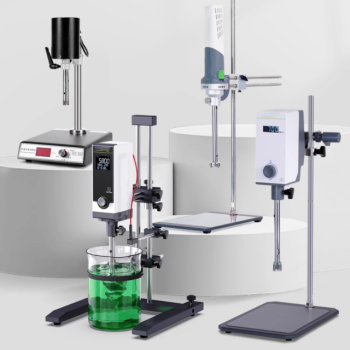
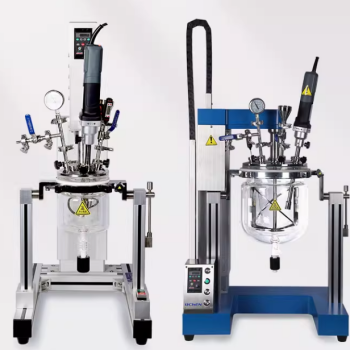
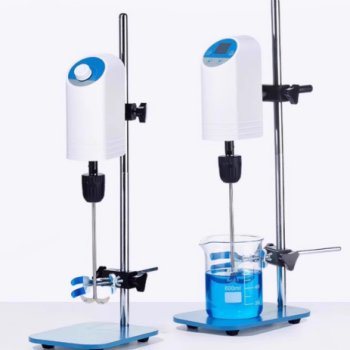
The primary function of high-shear mixers or homogenizers in geopolymer concrete is to mechanically force the integration of fly ash, aggregates, and alkaline activators (typically sodium hydroxide and sodium silicate). Unlike standard mixing, this high-energy process is required to physically break down the surface barriers of fly ash particles. This ensures the alkaline solution can make full contact with the aluminosilicate material, which is a prerequisite for the chemical reaction that hardens the concrete.
High-shear mixing is more than a blending step; it is a mechanical activation process that exposes reactive surfaces to the alkaline solution. This ensures a complete polymerization reaction, guaranteeing the slurry’s uniformity and the final product's structural strength.
The Mechanics of High-Energy Mixing
Breaking Surface Barriers
In geopolymer concrete, simply placing ingredients together is insufficient for a high-quality reaction. Fly ash particles often possess physical barriers on their surfaces that impede chemical bonding.
High-shear mixers apply intense mechanical force to shatter these barriers. This "unlocks" the particle, making the underlying material accessible for chemical activation.
Facilitating the Polymerization Reaction
The core of geopolymer strength lies in the polymerization reaction between the aluminosilicate source (fly ash) and the alkaline activators.
By stripping away surface inhibitors, the mixer ensures full contact between the liquid activator and the solid raw materials. This contact is the catalyst that allows the chemical reaction to proceed efficiently.
Impact on Material Properties
Achieving Slurry Uniformity
Consistency is critical in concrete production. High-shear homogenizers eliminate pockets of unmixed material, creating a perfectly uniform slurry.
This prevents "weak zones" within the concrete matrix where the activator failed to reach the aggregate or fly ash.
Ensuring Consistent Strength
The ultimate goal of using high-shear equipment is reliability in the hardened product.
Because the mixing process guarantees that the polymerization reaction occurs comprehensively throughout the mixture, the final concrete exhibits consistent strength. This reduces the variability often seen in batches mixed with low-energy equipment.
Understanding the Risks of Inadequate Mixing
Incomplete Chemical Reactions
If the mixing energy is too low, the physical barriers on the fly ash particles remain intact.
This leads to an incomplete reaction where portions of the raw material act as inert fillers rather than active binders, significantly reducing the load-bearing capacity of the concrete.
The Threat of Agglomeration
While the primary focus is on fly ash, the principles of dispersion apply broadly to particle integration.
Just as high-shear dispersion prevents nanoparticle agglomeration in advanced composites, it prevents the clumping of fine particles in concrete. Without this shear force, particle clusters can form, causing local stress concentrations and potential structural failure.
Making the Right Choice for Your Project
To maximize the quality of your geopolymer concrete, align your mixing protocol with your specific performance goals:
- If your primary focus is Maximum Structural Strength: Prioritize high-shear equipment capable of completely breaking down fly ash surface barriers to maximize the extent of the polymerization reaction.
- If your primary focus is Product Consistency: Focus on the homogenizing capabilities of the mixer to ensure the alkaline activator is distributed evenly, eliminating weak spots in the final cure.
Effective mixing is the bridge between raw ingredients and a chemically stable, high-performance geopolymer structure.
Summary Table:
| Mixing Feature | High-Shear Mixing | Standard Mixing |
|---|---|---|
| Primary Mechanism | Mechanical surface activation | Simple ingredient blending |
| Fly Ash Interaction | Breaks surface barriers for reaction | Surface remains largely intact |
| Slurry Consistency | Perfectly uniform; no weak zones | Potential for unmixed pockets |
| Chemical Reaction | Complete polymerization | Often incomplete / inefficient |
| Final Product | High load-bearing capacity | Variable structural strength |
Elevate Your Material Research with KINTEK Precision
Achieving the perfect geopolymer reaction requires more than just blending—it demands high-energy mechanical activation. KINTEK specializes in advanced laboratory equipment designed to meet the rigorous demands of material science.
Whether you are developing high-performance geopolymer concrete or advanced composites, our comprehensive range of homogenizers, high-shear mixers, crushing and milling systems, and hydraulic presses provides the reliability and precision your lab requires. From high-temperature furnaces for curing studies to PTFE consumables and ceramics, we offer the complete toolkit to ensure your research results are consistent and reproducible.
Ready to optimize your mixing process for superior structural strength? Contact KINTEK today to find the perfect solution for your lab!
References
- G. Saravanan, S. Kandasamy. Flyash Based Geopolymer Concrete – A State of t he Art Review. DOI: 10.25103/jestr.061.06
This article is also based on technical information from Kintek Solution Knowledge Base .
Related Products
- High Shear Homogenizer for Pharmaceutical and Cosmetic Applications
- High Performance Lab Homogenizer for Pharma Cosmetics and Food R&D
- Laboratory Disc Rotary Mixer for Efficient Sample Mixing and Homogenization
- Laboratory High Throughput Tissue Grinding Mill Grinder
- Lab Sterile Slapping Type Homogenizer for Tissue Mashing and Dispersing
People Also Ask
- Why Use a High Shear Homogenizer for Cathode Slurries? Optimize Double-Layer Solid-State Battery Production
- What is the function of high-shear dispersion equipment in corona-resistant nanocomposites? Elevate Your Insulation
- What is the necessity of using an industrial-grade high-shear homogenizer for biomass washing? Ensure Process Efficiency
- What are the advantages of using a high-shear homogenizer for BED/GMA coatings? Achieve Superior Nano-Dispersion
- What role does a high-shear homogenizer play in ODC catalyst suspensions? Unlock Superior Electrochemical Efficiency