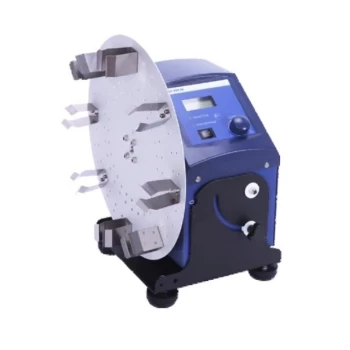
Extended homogenization is critical for achieving microscopic uniformity. In the production of forsterite-spinel ceramics, a rotary mechanical homogenizer is often operated for durations as long as 24 hours to intimately mix fly ash, active alumina, and magnesium-containing raw materials. This prolonged process ensures that the precursors are distributed evenly at the particle level, which is a prerequisite for successful chemical synthesis.
Because spinel synthesis relies on contact reactions between solid oxides, extended mechanical mixing is necessary to maximize the surface area of interaction. Without this microscopic homogeneity, the final ceramic will suffer from inconsistent mechanical properties and chemical instability.
The Mechanism of Synthesis
Facilitating Solid-State Reactions
The synthesis of spinel is not a liquid-phase reaction where ingredients mix naturally; it depends entirely on the contact reaction between aluminum oxides and magnesium oxides.
For this reaction to occur efficiently, the particles of the different raw materials must be physically adjacent to one another.
Maximizing Particle Interaction
A standard mix is insufficient because the reaction occurs at the interface of solid particles.
Extended mixing maximizes the contact points between the active alumina and magnesium sources, reducing the diffusion path required for the chemical reaction to complete during sintering.
Critical Outcomes of Uniformity
Preventing Local Phase Enrichment
Short mixing durations often result in "pockets" where one ingredient is more concentrated than the others.
By homogenizing for extended periods (e.g., 24 hours), you prevent local phase enrichment, ensuring that there are no isolated regions of unreacted material that could weaken the ceramic structure.
Ensuring Isotropic Properties
The goal of high-performance ceramics is to achieve isotropic mechanical properties, meaning the material is equally strong in all directions.
Microscopic uniformity ensures the internal structure is consistent throughout the bulk of the material, eliminating weak spots caused by poor particle distribution.
Guaranteeing Chemical Stability
A partially reacted ceramic is chemically unstable.
High-level mixing guarantees that the precursors react fully to form the desired crystal phases, resulting in superior chemical stability in the final product.
Understanding the Trade-offs
Process Efficiency vs. Material Quality
Running a rotary mechanical homogenizer for 24 hours represents a significant energy and time investment.
This creates a bottleneck in production throughput compared to standard mixing protocols. However, this cost is a necessary trade-off to achieve the requisite material performance for forsterite-spinel ceramics.
Equipment Wear and Contamination
Extended operation increases the wear on the homogenizer's mechanical components and lining.
Operators must monitor the equipment closely to prevent mechanical failure or the introduction of impurities from worn milling media into the ceramic mixture.
Making the Right Choice for Your Goal
When optimizing the preparation of ceramic precursors, the duration of mixing should be dictated by the performance requirements of the final application.
- If your primary focus is structural integrity: Prioritize extended mixing times to ensure isotropic mechanical properties and eliminate structural weak points.
- If your primary focus is reaction efficiency: Ensure the homogenization duration is sufficient to maximize particle contact, which drives the synthesis of the spinel phase.
Ultimately, the time invested in homogenization is the determining factor between a high-performance ceramic and an inconsistent material.
Summary Table:
| Feature | Impact of Extended Homogenization | Importance in Ceramic Synthesis |
|---|---|---|
| Particle Distribution | Achieves microscopic uniformity | Essential for solid-state contact reactions |
| Phase Consistency | Prevents local phase enrichment | Eliminates unreacted pockets and weak spots |
| Mechanical Performance | Ensures isotropic properties | Guarantees consistent strength in all directions |
| Chemical Stability | Maximizes spinel crystal formation | Results in a stable, high-performance final product |
| Diffusion Path | Minimizes distance between reactants | Increases reaction efficiency during sintering |
Elevate Your Material Synthesis with KINTEK
Precision in ceramic production begins with superior homogenization. KINTEK specializes in high-performance laboratory equipment designed to withstand the rigorous demands of extended processing. Whether you are synthesizing forsterite-spinel components or developing advanced alloys, our robust homogenizers, crushing and milling systems, and high-temperature furnaces provide the reliability you need for consistent results.
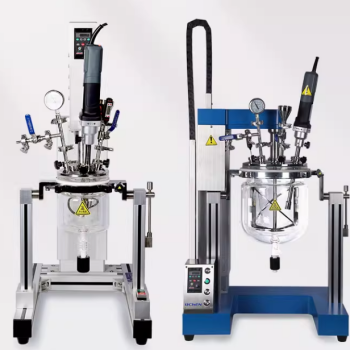
From rotary homogenizers and planetary ball mills to high-pressure reactors and sintering furnaces, we offer a comprehensive portfolio tailored for material science researchers and industrial manufacturers. Our equipment ensures microscopic uniformity, preventing local phase enrichment and guaranteeing the chemical stability of your final products.
Ready to optimize your lab's efficiency and material quality? Contact our technical experts today to find the perfect solution for your processing needs!
References
- Martin Nguyen, Radomír Sokolář. Corrosion Resistance of Novel Fly Ash-Based Forsterite-Spinel Refractory Ceramics. DOI: 10.3390/ma15041363
This article is also based on technical information from Kintek Solution Knowledge Base .
Related Products
- Laboratory Disc Rotary Mixer for Efficient Sample Mixing and Homogenization
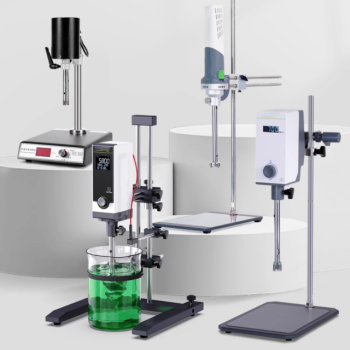
- High Shear Homogenizer for Pharmaceutical and Cosmetic Applications
- High Performance Lab Homogenizer for Pharma Cosmetics and Food R&D
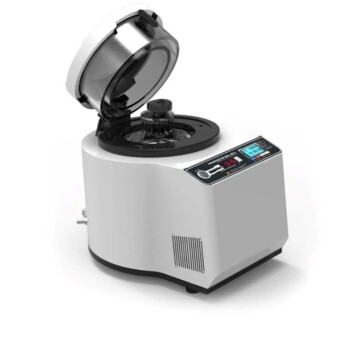
- Lab Sterile Slapping Type Homogenizer for Tissue Mashing and Dispersing
- Laboratory High Throughput Tissue Grinding Mill Grinder
People Also Ask
- What is a laboratory mixer used for? Choose the Right Tool for Liquids or Solids
- What is a laboratory mixer? A Guide to Achieving Perfect Sample Homogeneity
- What are laboratory mixers used for? Achieve Perfect Sample Homogeneity and Reliable Results
- How does a high-efficiency homogenizing mixer contribute to the preparation of Tobermorite and Xonotlite precursors?
- Why is precision mixing required for concrete corrosion studies? Ensure Data Integrity through Homogenization