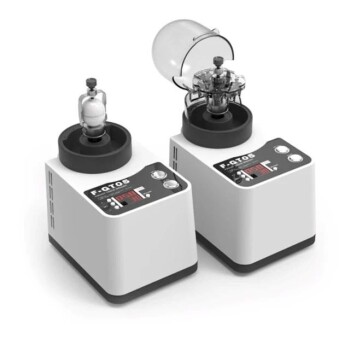
The primary function of laboratory fine grinding equipment, such as ball mills or centrifugal mills, is to mechanically reduce crushed Printed Circuit Board (PCB) fragments into a fine powder with particle sizes of 5–10 mm or smaller. This step serves as the critical interface between physical preparation and chemical extraction, transforming coarse waste into a state that is chemically reactive.
Core Insight: The efficiency of bioleaching is strictly limited by accessibility. Fine grinding solves this by maximizing the specific surface area of the material, ensuring that bioleaching agents can physically reach and react with the metals trapped inside the PCB structure.
The Mechanics of Material Preparation
Refining Coarse Fragments
The process begins with PCBs that have already been crushed, but these fragments are often too large for effective chemical processing.
Laboratory equipment like ball mills or centrifugal mills takes these coarse fragments and pulverizes them further. The target output is a powder consistency with a particle size range of 5–10 mm or smaller.
Liberating Encased Metals
PCBs are composite materials where metals are often layered between or encased in non-metallic substrates like plastics and ceramics.
Fine grinding acts as a liberation stage. By reducing the material to a powder, the equipment physically breaks apart these composite structures, exposing the metallic surfaces that were previously hidden inside the board's matrix.
Why Particle Size Drives Bioleaching Efficiency
Increasing Specific Surface Area
Bioleaching is a surface-dependent reaction; the more metal surface exposed to the liquid agent, the better the reaction.
Reducing particle size to the 5–10 mm range drastically increases the material's specific surface area. This provides a significantly larger "contact patch" for the bioleaching agents to work on, compared to larger, coarser fragments.
Removing Physical Barriers
The primary reference emphasizes that unground material presents physical barriers that block leaching agents.
Fine grinding systematically destroys these barriers. This ensures that the biological agents do not just wash over inert plastic surfaces but make direct contact with the target metals.
Enhancing Kinetics and Yield
The ultimate goal of this mechanical reduction is improved performance.
By fully exposing the metal components, the process achieves a substantially higher leaching rate. This directly translates to an improved recovery yield of precious metals, particularly gold, which requires direct contact with the lixiviant to dissolve.
Understanding the Operational Trade-offs
The Requirement for Specialized Equipment
Achieving a consistent 5–10 mm particle size from robust PCB material is difficult with standard crushers.
You must rely on high-energy grinding equipment, such as ball mills or centrifugal mills, to achieve the necessary reduction. Attempting to skip this step or use inadequate milling tools will result in larger particles that shield the metal from the bioleaching process.
Balancing Reduction and Accessibility
While the goal is "fine grinding," the target is a specific window (5–10 mm or smaller).
The objective is to grind the material enough to expose the metal, but the equipment must be capable of handling the heterogeneous mix of hard metals and soft plastics found in PCBs without failing or clogging.
Making the Right Choice for Your Goal
To maximize the efficiency of your bioleaching process, align your grinding strategy with your recovery targets:
- If your primary focus is process speed: Ensure your milling equipment consistently produces the smallest possible particle size within the target range to maximize reaction kinetics.
- If your primary focus is maximum gold recovery: Prioritize thorough milling that guarantees no metal remains encapsulated within the non-metallic substrate.
Fine grinding is not merely a sizing step; it is the mechanism that unlocks the material's potential for chemical recovery.
Summary Table:
| Feature | Function in Bioleaching Process | Key Benefit |
|---|---|---|
| Particle Size Reduction | Crushing fragments to 5–10 mm or smaller | Drastically increases specific surface area |
| Material Liberation | Breaking composite bonds (plastic/metal) | Exposes encased metals to leaching agents |
| Kinetic Enhancement | Removing physical barriers to reaction | Faster leaching rates and improved gold yield |
| Equipment Choice | Using Ball Mills or Centrifugal Mills | Ensures consistent powder for heterogeneous materials |
Revolutionize Your PCB Recycling Research with KINTEK
Maximize your bioleaching efficiency and recover precious metals with precision. KINTEK specializes in high-performance laboratory equipment tailored for the most demanding material preparation tasks. Whether you need robust crushing and milling systems to achieve a perfect 5–10 mm powder or advanced high-temperature reactors and autoclaves for subsequent chemical processing, we have the expertise to support your lab.
Our comprehensive range includes:
- Milling & Sieving: Precision ball mills and centrifugal mills for material liberation.
- Thermal Processing: Muffle, tube, and vacuum furnaces for metal refining.
- Hydraulic Presses: Pellet and isostatic presses for sample preparation.
- Lab Consumables: High-quality ceramics, crucibles, and PTFE products.
Ready to optimize your metal recovery yield? Contact our technical experts today to find the perfect grinding solution for your research!
References
- Zahra Ilkhani, Farid Aiouache. Bioleaching of Gold from Printed Circuit Boards: Potential Sustainability of Thiosulphate. DOI: 10.3390/recycling10030087
This article is also based on technical information from Kintek Solution Knowledge Base .
Related Products
- High-Energy Omnidirectional Planetary Ball Mill Milling Machine for Laboratory
- High-Energy Omnidirectional Planetary Ball Mill Machine for Laboratory
- Stainless Steel Laboratory Ball Mill for Dry Powder and Liquid with Ceramic Polyurethane Lining
- Laboratory Planetary Ball Mill Rotating Ball Milling Machine
- Hybrid High Energy Vibratory Ball Mill for Lab Use
People Also Ask
- How does a planetary ball mill solve mixing challenges with PEO? Unlock solid-state synthesis for insoluble dopants
- What is the role of a planetary ball mill in preparing doped high-nickel cathode materials? Enhance Battery Stability
- Why is a planetary ball mill used for LNMO precursor powders? Optimize Particle Uniformity & Battery Performance
- What is the function of a planetary ball mill in the solid-state synthesis of LiTa2PO8? Achieve High-Purity Electrolytes
- What is the critical role of a planetary ball mill in the processing of inorganic fillers? Enhance Battery Performance