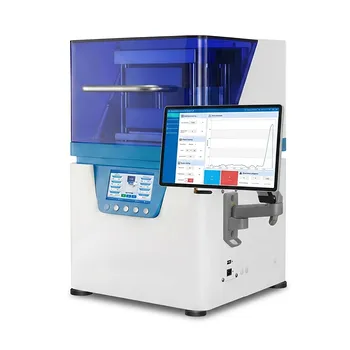
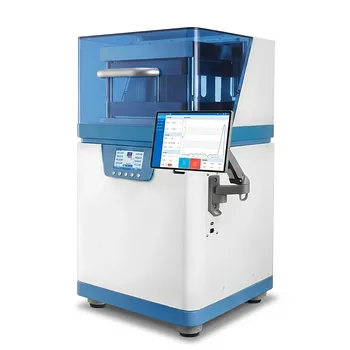
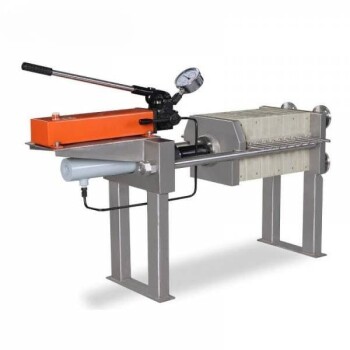
Laboratory hydraulic presses and electrode coating equipment are essential for converting raw g-C3N4/SrZrO3 catalyst powders into stable, conductive electrodes or pellets. These tools ensure the catalyst is uniformly applied to substrates like Indium Tin Oxide (ITO) glass or compressed into dense forms to minimize electrical resistance. Without this precise preparation, electrochemical measurements like transient photocurrent response would be plagued by noise and poor reproducibility.
Core Takeaway: The primary function of this equipment is to establish optimal mechanical and electrical contact between the g-C3N4/SrZrO3 catalyst and the testing apparatus. By ensuring uniform density and strong adhesion, these tools allow researchers to measure the material's intrinsic catalytic properties rather than artifacts caused by poor sample preparation.
Ensuring Uniformity and Adhesion via Precision Coating
Applying Uniform Catalyst Slurries
Electrode coating equipment, such as doctor blade coaters, is used to spread g-C3N4/SrZrO3 slurries onto conductive substrates like ITO or FTO glass. This process creates a thin, consistent layer that is necessary for even light absorption and consistent chemical reactions across the entire surface.
Facilitating Stable Photocurrent Signals
By providing a uniform layer, these tools ensure that transient photocurrent response signals remain stable during electrochemical testing. This is critical for g-C3N4/SrZrO3, as its performance relies heavily on the efficient movement of charge carriers from the catalyst to the conductive glass.
Removing Volatiles and Improving Durability
Following the coating process, samples undergo drying and calcination to remove organic solvents and improve mechanical adhesion. This prevents the catalyst from peeling off the substrate when it is submerged in electrolytes during testing.
Optimizing Charge Carrier Transport through Hydraulic Compression
Minimizing Contact Resistance
A laboratory hydraulic press applies high-precision vertical pressure to compress catalyst powders—often mixed with conductive carbon or binders—onto current collectors like nickel foam or steel mesh. This physical molding process eliminates internal voids and ensures excellent Ohmic contact, which drastically reduces interface resistance.
Improving Signal Intensity and Quality
For spectroscopic analysis, the press is used to create dense, cylindrical pellets that enhance the intensity of photoelectron signals. This high-density preparation makes the sample easier to mount and results in more representative data by increasing the concentration of the active material in the path of the probe.
Standardizing Particle Density
The press allows for the creation of pellets with uniform density and mechanical strength. This standardization is vital for comparing different batches of g-C3N4/SrZrO3, ensuring that variations in test results are due to the catalyst's chemistry rather than physical differences in how the powder was packed.
Maintaining Structural Integrity under Testing Conditions
Preventing Catalyst Degradation from Flow Friction
In evaluations involving continuous gas or liquid flow, such as Selective Catalytic Reduction (SCR), hydraulic presses provide the mechanical strength needed to prevent granule breakage. This ensures that the catalyst bed does not collapse or clog the reactor, which would otherwise cause erratic pressure drops.
Ensuring Fluid Dynamic Stability
By pressing and then sieving catalysts to a specific particle size (granulation), researchers prevent system back-pressure issues in micro-packed bed reactors. This stability is essential for obtaining accurate kinetic data during long-term performance evaluations.
Understanding the Trade-offs and Pitfalls
Pressure Sensitivity and Pore Blockage
While high pressure improves electrical contact, excessive force can crush the porous structure of g-C3N4/SrZrO3. If the pores are closed, the surface area available for the reaction decreases, leading to an underestimation of the catalyst's true activity.
Film Thickness vs. Mass Transport
Using coating equipment to create a film that is too thick can hinder charge carrier collection. While a thicker film might capture more light, the electrons generated deep within the layer may struggle to reach the conductive substrate, increasing recombination rates.
Practical Recommendations for Catalyst Evaluation
How to Apply This to Your Project
- If your primary focus is photoelectrochemical (PEC) testing: Utilize a doctor blade coater on ITO glass to ensure a thin, transparent, and uniform layer for optimal light penetration and charge collection.
- If your primary focus is Oxygen/Hydrogen Evolution (OER/HER): Use a manual hydraulic press (approx. 6 MPa) to compress the catalyst onto nickel foam to minimize contact resistance and ensure the stability of the electrode under gas evolution.
- If your primary focus is gas-phase continuous flow reactions: Employ a hydraulic press for granulation and sieving to create pellets that withstand gas flow friction and maintain a consistent pressure drop across the reactor.
Mastering these preparation techniques ensures that the observed performance of g-C3N4/SrZrO3 is a true reflection of its chemical potential.
Summary Table:
| Equipment | Primary Function | Research Benefit |
|---|---|---|
| Doctor Blade Coater | Applies uniform slurries to ITO/FTO substrates | Ensures stable photocurrent signals and even light absorption |
| Hydraulic Press | Compresses powders onto current collectors | Minimizes Ohmic contact resistance and optimizes charge transport |
| Drying/Calcination | Removes volatiles and strengthens adhesion | Prevents catalyst peeling and degradation during long-term testing |
| Granulation & Sieving | Standardizes particle density and size | Maintains fluid dynamic stability and prevents back-pressure in reactors |
Elevate Your Catalyst Research with KINTEK Precision
Achieve the highest level of accuracy in your g-C3N4/SrZrO3 evaluations with KINTEK’s specialized laboratory equipment. Whether you are developing thin-film electrodes for photoelectrochemical testing or high-density pellets for gas-phase reactions, our tools are engineered to deliver the uniformity and durability your research demands.
Our laboratory portfolio includes:
- High-Precision Hydraulic Presses: Manual and automatic systems for pelletizing and current collector integration.
- Advanced Coating Solutions: Doctor blade and specialized electrode coaters for uniform thin-film application.
- Thermal Processing: Muffle and tube furnaces for precise catalyst calcination and annealing.
- Material Preparation: Crushing, milling, and sieving systems for standardized particle granulation.
Don't let poor sample preparation mask your catalyst's true potential. Contact KINTEK today to discuss your specific application and find the perfect equipment to ensure your data is stable, reproducible, and publication-ready.
References
- Shizhao Si, Bo Tang. Visible Photocatalytic Hydrogen Evolution by g-C3N4/SrZrO3 Heterostructure Material. DOI: 10.3390/nano13060977
This article is also based on technical information from Kintek Solution Knowledge Base .
Related Products
- Laboratory Hydraulic Press Lab Pellet Press Machine for Glove Box
- Laboratory Hydraulic Press Split Electric Lab Pellet Press
- Fully Automatic Heated Hydraulic Lab Press for Materials Sintering and Sample Preparation
- Laboratory Hydraulic Press Lab Pellet Press for Button Battery
- Automatic Laboratory Hydraulic Press for XRF & KBR Pellet Press
People Also Ask
- What is the function of a laboratory hydraulic press in W-Cu composites? Control Porosity and Material Ratio
- What is the role of a laboratory hydraulic press in the initial stages of Li6PS5Cl preparation? Key to Green Pellets
- What role does a laboratory hydraulic press play in triboelectric testing? Achieve Precision Alloy Sample Prep
- How can a laboratory hydraulic press be applied to chitosan for wastewater treatment? Optimize Pores & Strength
- How do a precision laboratory hydraulic press and specialized molds contribute to the fabrication of spherical ceramic samples? Achieving High-Density Material Precision