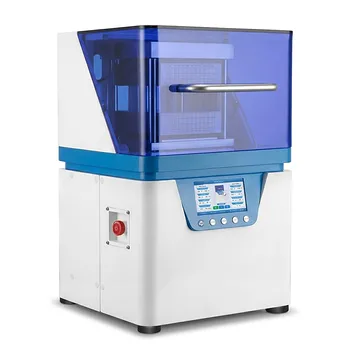
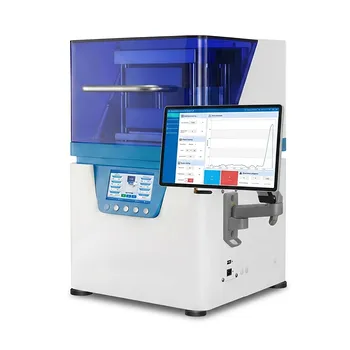
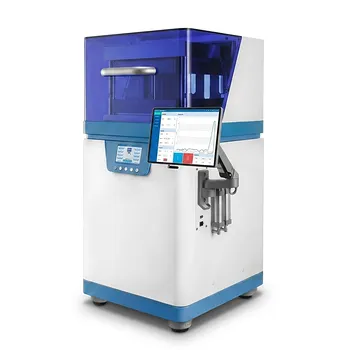
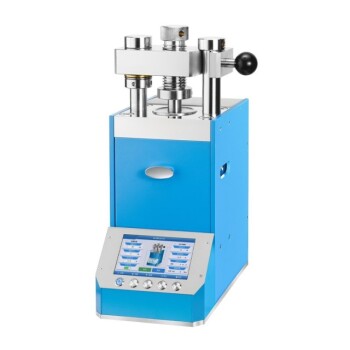
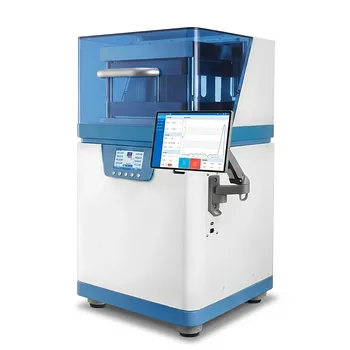
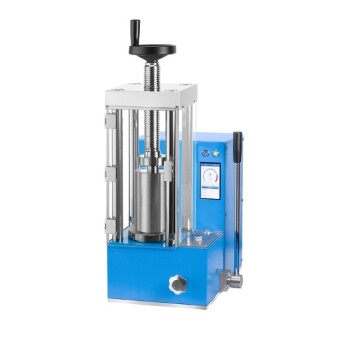
Laboratory pressing equipment serves as the critical bridge between loose metal powders and a stable metallurgical precursor. In the preparation of Ti-48Al-2Nb-0.7Cr-0.3Si alloy, this equipment performs high-pressure cold-pressing to transform mixed high-purity powders into a dense "green compact." This process ensures tight mechanical contact between particles, which is the essential physical requirement for uniform melting and efficient solid-state diffusion in subsequent processing stages.
The primary function of laboratory pressing equipment is to consolidate elemental or pre-alloyed powders into a structurally sound compact with controlled density. By establishing intimate particle-to-particle contact, the press facilitates the transition from a mechanical mixture to a chemically integrated alloy during melting or sintering.
Mechanical Consolidation and Particle Rearrangement
Establishing Intimate Particle Contact
The hydraulic press applies significant uniaxial pressure to force individual powder particles of Titanium, Aluminum, Niobium, Chromium, and Silicon into close proximity. This pressure helps the powder mass overcome internal friction, allowing particles to relocate and fill voids. The resulting mechanical interlocking is what gives the compact its initial structural integrity.
Inducing Plastic Deformation
As the pressure increases—often reaching levels between 500 MPa and 1500 MPa—the particles undergo localized plastic deformation at their contact points. This deformation is crucial for aluminum-based alloys, as it breaks down surface oxides and increases the effective contact area. Larger contact areas are vital for the thermal and chemical reactions that occur in later stages.
Creation of the "Green Body"
The equipment transforms loose, unmanageable powder into a green compact with a defined geometric shape, such as a flake or cylinder. This "green" state provides sufficient structural strength for the sample to be handled and transported to melting or sintering furnaces without crumbling. Without this step, achieving a homogenous melt in a vacuum arc furnace would be nearly impossible.
Facilitating Downstream Thermal Processing
Optimization for Vacuum Arc Melting
In the specific case of Ti-48Al-2Nb-0.7Cr-0.3Si, the press ensures the powder mixture is dense enough for efficient energy transfer during vacuum arc melting. Tight mechanical contact prevents the arc from "wandering" and ensures that all alloying elements melt at a uniform rate. This prevents localized chemistry imbalances in the final ingot.
Enabling Solid-State Diffusion
For processes involving sintering rather than melting, the laboratory press establishes the foundation for solid-state diffusion. By minimizing the distance between atoms across particle boundaries, the press enables the formation of sintering necks. These necks are the precursors to a fully densified, high-strength final component.
Precision Control of Porosity
Advanced laboratory presses allow researchers to manipulate the volume percentage of voids within a compact. By applying lower, controlled pressures, users can create porous structures (up to 60 vol% voids) to study specific material properties like thermal conductivity. This repeatability is essential for isolating the effects of microstructure on alloy performance.
Understanding the Trade-offs and Constraints
The Challenge of Density Gradients
One primary limitation of uniaxial pressing is the creation of internal density gradients. Friction between the powder and the die walls can lead to the "edge effect," where the center or bottom of the compact is less dense than the top. This can result in uneven shrinkage or warping during high-temperature sintering.
Risk of Tooling Contamination
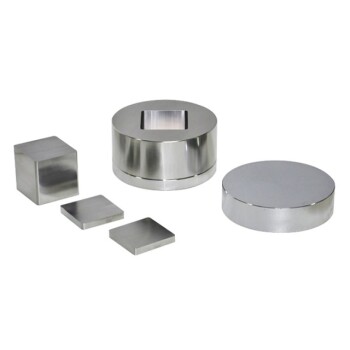
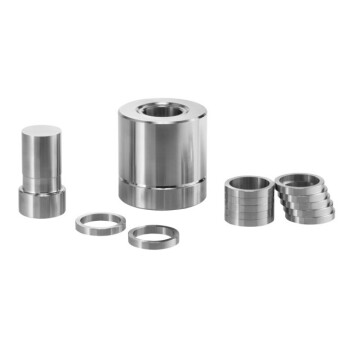
High-pressure compaction requires the use of steel dies, which can introduce trace impurities into the high-purity Ti-Al powder mixture. While lubricants can reduce friction and die wear, they must be completely removed (de-bound) before melting to avoid carbon or oxygen contamination, which embrittles titanium alloys.
Over-compaction and Lamination
Applying excessive pressure can lead to a phenomenon known as capping or lamination, where the compact cracks into horizontal layers upon release from the die. This occurs when the stored elastic energy in the particles exceeds the mechanical strength of the particle bonds. Finding the optimal pressure window is a critical balancing act for every specific alloy composition.
Making the Right Choice for Your Goal
How to Apply This to Your Project
Success in alloy preparation depends on aligning your pressing parameters with your ultimate manufacturing objective.
- If your primary focus is Vacuum Arc Melting: Use high pressure to maximize density and ensure the compact remains intact during the initial arc strike for a homogenous melt.
- If your primary focus is Solid-State Sintering: Prioritize a uniform pressure distribution and consider using bi-directional dies to minimize density gradients and ensure isotropic shrinkage.
- If your primary focus is Porosity Research: Utilize the manual control systems of the press to apply low, repeatable loads that intentionally retain a specific volume of interconnected voids.
The precision of the laboratory press is the foundation upon which the final mechanical properties of the Ti-48Al-2Nb-0.7Cr-0.3Si alloy are built.
Summary Table:
| Function | Key Mechanism | Benefit for Alloy Preparation |
|---|---|---|
| Mechanical Consolidation | High-pressure uniaxial force | Creates a stable "green body" for safe handling |
| Plastic Deformation | Breakdown of surface oxides | Increases contact area for better chemical reactions |
| Energy Transfer Prep | Tight particle interlocking | Ensures uniform melting rate in vacuum arc furnaces |
| Diffusion Facilitation | Minimizing atomic distance | Foundations for strong sintering neck formation |
| Porosity Management | Precise load control | Allows for research into specific thermal properties |
Elevate Your Material Research with KINTEK Precision
At KINTEK, we understand that the structural integrity of your Ti-48Al-2Nb-0.7Cr-0.3Si alloy starts with a perfect compact. Our industry-leading hydraulic presses—including pellet, hot, and isostatic systems—deliver the precise, repeatable pressure required to eliminate density gradients and ensure the highest quality "green bodies."
Beyond compaction, KINTEK offers a comprehensive ecosystem for advanced metallurgy, featuring:
- High-Temperature Furnaces: Muffle, vacuum, and induction melting systems for uniform heat treatment.
- Processing Tools: Crushing, milling, and sieving equipment for powder preparation.
- Specialized Labware: High-purity ceramics, crucibles, and PTFE products to prevent contamination.
Ready to achieve superior homogeneity and reliable research outcomes? Contact our technical experts today to find the perfect equipment solution for your laboratory’s unique requirements!
References
- Steven Magogodi, Charles W. Siyasiya. Hot corrosion effect of the vacuum arc melted (a<sub>2</sub>/γ)Ti-48Al-2Nb-0.7Cr-0.3Si alloy under an environment of NaCl-Na<sub>2</sub>SO<sub>4</sub> salt. DOI: 10.1051/matecconf/202338806007
This article is also based on technical information from Kintek Solution Knowledge Base .
Related Products
- Automatic Laboratory Hot Press Dual Plate Heating Sintering Compaction System 120x120mm
- Round Bidirectional Press Mold for Lab
- Fully Automatic Heated Hydraulic Lab Press for Materials Sintering and Sample Preparation
- Assemble Square Lab Press Mold for Laboratory Applications
- Metallographic Specimen Mounting Machine for Laboratory Materials and Analysis
People Also Ask
- What is the primary function of a laboratory hot press in MEA assembly? Optimize Fuel Cell Bonding & Performance
- What specific conditions does a laboratory hot press provide for the assembly of fuel cell MEA? Expert Bond Tips.
- What are the core advantages of using a laboratory hot press to produce Bi2Se3? Achieve 93% Density & High Conductivity
- How do a laboratory hydraulic hot press and standardized steel molds ensure the quality of WPC test specimens?
- How does a laboratory heating hydraulic press contribute to the preparation of recycled graphite green bodies? - Optimize Density.