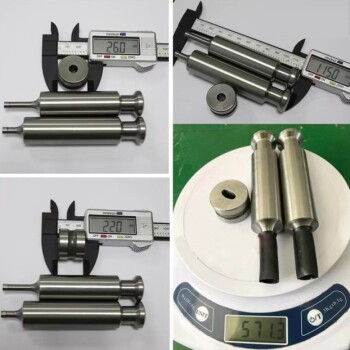
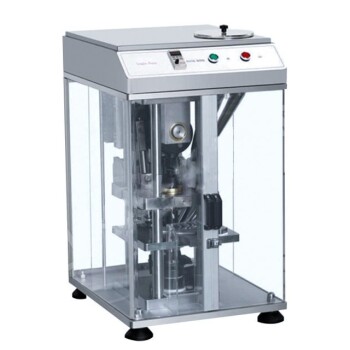
At its core, the pressed pellet technique is a materials processing method used to convert a loose powder into a dense, solid, and geometrically uniform disc, known as a pellet. This is achieved by confining the powder within a cylindrical die and compacting it under high pressure, typically using a hydraulic press. The result is a solid sample that is far easier to handle and analyze than the original powder.
The central challenge of the pressed pellet technique is not simply applying pressure, but managing the precise relationship between force, sample volume, and die geometry to create a flawless, uniform pellet without damaging the equipment.
Why Use the Pressed Pellet Technique?
This method is fundamental in many scientific and industrial fields because it solves the problem of working with powders. It standardizes the sample form for analysis and further processing.
Creating Homogeneous Samples for Analysis
For analytical techniques like FTIR (Fourier-transform infrared) spectroscopy or XRF (X-ray fluorescence), the sample must be uniform. A pressed pellet provides a consistent thickness and density, ensuring that the measurement is repeatable and representative of the bulk material.
In FTIR, for example, a sample powder is often mixed with a transparent salt like Potassium Bromide (KBr). Pressing this mixture creates a transparent pellet that allows the infrared beam to pass through with minimal scattering.
Improving Material Density and Handling
Loose powders are difficult to handle, measure, and transport. Compacting them into a solid pellet creates a durable, high-density form that is dimensionally stable and easy to manage.
Preparing Precursors for Sintering
In ceramics and powder metallurgy, "green bodies" are created by pressing powders into a desired shape. These pellets are dense but not fully bonded. They are then heated in a process called sintering to fuse the particles together into a final, robust part.
The Core Process: From Powder to Pellet
Creating a high-quality pellet requires careful attention to each step of the process, from initial material handling to the final application of force.
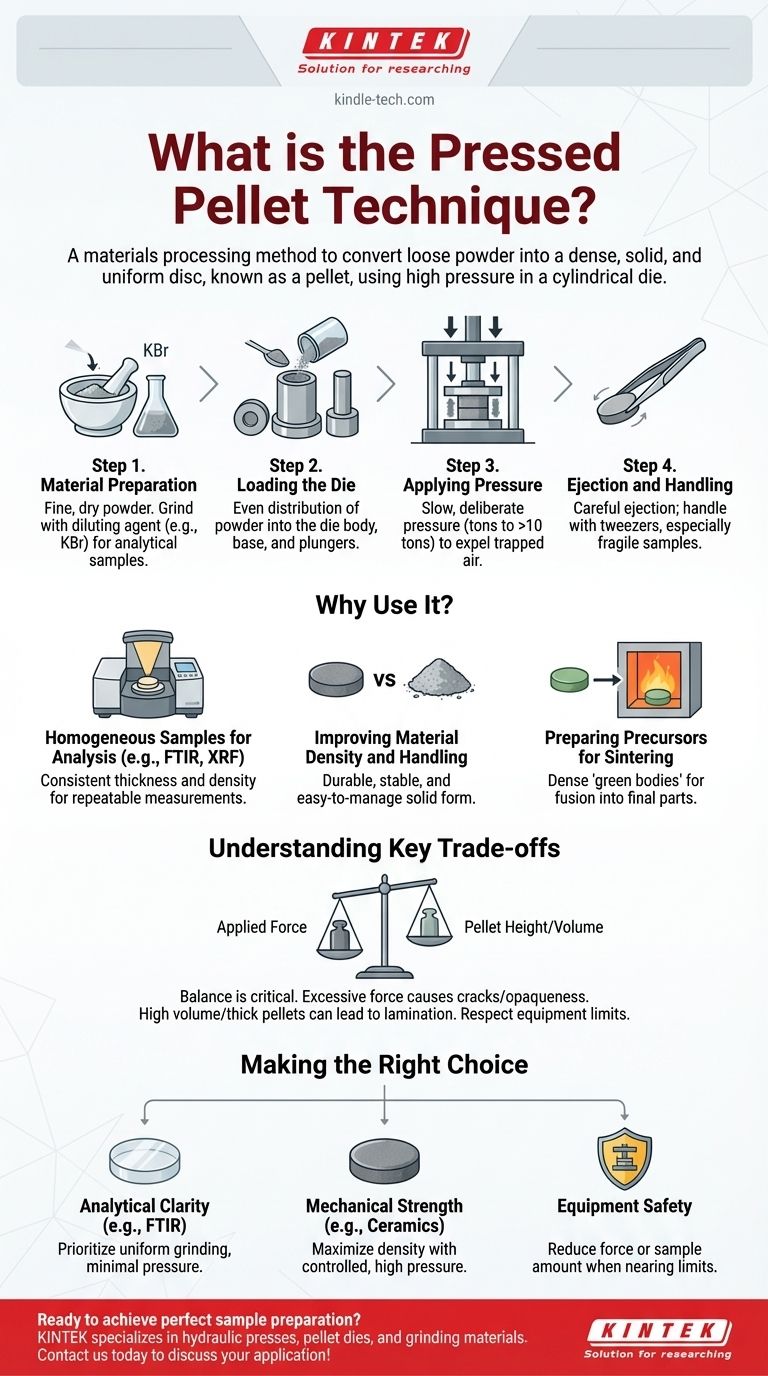
Step 1: Material Preparation
The starting powder must be extremely fine and dry. Any large particles or moisture can cause imperfections like cracks or cloudiness in the final pellet. For analytical pellets, this step often involves grinding the sample with a diluting agent (like KBr) in an agate mortar and pestle.
Step 2: Loading the Die
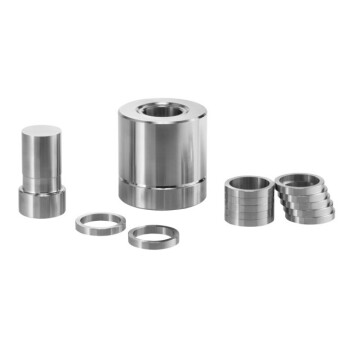
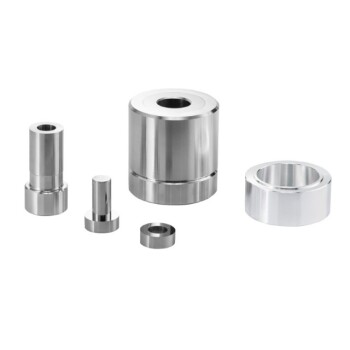
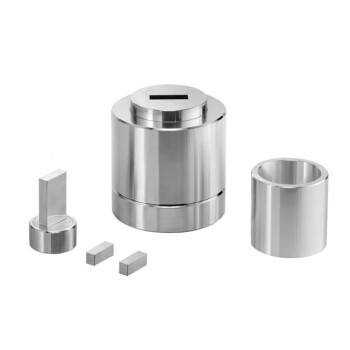
The powder is carefully loaded into the body of a pellet die, which consists of a base, a cylindrical body, and one or two plungers. Even distribution of the powder is critical to ensure the final pellet has uniform density.
Step 3: Applying Pressure
The loaded die is placed in a hydraulic press. Pressure is applied slowly and deliberately to allow trapped air to escape. The final pressure can range from a few tons to over ten tons, depending on the material and desired density.
Step 4: Ejection and Handling
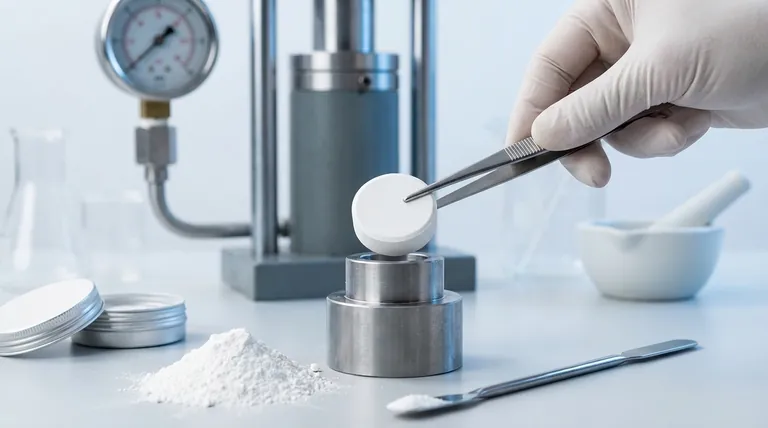
After releasing the pressure, the pellet is carefully ejected from the die. The finished pellet is often fragile and should be handled with tweezers, especially if it is intended for sensitive analysis.
Understanding the Key Trade-offs
Success with this technique hinges on balancing competing factors. The information from the reference highlights the most critical relationship: force versus sample volume.
The Impact of Applied Force
Applying sufficient force is necessary to compact the powder into a coherent, strong pellet. However, excessive force is a common mistake. It can lead to stress fractures within the pellet or, in the case of analytical pellets, create a sample that is too dense and opaque for analysis.
Managing Pellet Height and Volume
The amount of powder you use directly determines the final pellet's height. As you approach the recommended loading for a press or die set, you must manage this carefully. A very thick pellet under high force can concentrate stress and lead to lamination, where the pellet separates into layers.
This is why it is often necessary to reduce the force or reduce the pellet height when working near equipment limits. Using less powder or a shorter plunger ensures that the pressure is distributed effectively without exceeding the mechanical tolerances of the die.
Equipment Integrity and Safety
Pushing the equipment beyond its specified limits by using too much powder and too much force can cause catastrophic failure of the die set. The plungers or die body can crack, creating a significant safety hazard and a costly replacement.
Making the Right Choice for Your Goal
Your approach to the pressed pellet technique should be dictated by your final objective.
- If your primary focus is analytical clarity (e.g., FTIR): Prioritize uniform grinding and thorough mixing with KBr, and use just enough pressure to create a transparent, crack-free pellet.
- If your primary focus is mechanical strength (e.g., a ceramic green body): Concentrate on achieving maximum density by using controlled, high pressure and ensuring all trapped air is evacuated during the pressing stage.
- If your primary focus is equipment safety and longevity: Always respect the manufacturer's recommended loading limits and reduce either the applied force or the amount of sample powder (pellet height) if you are approaching them.
Ultimately, mastering this technique is an exercise in control, transforming a disorderly powder into a precisely engineered solid.
Summary Table:
| Aspect | Key Consideration |
|---|---|
| Primary Use | Sample standardization for analysis (FTIR, XRF) and creating precursors for sintering. |
| Core Process | Confine powder in a die; apply high pressure with a hydraulic press. |
| Critical Factor | Balance applied force with sample volume to avoid cracks or equipment damage. |
| Ideal For | Laboratories needing consistent, high-density samples from powders. |
Ready to achieve perfect sample preparation?
The pressed pellet technique is fundamental for reliable analytical results and material processing. KINTEK specializes in providing the high-quality lab equipment and consumables—including hydraulic presses, pellet dies, and grinding materials—you need to master this method.
Contact us today via our contact form to discuss your specific application. Our experts will help you select the right equipment to ensure your pellets are uniform, dense, and flawlessly prepared for accurate analysis and robust material synthesis.
Visual Guide
Related Products
- Automatic Laboratory Hydraulic Pellet Press Machine for Lab Use
- Laboratory Hydraulic Pellet Press for XRF KBR FTIR Lab Applications
- Laboratory Manual Hydraulic Pellet Press for Lab Use
- Laboratory Manual Hydraulic Pellet Press for Lab Use
- kbr pellet press 2t
People Also Ask
- How are laboratory pellet presses or rolling machines utilized in the preparation of LCO-LSLBO composite cathode sheets?
- Why is a laboratory hydraulic press used to compress powders into pellets? Enhance Solid-State Reaction Kinetics
- What is the significance of applying 200 MPa of pressure with a laboratory hydraulic pellet press for composite ceramics?
- Why is a laboratory hydraulic press used to process perovskite powders? Ensure High-Density Sintering Results
- What is the purpose of using a laboratory hydraulic press for powder compaction? Achieve Precise Pellet Densification