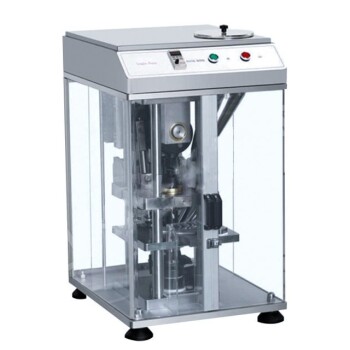
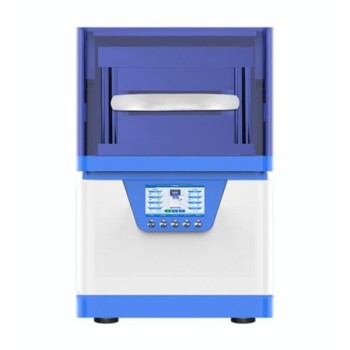
Laboratory pellet presses and rolling machines are the mechanical drivers responsible for transforming loose powder mixtures into functional, high-density electrode sheets. Specifically, they compress a blend of active materials, electrolytes, conductive agents, and binders into a thin, uniform composite layer, often targeting a precise thickness like 0.2 mm.
Core Takeaway These machines do more than just shape materials; they densify the composite structure to ensure intimate physical contact between active particles and the solid electrolyte. This contact is the defining factor for efficient lithium-ion transport and overall battery performance.
The Mechanics of Composite Preparation
Ingredient Integration
The process begins with a complex mixture rather than a single material. The equipment processes a blend of active materials (such as LCO), electrolyte powders (LSLBO), conductive agents, and PTFE binders.
Precision Forming
The primary function of the press or rolling machine is to flatten this heterogenous mixture into a cohesive sheet. Achieving a uniform thickness, such as the standard 0.2 mm, is essential for ensuring consistent electrochemical performance across the entire electrode area.
Controlling Electrode Density
Mechanical pressure is the tool used to control the density of the final component. By compressing the mixture, the machine minimizes void space and packs the material volume efficiently.
Why Compression Defines Performance
Ensuring Particle Contact
In solid-state composites, chemical reactions rely heavily on physical proximity. The rolling or pressing process ensures tight physical contact between the active material particles and the electrolyte particles.
Enabling Lithium-Ion Transport
This physical contact is not merely structural; it is functional. The interface created by compression is the pathway through which ions move.
Efficiency Implications
The quality of the mechanical compression directly impacts the efficiency of lithium-ion transport. A well-pressed sheet facilitates smooth ion flow, while a poorly compressed one creates resistance.
Understanding the Stakes
The Consequence of Low Density
If the press or rolling machine fails to apply sufficient pressure, the electrode density will remain low. This results in poor contact between particles, severing the pathways required for ion movement.
Precision vs. Performance
The thickness of the sheet must be uniform. Variations from the target 0.2 mm can lead to uneven current distribution, undermining the reliability of the composite cathode.
Optimizing the Fabrication Process
To ensure the highest quality LCO-LSLBO composite cathode sheets, consider the following goals:
- If your primary focus is Ion Conductivity: Prioritize compression settings that maximize physical contact to reduce interfacial resistance between particles.
- If your primary focus is Consistency: Ensure your equipment is calibrated to maintain a strict 0.2 mm thickness to guarantee uniform performance across the sheet.
The mechanical processing of the cathode sheet is not just a shaping step; it is the fundamental enabler of ionic mobility in the battery.
Summary Table:
| Process Step | Equipment Role | Impact on Performance |
|---|---|---|
| Ingredient Integration | Blending LCO, LSLBO, and PTFE | Ensures uniform material distribution |
| Precision Forming | Controlling thickness (e.g., 0.2 mm) | Guarantees consistent electrochemical area |
| Densification | High-pressure compression | Minimizes void space for better ion flow |
| Interface Creation | Particle-to-particle contact | Reduces interfacial resistance for ion transport |
Elevate Your Battery Research with KINTEK Precision
Achieving the perfect 0.2 mm thickness and optimal particle density requires laboratory equipment built for precision. KINTEK specializes in high-performance laboratory equipment and consumables, offering professional hydraulic pellet presses (pellet, hot, and isostatic) and advanced rolling systems specifically designed for battery material fabrication.
Whether you are developing next-generation LCO-LSLBO composites or optimizing solid-state electrolytes, our team provides the tools you need for superior ionic mobility. From high-temperature furnaces and crushing systems to battery research consumables and electrolytic cells, KINTEK is your partner in material science innovation.
Ready to optimize your electrode density? Contact KINTEK today for a customized solution!
Related Products
- Automatic Laboratory Hydraulic Pellet Press Machine for Lab Use
- Laboratory Hydraulic Pellet Press for XRF KBR FTIR Lab Applications
- Laboratory Manual Hydraulic Pellet Press for Lab Use
- Automatic Laboratory Hydraulic Press for XRF & KBR Pellet Press
- Laboratory Hydraulic Press Lab Pellet Press Machine for Glove Box
People Also Ask
- What is the role of a laboratory hydraulic pellet press and stainless steel molds in the fabrication of RuO2/NbC anodes?
- What role does a laboratory pellet press play in the enhancement of biomass energy products? Optimize Fuel Efficiency
- What is the purpose of using a laboratory pellet press when evaluating the electronic conductivity of carbon powders? Guide
- How does a laboratory hydraulic pellet press contribute to SiCw/2024 aluminum composite preforms? Optimize Densification
- What is the significance of applying 200 MPa of pressure with a laboratory hydraulic pellet press for composite ceramics?