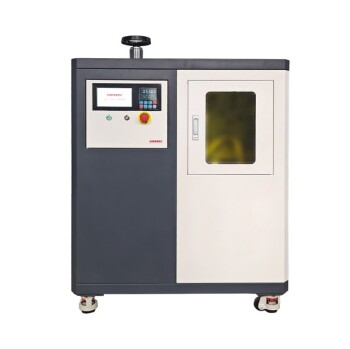
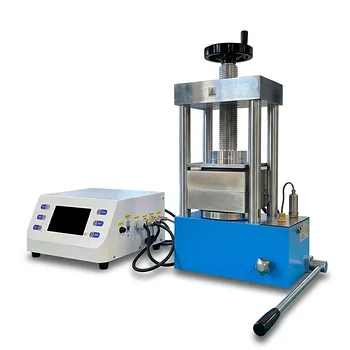
Cold Isostatic Pressing (CIP) functions as the critical structural foundation in the fabrication of high-performance ceramics, serving as a high-pressure pretreatment that maximizes particle packing before heat is ever applied. By subjecting the material to isotropic pressure of up to 230 MPa, CIP eliminates density gradients and forces ceramic powders into a highly uniform "green body," ensuring the structural integrity necessary for solid-state electrolytes.
The core value of CIP is not just shaping, but uniform densification. It bridges the gap between a loose powder and a solid ceramic, acting as the prerequisite for achieving high relative densities (up to 98%) and optimized ionic conductivity in the final product.
The Mechanics of Isotropic Densification
Applying Pressure from All Directions
Unlike standard pressing methods that apply force from a single direction, CIP utilizes isotropic pressure. This means the pressure is applied equally from every angle simultaneously, often through a liquid medium.
Maximizing Particle Packing
This multi-directional force causes the ceramic powder particles to rearrange and pack much more tightly than is possible with mechanical pressing alone. The result is a significant increase in the relative density of the green body (the object before it is fired/sintered).
Eliminating Structural Inconsistencies
Standard uniaxial pressing often leaves "density gradients"—areas where the powder is packed tighter in some spots than others. CIP eradicates these gradients, producing a component with consistent density throughout its entire volume.
Why CIP is Critical for HE-O-MIEC and LLZTO
Ensuring High Sintered Density
For materials like High-Entropy Mixed Ionic-Electronic Conductors (HE-O-MIEC), the density achieved during the green stage dictates the quality of the final product. A CIP-treated green body allows the material to reach extremely high relative densities, such as 98%, during the subsequent sintering phase.
Optimizing Ionic Conductivity
In solid-state electrolytes like LLZTO (Li7La3Zr2O12), performance depends on how easily ions can move through the material. Pores act as roadblocks to ion movement.
Reducing Internal Pores
By crushing internal voids during the green stage, CIP minimizes the number of pores and defects in the final sintered body. This creates a dense, continuous pathway for ions, directly facilitating the smooth ion movement required for efficient battery performance.
Understanding the Trade-offs
Two-Step Processing Requirement
CIP is rarely a standalone forming process for these materials. It typically requires the sample to be initially shaped via uniaxial pressing to establish its geometry before it can be subjected to isostatic pressure. This adds a step to the manufacturing workflow compared to single-stage pressing.
"Green" Limitations
While CIP significantly increases density, it produces a green body, not a finished ceramic. The material remains in a pre-sintered state; CIP cannot replace the thermal sintering process required to fuse the particles chemically and mechanically.
Making the Right Choice for Your Goal
When fabricating solid-state electrolytes, your processing choices should align with your performance targets.
- If your primary focus is maximum ionic conductivity: You must employ CIP to eliminate internal pores and density gradients, as these defects directly impede ion transport in LLZTO.
- If your primary focus is structural reliability: Use CIP to ensure the green body has uniform density, which prevents warping and cracking during the high-heat sintering of HE-O-MIEC.
By prioritizing density uniformity at the green stage, you guarantee the material properties required for high-performance energy storage.
Summary Table:
| Feature | Uniaxial Pressing | Cold Isostatic Pressing (CIP) |
|---|---|---|
| Pressure Direction | Single Direction (Unidirectional) | All Directions (Isotropic) |
| Density Uniformity | Low (Presence of gradients) | High (Uniform throughout) |
| Max Relative Density | Lower | Up to 98% (Post-sintering) |
| Internal Defects | Common (Voids/Pores) | Minimized (Eliminated voids) |
| Primary Role | Initial Shaping | Densification & Pre-treatment |
Elevate Your Material Research with KINTEK Precision
Unlock the full potential of your solid-state electrolytes and HE-O-MIEC ceramics with KINTEK’s industry-leading Cold Isostatic Presses (CIP). Our high-pressure systems are engineered to eliminate density gradients and maximize particle packing, ensuring your green bodies achieve the structural integrity and high ionic conductivity required for next-generation energy storage.
Beyond isostatic pressing, KINTEK offers a comprehensive suite of laboratory solutions tailored for advanced battery and materials science, including:
- High-Temperature Furnaces: Muffle, vacuum, and CVD systems for precision sintering.
- Sample Preparation: Hydraulic pellet presses, crushing and milling systems, and sieving equipment.
- Specialized Labware: PTFE products, ceramics, and high-purity crucibles.
Ready to optimize your fabrication workflow? Contact our technical experts today to find the perfect CIP solution or laboratory equipment for your specific research goals.
Related Products
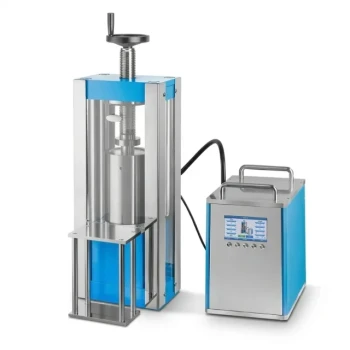
- Electric Split Lab Cold Isostatic Press CIP Machine for Cold Isostatic Pressing
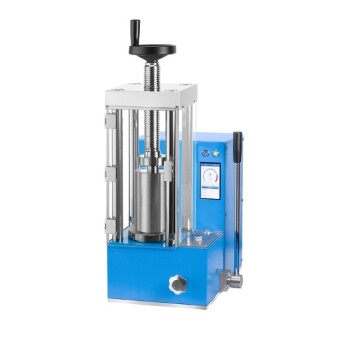
- Electric Lab Cold Isostatic Press CIP Machine for Cold Isostatic Pressing
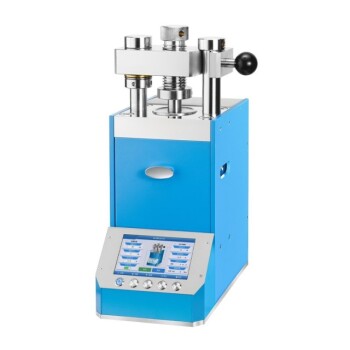
- Automatic Lab Cold Isostatic Press CIP Machine Cold Isostatic Pressing
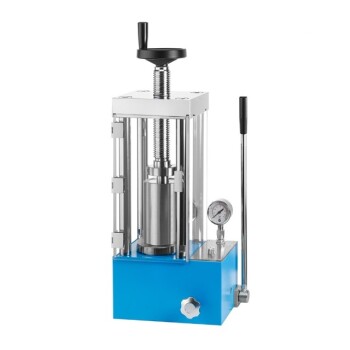
- Manual Cold Isostatic Pressing Machine CIP Pellet Press
- Warm Isostatic Press for Solid State Battery Research
People Also Ask
- How is isostatic pressing equipment utilized to integrate lithium metal anodes during solid-state battery assembly?
- How does isostatic pressing equipment enhance lithium metal anode contact? Optimize Your Solid-State Battery Assembly
- What is the meaning of isostatic pressing? Achieve Uniform Density in Complex Parts
- What is isostatic pressing method for ceramics? Achieve Uniform Density for Complex Parts
- What role does cold isostatic pressing play in the formation of feed rods for single crystal growth? Ensure Stability.