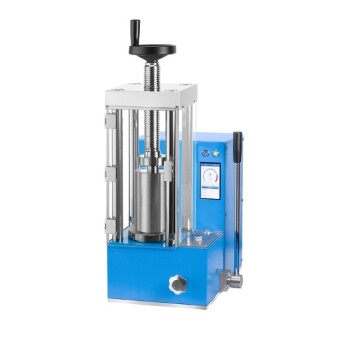
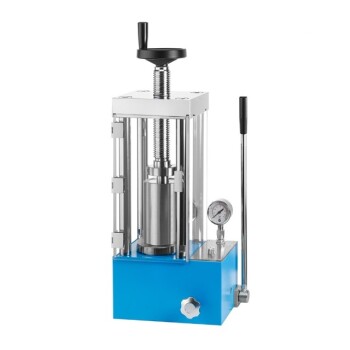
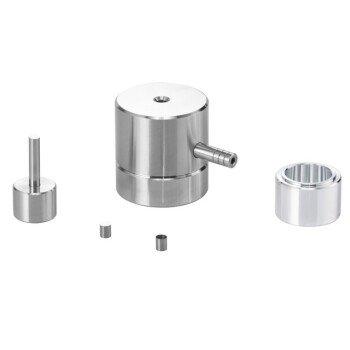
A cold isostatic press (CIP) functions as the critical densification step for TZC molybdenum alloy by converting loose powder mixtures into solid, cohesive forms. Through the application of isotropic pressure reaching 200 MPa at room temperature, the press compacts the material into a "green body" with an initial relative density of approximately 81% to 83%, ensuring it is structurally sound enough for handling and subsequent sintering.
Core Insight: The primary value of Cold Isostatic Pressing for TZC alloys is not just compression, but uniformity. Unlike directional pressing, CIP applies force equally from all sides, eliminating the internal density gradients that often lead to cracking or delamination during the final high-temperature sintering phase.
The Mechanics of Densification
Applying Isotropic Pressure
The defining characteristic of this process is the application of isotropic pressure, meaning force is applied equally from every direction.
For TZC molybdenum alloy, the system utilizes liquid pressure up to 200 MPa. This multi-directional force compresses the loose mixed powders far more effectively than standard uniaxial pressing, which only applies force from the top and bottom.
The Role of the Flexible Mold
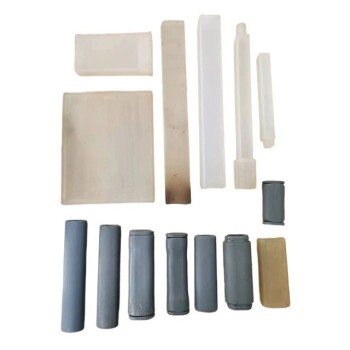
To achieve this uniform pressure, the alloy powder is placed inside a flexible mold sleeve.
This sleeve acts as both a carrier and a sealant. It isolates the powder from the liquid pressure medium while transferring the force uniformly to every surface of the powder. This ensures that the consolidation process is consistent across the entire geometry of the part.
Critical Improvements to Material Quality
Achieving Specific Relative Density
The immediate goal of the CIP process is to increase the material's density before heat treatment.
By compressing the pores between powder particles, the process achieves a green body relative density of 81% to 83%. Reaching this specific density threshold is vital; it provides the necessary mechanical strength to maintain the shape of the preform without crumbling.
Eliminating Structural Defects
In powder metallurgy, uneven density is a major cause of failure.
Because the flexible sleeve transfers pressure evenly, the green body avoids common defects such as delamination or uneven density distribution. This uniformity creates a homogeneous internal structure, which is a prerequisite for achieving a high-quality final product after sintering.
Understanding the Trade-offs
Green Body Limitations
It is important to recognize that the output of a CIP is a "green" body, not a finished part.
While the density is significantly improved (up to 83%), the material is not yet fully dense (which would be closer to 98-99% after sintering). The green body relies on mechanical interlocking of particles rather than atomic bonding, meaning it remains relatively fragile compared to the final sintered alloy.
Dimensional Tolerances
The use of flexible molds sacrifices some geometric precision compared to rigid die pressing.
While CIP is superior for density uniformity, the flexible nature of the mold means the final dimensions of the green body can vary slightly. Manufacturers must account for this shrinkage and variation when designing the initial mold.
Making the Right Choice for Your Goal
The use of Cold Isostatic Pressing is a strategic choice for high-performance alloys. Here is how to align this process with your specific objectives:
- If your primary focus is defect prevention: Rely on the flexible mold sleeve mechanism to eliminate density gradients and prevent delamination.
- If your primary focus is sintering preparation: Ensure you achieve the target relative density of 81-83% to minimize shrinkage and deformation during the heating stage.
Success in producing TZC molybdenum alloys relies on establishing a uniform, high-density foundation during the green body stage.
Summary Table:
| Feature | Specification/Detail |
|---|---|
| Pressure Applied | 200 MPa (Isotropic) |
| Processing Temp | Room Temperature |
| Green Body Density | 81% - 83% Relative Density |
| Mold Type | Flexible Sleeve (Isolates & Transfers Force) |
| Key Benefits | Uniform density, prevents delamination & cracking |
| Primary Output | Solid, cohesive "green" preform for sintering |
Elevate Your Material Performance with KINTEK
Precision in the "green body" stage is the foundation of high-performance TZC molybdenum alloys. KINTEK specializes in advanced laboratory equipment designed to meet the most rigorous powder metallurgy standards. From our high-performance isostatic presses (cold, hot, and isostatic) to our specialized high-temperature furnaces and sintering systems, we provide the end-to-end solutions your lab needs to achieve superior material density and structural integrity.
Our Expertise Includes:
- Hydraulic & Isostatic Presses: Reliable densification for pellet and preform production.
- Thermal Processing: Muffle, vacuum, and atmosphere furnaces for perfect sintering.
- Crushing & Milling: Precision systems to prepare your TZC powder mixtures.
Don't let internal defects compromise your research or production. Contact KINTEK today to discover how our comprehensive range of equipment and consumables can optimize your material workflows and deliver consistent, high-quality results.
Related Products
- Electric Split Lab Cold Isostatic Press CIP Machine for Cold Isostatic Pressing
- Electric Lab Cold Isostatic Press CIP Machine for Cold Isostatic Pressing
- Automatic Lab Cold Isostatic Press CIP Machine Cold Isostatic Pressing
- Manual Cold Isostatic Pressing Machine CIP Pellet Press
- Warm Isostatic Press for Solid State Battery Research
People Also Ask
- How is isostatic pressing equipment utilized to integrate lithium metal anodes during solid-state battery assembly?
- How does isostatic pressing equipment enhance lithium metal anode contact? Optimize Your Solid-State Battery Assembly
- What is the meaning of isostatic pressing? Achieve Uniform Density in Complex Parts
- What is isostatic pressing method for ceramics? Achieve Uniform Density for Complex Parts
- What role does cold isostatic pressing play in the formation of feed rods for single crystal growth? Ensure Stability.