The preferred status of a Cold Isostatic Press (CIP) in preparing sulfide solid electrolyte pellets is defined by its ability to apply ultra-high, isotropic pressure from all directions simultaneously. While a uniaxial hydraulic press applies force in a single direction—often creating density gradients and leaving inter-particle gaps—a CIP utilizes a liquid medium to ensure uniform compaction, resulting in maximized particle contact and minimized resistance to ion transport.
Core Takeaway To achieve the highest possible ionic conductivity, you must eliminate the internal voids and density variations that impede ion flow. CIP outperforms uniaxial pressing by applying omnidirectional pressure, which effectively erases these microstructural defects and minimizes grain boundary resistance.
The Mechanics of Densification
The Limitation of Uniaxial Pressing
A uniaxial hydraulic press compacts powder by applying force from a single vertical axis. While it can generate high pressures (e.g., 300 MPa), the friction between the powder and the die walls creates uneven stress distribution.
This often results in density gradients, where the edges or center of the pellet may remain less dense than the surfaces directly in contact with the piston.
The Advantage of Isotropic Pressure
In contrast, a Cold Isostatic Press (CIP) submerges the sample in a liquid medium to apply pressure (e.g., 370 MPa) evenly from every angle. This is known as isotropic pressure distribution.
Because the force is equal on all sides, the powder particles are rearranged and compressed much more efficiently. This eliminates the "shadowing" effects seen in uniaxial pressing, where some particles protect others from the full force of the press.
Impact on Electrochemical Performance
Eliminating Particle Gaps
The primary barrier to high ionic conductivity in solid electrolytes is the presence of physical gaps between powder particles. These voids act as insulators, forcing ions to take longer, more tortuous paths through the material.
CIP is significantly more effective at crushing these voids. By forcing particles into intimate contact from all sides, the "green density" (density before any potential sintering) is maximized.
Reducing Grain Boundary Resistance
Ionic conductivity is heavily influenced by how easily ions can cross from one crystal grain to another (grain boundaries).
The uniform ultra-high pressure of CIP tightens these boundaries. This reduction in internal defects lowers the ion transport resistance, allowing the test results to reflect the material's true intrinsic properties rather than the quality of its fabrication.
Understanding the Trade-offs
Process Complexity vs. Performance
While CIP yields superior conductivity, it is inherently more complex than uniaxial pressing. It requires liquid media (often water or oil) and flexible molds, whereas a uniaxial press simply requires a steel die and a piston.
The Hybrid Approach
It is common practice to use a uniaxial press first to form the loose powder into a cohesive disc shape. This "pre-forming" step provides the necessary geometric form.
The CIP is then used as a secondary treatment to optimize the density of that pre-formed disc. Relying solely on uniaxial pressing is faster but will likely result in lower measured conductivity due to inferior particle contact.
Making the Right Choice for Your Goal
When designing your fabrication protocol, consider the specific requirements of your experiment:
- If your primary focus is maximum ionic conductivity: You must use CIP (or CIP following uniaxial pressing) to ensure the pellet is as dense and defect-free as possible.
- If your primary focus is high-throughput screening: A uniaxial press provides a faster, reproducible way to create pellets, though the conductivity values may be slightly lower than the material's theoretical maximum.
Ultimately, CIP is preferred because it creates a mechanically uniform path for ions, ensuring the performance limit is defined by the chemistry, not the porosity.
Summary Table:
| Feature | Uniaxial Hydraulic Press | Cold Isostatic Press (CIP) |
|---|---|---|
| Pressure Direction | Single axis (vertical) | Isotropic (all directions) |
| Pressure Medium | Steel die and piston | Liquid (water or oil) |
| Density Uniformity | Low (prone to density gradients) | High (uniform compaction) |
| Particle Contact | Leaves inter-particle gaps | Maximizes intimate contact |
| Conductivity Result | Lower (due to grain resistance) | Maximum (intrinsic performance) |
| Process Complexity | Low / Fast | Moderate / Secondary process |
Elevate Your Battery Research with KINTEK Precision
Achieving theoretical ionic conductivity requires equipment that eliminates microstructural defects. KINTEK specializes in advanced laboratory solutions, including high-performance Cold Isostatic Presses (CIP) and uniaxial hydraulic presses designed for the rigors of sulfide electrolyte fabrication.
From high-pressure reactors to specialized battery research tools, our equipment ensures your materials reach their maximum potential. Contact KINTEK today to discuss how our CIP systems and crushing and milling solutions can optimize your lab's workflow and research results.
Related Products
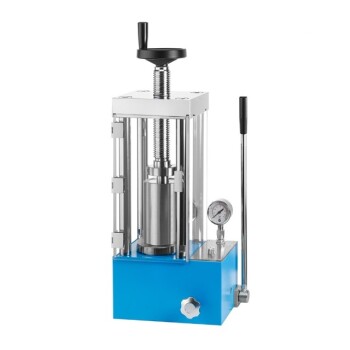
- Manual Cold Isostatic Pressing Machine CIP Pellet Press
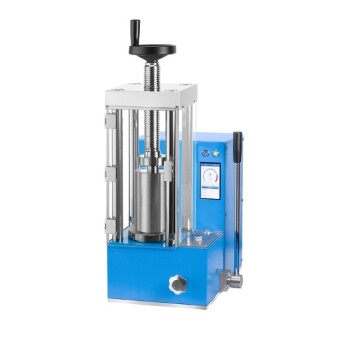
- Electric Lab Cold Isostatic Press CIP Machine for Cold Isostatic Pressing
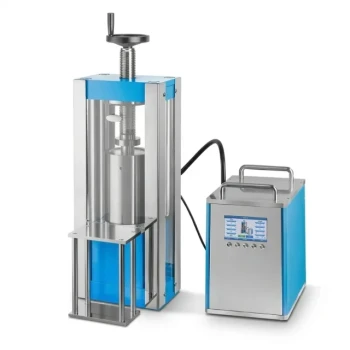
- Electric Split Lab Cold Isostatic Press CIP Machine for Cold Isostatic Pressing
- kbr pellet press 2t
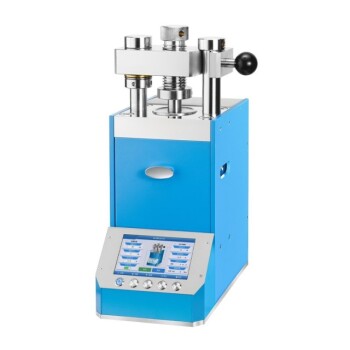
- Automatic Lab Cold Isostatic Press CIP Machine Cold Isostatic Pressing
People Also Ask
- What is isostatic pressing method for ceramics? Achieve Uniform Density for Complex Parts
- What is an isostatic press used for? Achieve Uniform Density & Eliminate Defects
- What role does cold isostatic pressing play in the formation of feed rods for single crystal growth? Ensure Stability.
- What is the process of isostatic press? Achieve Uniform Density and Complex Shapes
- Why does the use of an isostatic press for LSGM green bodies lead to a reduction in sintering temperature? Enhance Density