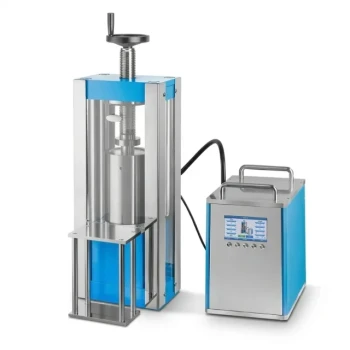
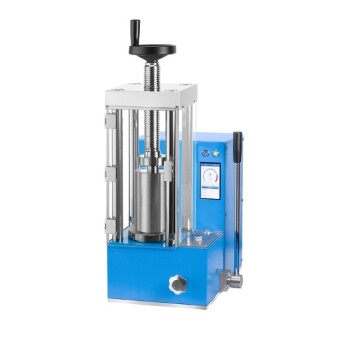
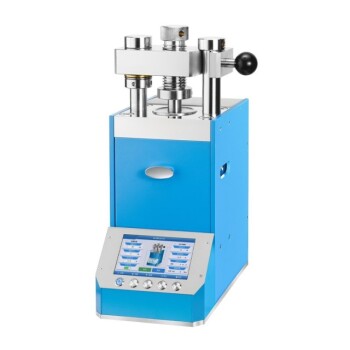
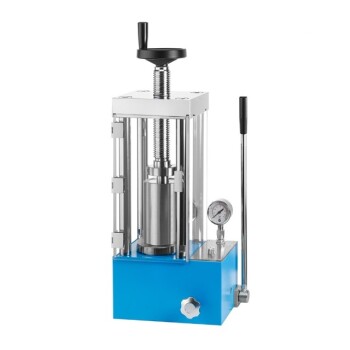
The role of a Cold Isostatic Press (CIP) in the fabrication of carbon-based perovskite solar cells (C-PSCs) is to physically laminate pre-coated carbon/silver bilayer electrodes onto the hole transport layer (HTL). By applying uniform omnidirectional pressure of up to 380 MPa via a liquid medium, typically water, the CIP process establishes a robust physical interface without the need for heat or chemical solvents.
Core Takeaway: CIP technology creates a high-performance electrode interface comparable to vacuum-evaporated gold, but it achieves this mechanically rather than thermally. This preserves the sensitive perovskite layers from heat degradation, directly leading to significantly enhanced power conversion efficiency (PCE).
The Mechanics of Pressure-Based Lamination
The Cold Isostatic Press operates on a principle distinct from standard mechanical presses. Understanding this mechanism is key to understanding why it is effective for delicate solar cell structures.
Uniform Omnidirectional Force
Unlike uniaxial presses that apply force from a single direction, a CIP utilizes a liquid medium to transmit pressure equally from all directions.
This ensures that the carbon/silver electrode material is compacted uniformly onto the underlying transport layer. The "wet-bag" technique typically involves sealing the components in an elastomeric tool before submerging them in the pressure vessel, ensuring the pressure is applied evenly across complex geometries.
Elimination of Thermal Stress
The defining characteristic of this process is the absence of heat.
Traditional sintering or annealing processes often require high temperatures that can degrade perovskite functional layers. CIP achieves the necessary density and adhesion purely through hydraulic force, keeping the process at ambient temperature and protecting the device's structural integrity.
enhancing Device Performance
The primary motivation for employing CIP in C-PSCs is to maximize the electrical output of the device by optimizing the internal interfaces.
Creating a Seamless Interface
The extreme pressure (up to 380 MPa) forces the electrode materials into intimate contact with the HTL.
This results in a seamless physical interface that facilitates efficient charge transfer. The quality of this contact is substantial enough to rival expensive vacuum-evaporated gold electrodes, offering a high-performance alternative using lower-cost materials.
Preventing Solvent Damage
Many alternative lamination methods rely on solvents to bond layers.
Solvents can chemically attack or dissolve the underlying perovskite layers, reducing the cell's lifespan and efficiency. Because CIP is a dry, mechanical process (regarding the internal components), it eliminates the risk of solvent-induced degradation.
Operational Considerations and Trade-offs
While CIP offers superior interface quality for C-PSCs, the nature of the equipment introduces specific operational constraints.
Multi-Stage Processing
CIP is generally a batch process rather than a continuous one.
It involves several distinct stages: tool creation, sealing, pressurization, dwell time, depressurization, and extraction. This multi-step cycle can increase production lead times compared to faster, continuous manufacturing methods like roll-to-roll printing.
Tooling Limitations
The process relies on flexible elastomeric molds or bags to transmit pressure.
These molds are subject to abrasive wear and have a finite lifespan. Furthermore, dimensional control in isostatic pressing is generally less precise than rigid die compaction, which may require careful calibration of the pre-lamination assembly to ensure the final layers align correctly.
Strategic Application for Solar Fabrication
To determine if CIP is the correct solution for your specific solar cell architecture, consider your production priorities.
- If your primary focus is Maximum Efficiency: CIP is highly recommended because it creates the tightest possible electrode interface without thermally degrading the perovskite absorber.
- If your primary focus is Material Cost Reduction: CIP allows for the use of carbon/silver electrodes, which are significantly cheaper than gold, without sacrificing the interface quality usually associated with precious metals.
- If your primary focus is High-Throughput Manufacturing: You must weigh the efficiency gains against the slower, multi-stage batch nature of the CIP process compared to continuous lamination techniques.
By substituting thermal energy with hydraulic force, CIP allows for the creation of high-efficiency, robust solar cells using cost-effective materials.
Summary Table:
| Feature | CIP Lamination Impact | Benefit to C-PSCs |
|---|---|---|
| Pressure Method | Uniform Omnidirectional (up to 380 MPa) | Eliminates voids and ensures seamless interface |
| Thermal Profile | Ambient Temperature Processing | Prevents thermal degradation of perovskite layers |
| Interface Quality | Robust Physical Bonding | Matches performance of vacuum-evaporated gold |
| Chemical Impact | Solvent-Free Mechanical Process | Avoids chemical attack on underlying functional layers |
| Material Compatibility | Carbon/Silver Bilayer Electrodes | Enables high efficiency with cost-effective materials |
Maximize Your Solar Research with KINTEK Precision Engineering
Are you looking to bridge the gap between cost-efficiency and high power conversion efficiency (PCE)? KINTEK specializes in advanced laboratory equipment designed for the most demanding material science applications. Our industry-leading Cold Isostatic Presses (CIP) and isostatic pressing solutions provide the uniform pressure needed to create flawless electrode interfaces without damaging sensitive perovskite structures.
Beyond isostatic pressing, KINTEK offers a comprehensive range of hydraulic presses (pellet, hot, isostatic), high-temperature furnaces, and battery research tools to support your entire fabrication workflow.
Ready to elevate your solar cell performance? Contact our technical experts today to find the perfect pressing solution for your lab's specific needs.
Related Products
- Electric Split Lab Cold Isostatic Press CIP Machine for Cold Isostatic Pressing
- Electric Lab Cold Isostatic Press CIP Machine for Cold Isostatic Pressing
- Automatic Lab Cold Isostatic Press CIP Machine Cold Isostatic Pressing
- Manual Cold Isostatic Pressing Machine CIP Pellet Press
- Warm Isostatic Press for Solid State Battery Research
People Also Ask
- How is isostatic pressing equipment utilized to integrate lithium metal anodes during solid-state battery assembly?
- How does isostatic pressing equipment enhance lithium metal anode contact? Optimize Your Solid-State Battery Assembly
- What is the meaning of isostatic pressing? Achieve Uniform Density in Complex Parts
- What is isostatic pressing method for ceramics? Achieve Uniform Density for Complex Parts
- What role does cold isostatic pressing play in the formation of feed rods for single crystal growth? Ensure Stability.