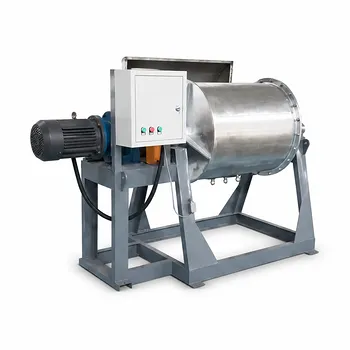
The primary function of a ball mill in this context is to apply mechanical force to create a unified interface between active materials (like NCM or LTO) and solid electrolytes (like sulfide-based Li6PS5Cl).
By reducing particle sizes and forcing these distinct solids together, the ball mill establishes continuous ion transport channels necessary for the battery to function.
The Core Takeaway In all-solid-state batteries, liquid electrolytes are absent, meaning ions cannot simply "flow" to the active material. The ball mill solves this by mechanically fusing particles to create a tight, uniform solid-solid contact, ensuring the electrochemical reaction can actually occur.
The Mechanics of the Process
Generating Mechanical Force
A ball mill operates by tumbling a container filled with grinding media and the target materials. This generates significant mechanical impact and shear forces.
Unlike standard mixing, which creates a loose blend, this energy is sufficient to physically alter the state of the powders.
Particle Size Reduction
The primary reference indicates that this process actively reduces the particle size of the materials.
Smaller particles possess a larger specific surface area. This increased surface area is essential for maximizing the points of contact between the energy-storing materials and the conductive electrolyte.
Breaking Agglomerates
Raw materials often clump together in "agglomerates" that hinder performance.
The grinding action effectively breaks these clusters apart. This ensures that the solid electrolyte is dispersed uniformly around the individual active material particles, rather than just coating large clumps.
The Critical Goal: Ion Transport
Establishing Ion Channels
The most critical output of ball milling is the creation of effective ion transport channels.
For a battery to discharge, lithium ions must move from the electrode material through the electrolyte. If there are gaps or voids between these solids, the ions are trapped, and the battery fails.
Ensuring Tight Contact
The process ensures tight, uniform contact at the microscopic level.
This intimate contact mimics the "wetting" effect of liquid electrolytes in traditional batteries. It bridges the physical gap between solids, significantly lowering the resistance to ion movement.
Common Pitfalls to Avoid
The Risk of Simple Mixing
A common mistake is assuming that standard blending (like vacuum mixing or stirring) is sufficient for solid-state electrodes.
While vacuum mixing removes air bubbles, it often lacks the mechanical energy required to deform particles and force the necessary solid-solid contact. Relying solely on low-energy mixing can lead to poor interfacial contact and high internal resistance.
Balancing Impact and Integrity
While high-energy milling is effective, it requires precise control over duration and intensity.
The goal is to refine the microstructure and achieve uniform distribution without degrading the crystal structure of the active materials. The mechanical force must be optimized to achieve contact without destruction.
Making the Right Choice for Your Goal
To maximize the performance of your all-solid-state battery electrodes, consider these specific objectives:
- If your primary focus is Ion Conductivity: Prioritize ball milling protocols that maximize particle size reduction to increase the surface area available for ion transfer.
- If your primary focus is Cycle Stability: Ensure the milling process achieves a perfectly uniform dispersion of the solid electrolyte to prevent "hot spots" of resistance that degrade the battery over time.
Ultimately, the ball mill is not just a mixer; it is the tool that engineers the microscopic highways required for ionic movement.
Summary Table:
| Feature | Function in Electrode Preparation | Benefit to Solid-State Batteries |
|---|---|---|
| Mechanical Force | Applies high impact and shear stress | Fuses active materials and solid electrolytes |
| Size Reduction | Increases specific surface area | Maximizes contact points for ion transfer |
| De-agglomeration | Breaks clusters for uniform dispersion | Prevents high-resistance hotspots |
| Interface Engineering | Creates tight solid-solid contact | Establishes continuous ion transport pathways |
Revolutionize Your Battery Research with KINTEK Precision
Achieving the perfect solid-solid interface is the cornerstone of high-performance all-solid-state batteries. KINTEK specializes in advanced crushing and milling systems, providing the high-energy ball milling solutions required to engineer efficient ion transport channels and uniform composite electrodes.
Beyond milling, we offer a comprehensive suite of laboratory equipment tailored for battery innovators, including:
- Hydraulic Presses (Pellet, Hot, Isostatic): For high-density electrode and electrolyte shaping.
- High-Temperature Furnaces: Precision heating for material synthesis and sintering.
- Battery Research Tools & Consumables: From electrolytic cells to specialized crucibles.
Ready to optimize your electrode microstructure? Contact our technical experts today to find the ideal equipment for your laboratory and take your energy storage research to the next level.
Related Products
- Stainless Steel Laboratory Ball Mill for Dry Powder and Liquid with Ceramic Polyurethane Lining
- High-Energy Omnidirectional Planetary Ball Mill Milling Machine for Laboratory
- Laboratory Ball Mill Jar Mill with Metal Alloy Grinding Jar and Balls
- High-Energy Omnidirectional Planetary Ball Mill Machine for Laboratory
- Hybrid High Energy Vibratory Ball Mill for Lab Use
People Also Ask
- How do laboratory ball mills facilitate the mechanochemical synthesis of ZIF-8? Solvent-Free Synthesis Explained
- What is the primary function of a laboratory ball mill in the modification of sulfide-based solid electrolytes with LiPO2F2?
- How does a laboratory ball mill ensure the mixing quality of Mn3Zn0.8Sn0.2N and Ti? Achieve Perfect Homogeneity
- What is the function of a laboratory ball mill in the preparation of AMMCs? Optimize Dispersion & Grain Refinement
- In what way does a laboratory ball mill affect material properties when modifying PHBV/pulp fiber composites?