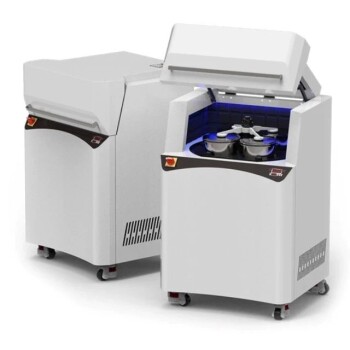
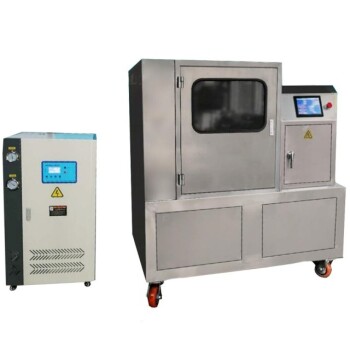
The primary function of a high-energy vibrating mill in this specific context is to facilitate a solid-state reaction through intense mechanical force. By subjecting 304L stainless steel and elemental lanthanum powders to high-frequency impact and shear forces, the mill drives atomic-level mixing to create a supersaturated solid solution.
Mechanical alloying is not merely mixing; it is a process of forcing structural evolution. The vibrating mill acts as a kinetic driver that fractures and cold-welds particles, refining grain sizes to approximately 11 nm to establish the foundation for bulk nanocrystalline materials.
The Mechanics of Atomic-Level Mixing
To understand the critical role of the vibrating mill, one must look beyond simple blending. The device is engineered to alter the material's internal structure through kinetic energy.
Generating High-Frequency Impact
The mill operates by delivering rapid, high-energy collisions. These impact and shear forces are necessary to break down the initial powder particles of 304L stainless steel and elemental lanthanum.
Forcing Solid Solubility
Under normal equilibrium conditions, certain elements may not mix readily. The vibrating mill utilizes mechanical force to forcibly mix the components at an atomic level. This creates a supersaturated solid solution, effectively extending the solubility limits of lanthanum within the stainless steel matrix.
Structural Evolution and Refinement
The ultimate goal of using this specific milling technique is to prepare the material for bulk applications by fundamentally changing its grain structure.
Achieving Nanometer-Scale Refinement
The process is highly effective at reducing crystalline size. Through continuous deformation, the initial grains are refined down to the nanometer scale, specifically around 11 nm.
Ensuring Uniform Distribution
Homogeneity is critical for the performance of the final alloy. The milling process ensures that the lanthanum is uniformly distributed throughout the 304L stainless steel, preventing segregation that could weaken the material.
Understanding Process Dynamics
While the high-energy vibrating mill is a powerful tool for synthesis, it is important to recognize the physical requirements of the process.
The Necessity of Kinetic Energy
Achieving a supersaturated solid solution is a non-equilibrium process. It requires substantial kinetic energy to overcome the thermodynamic barriers that typically prevent 304L stainless steel and lanthanum from mixing atomically.
Stability of the Nanostructure
The resulting 11 nm grain structure is a direct product of the intense energy input. This refinement provides the necessary structural foundation, but it relies on the precise application of force to maintain the integrity of the nanocrystalline state during synthesis.
Making the Right Choice for Your Goal
The use of a high-energy vibrating mill is a specific choice for projects requiring advanced material properties that standard melting cannot achieve.
- If your primary focus is Grain Refinement: Rely on this process to consistently drive grain sizes down to the ~11 nm range for enhanced mechanical properties.
- If your primary focus is Alloying Difficult Elements: Use the high-energy impact to forcibly create solid solutions between 304L stainless steel and lanthanum, regardless of their natural solubility limits.
By leveraging high-frequency mechanical force, you transform distinct powders into a unified, high-performance nanocrystalline material.
Summary Table:
| Feature | Function in Mechanical Alloying | Resulting Benefit |
|---|---|---|
| Kinetic Energy | High-frequency impact and shear forces | Overcomes thermodynamic barriers for alloying |
| Atomic Mixing | Forcibly mixes 304L SS and Lanthanum | Creates a supersaturated solid solution |
| Structural Evolution | Continuous cold-welding and fracturing | Refines grain size to ~11 nm |
| Distribution | Homogeneous dispersion of elements | Prevents material segregation and weakness |
Elevate Your Materials Research with KINTEK
Precision in mechanical alloying requires equipment that can withstand intense kinetic demands. KINTEK specializes in high-performance laboratory solutions, providing the robust crushing and milling systems—including high-energy vibrating mills—necessary to achieve nanometer-scale refinement and uniform element distribution.
Whether you are developing nanocrystalline stainless steels, exploring battery research, or require specialized high-temperature furnaces and hydraulic presses, our comprehensive portfolio is designed to meet the rigorous standards of advanced material science.
Ready to transform your powder metallurgy process? Contact KINTEK today to discover how our expert equipment and consumables can drive your next breakthrough.
References
- Congcong Du, Tongde Shen. Ultrastrong nanocrystalline steel with exceptional thermal stability and radiation tolerance. DOI: 10.1038/s41467-018-07712-x
This article is also based on technical information from Kintek Solution Knowledge Base .
Related Products
- High Energy Vibratory Laboratory Ball Mill Grinding Mill Single Tank Type
- High Energy Vibratory Ball Mill for Lab Use
- High Energy Vibratory Laboratory Ball Mill Double Tank Type
- Hybrid High Energy Vibratory Ball Mill for Lab Use
- Lab Vibration Mill
People Also Ask
- What is the function of a high-energy ball mill in the preparation of nanoparticle-reinforced steel? | KINTEK
- Why is a high-energy ball mill used in the preparation of NTP electrode slurries? Maximize Conductivity & Performance
- What is the role of a high-energy ball mill in Al/Si/Al2O3/SiO2/MWCNTs nanocomposites? Master Powder Pretreatment
- How is a high-energy ball mill utilized in the dry-process preparation of composite electrolytes? | KINTEK
- What is the role of a high-energy ball mill in battery material prep? Optimize Nanostructuring for Li-ion Performance