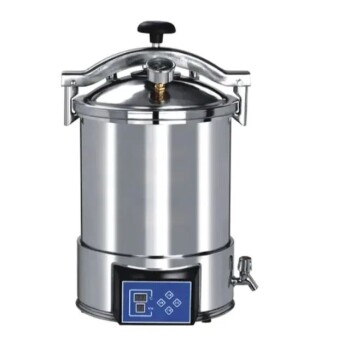
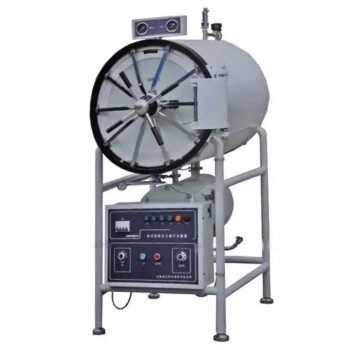
The primary function of a laboratory pressure steam sterilizer, or autoclave, in this specific context is to execute a wet-heat pretreatment process on food waste. By utilizing a high-temperature and high-pressure environment, the autoclave fundamentally alters the biological and physical state of the waste. This step is essential for creating a controlled environment where hydrogen production can occur efficiently.
In the context of dark fermentation, the autoclave acts as a biological reset button: it eliminates naturally occurring microorganisms that consume hydrogen while simultaneously breaking down the food waste to make it more accessible for fermentation.
Eliminating Biological Interference
Targeting Indigenous Microorganisms
Food waste naturally contains a complex community of "indigenous" microorganisms. Many of these native microbes are hydrogen-consuming, meaning they will deplete the very resource you are attempting to generate.
Creating an Interference-Free Environment
The most critical role of the autoclave is the inactivation of these competing microorganisms. By sterilizing the waste, you remove biological interference. This ensures that when you introduce your specific, efficient hydrogen-producing bacteria, they can function without competition.
Modifying the Physical Substrate
Increasing Nutrient Availability
Beyond sterilization, the autoclave utilizes heat and pressure to increase the solubility of the food waste. This process breaks down complex organic matter into simpler, soluble forms.
Homogenizing the Mixture
The treatment effectively homogenizes the substrate. This transforms the heterogeneous food waste into a uniform mixture, which ensures consistent access to nutrients for the bacteria during the fermentation process.
The Consequence of Inadequate Pretreatment
The Risk of Yield Loss
It is important to understand that skipping or under-utilizing this step compromises the entire reaction. Without the high-temperature inactivation provided by the autoclave, indigenous bacteria remain active.
Loss of Process Control
If these indigenous hydrogen-consumers survive, they will actively work against your production goals. This results in a reaction environment where your intended yield is continuously consumed by background biological activity.
Maximizing Hydrogen Yields
To ensure your dark fermentation process is successful, apply the autoclave's functions strategically:
- If your primary focus is Biological Efficiency: Ensure the autoclave reaches sufficient temperature and pressure to completely inactivate indigenous microorganisms, thereby protecting your hydrogen yield.
- If your primary focus is Substrate Accessibility: Utilize the wet-heat treatment to thoroughly homogenize and solubilize the waste, maximizing the surface area available for your inoculated bacteria.
By effectively utilizing the autoclave, you transform raw food waste into a sterile, soluble, and highly receptive medium for bio-hydrogen production.
Summary Table:
| Function Category | Process Action | Impact on Hydrogen Production |
|---|---|---|
| Biological Control | Inactivation of indigenous microbes | Prevents hydrogen consumption by competing bacteria |
| Physical Modification | Wet-heat pretreatment & homogenization | Increases substrate surface area and nutrient access |
| Chemical Enhancement | Improved solubility of organic matter | Breaks down complex waste into fermentable simple forms |
| Process Stability | Creation of a sterile environment | Ensures dominance of inoculated hydrogen-producing strains |
Optimize Your Bio-Hydrogen Production with KINTEK
Maximize your research efficiency and yield consistency with KINTEK’s advanced laboratory pressure steam sterilizers and autoclaves. Our precision-engineered systems are essential for the critical wet-heat pretreatment required in dark fermentation, ensuring complete biological inactivation and superior substrate homogenization.
Beyond sterilization, KINTEK specializes in high-performance equipment for every stage of your lab's workflow, including high-temperature high-pressure reactors, crushing and milling systems, and specialized battery research tools. Whether you are processing food waste or developing advanced energy solutions, our comprehensive range of high-temperature furnaces, hydraulic presses, and cooling solutions provides the reliability your innovations demand.
Ready to elevate your laboratory capabilities? Contact our technical experts today to find the perfect equipment tailored to your specific research needs.
References
- Djangbadjoa Gbiete, Michael Nelles. Insights into Biohydrogen Production Through Dark Fermentation of Food Waste: Substrate Properties, Inocula, and Pretreatment Strategies. DOI: 10.3390/en17246350
This article is also based on technical information from Kintek Solution Knowledge Base .
Related Products
- Portable High Pressure Laboratory Autoclave Steam Sterilizer for Lab Use
- Portable Digital Display Automatic Laboratory Sterilizer Lab Autoclave for Sterilization Pressure
- Desktop Fast High Pressure Laboratory Autoclave Sterilizer 16L 24L for Lab Use
- Desktop Fast Laboratory Autoclave Sterilizer 35L 50L 90L for Lab Use
- Desktop Fast Laboratory Autoclave Sterilizer 20L 24L for Lab Use
People Also Ask
- Why is a laboratory high-pressure autoclave sterilizer necessary? Ensure Accuracy in Antibacterial Research
- What is the role of a laboratory high-pressure autoclave in the conversion of furfural to piperidine? Optimize Yields
- What are the two types of autoclave used in the laboratory? Gravity vs. Pre-Vacuum Explained
- What precautions should be taken during autoclave in laboratory? A Complete Safety Guide to Prevent Burns and Explosions
- What extreme conditions does a laboratory autoclave simulate? Testing Wear Resistance of Nuclear Fuel Cladding