Knowledge What is the primary function of a planetary ball mill? Mastering TiC-Reinforced Steel Pretreatment
Author avatar

Tech Team · Kintek Solution

Updated 2 days ago

What is the primary function of a planetary ball mill? Mastering TiC-Reinforced Steel Pretreatment


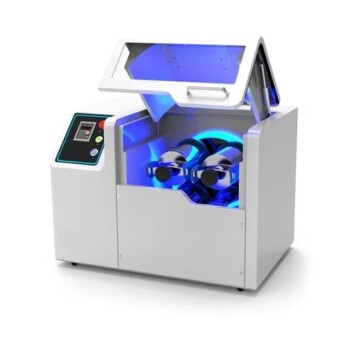
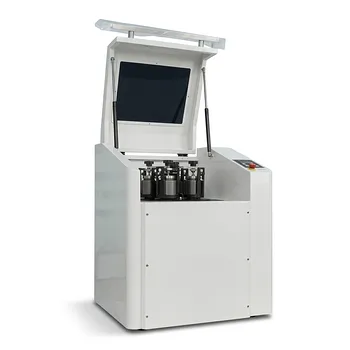
The primary function of a planetary ball mill in this context is to utilize high-energy mechanical forces to simultaneously mix and refine the composite powders. Specifically, the equipment employs intense impact and shear forces within an ethanol medium to ensure the uniform dispersion of TiC reinforcement particles while inducing plastic deformation and fragmentation in the steel matrix particles.

The planetary ball mill does not merely blend ingredients; it acts as a kinetic processing tool that alters particle morphology and distribution. This mechanical pretreatment is the critical control point for establishing the uniform foundation necessary to achieve a defect-free microstructure during the subsequent sintering stage.

Mechanisms of Microstructural Control

To understand the value of this process, you must look beyond simple mixing and examine how the equipment physically alters the material properties through energy transfer.

High-Energy Impact and Shear

The planetary ball mill generates significant mechanical energy through the complex motion of the grinding jars.

This motion creates intense impact and shear forces between the grinding media and the powder.

These forces are necessary to break down agglomerates of the hard TiC phase that standard mixing methods cannot separate.

Plastic Deformation and Fragmentation

Unlike softer mixing methods, this process actively changes the shape and size of the steel powder.

The high-energy collisions induce plastic deformation in the steel particles.

Simultaneously, the process causes fragmentation, which refines the particle size and increases the surface area for better bonding.

The Role of the Liquid Medium

The primary reference notes that this process occurs within an ethanol medium.

Wet milling is crucial because it facilitates the uniform suspension of particles and moderates the temperature generated by the high-energy collisions.

This medium prevents the excessive cold welding of steel particles while ensuring the TiC reinforcements are evenly distributed throughout the slurry.

Achieving Homogeneity in the Matrix

The ultimate goal of the pretreatment phase is to prevent "hot spots" or weak points in the final composite.

Dispersion of the Hard Phase

The mechanical force ensures that the TiC particles (the reinforcement phase) are not clumped together.

Uniform dispersion is vital because agglomerated TiC particles would act as stress concentrators in the final steel, leading to premature failure.

Establishing a Sintering Foundation

The combination of refined particle size and uniform mixing creates an ideal precursor for sintering.

By reducing the diffusion distance between different elements, the ball milling process ensures that the final microstructure remains uniform after the thermal cycle.

Understanding the Trade-offs

While planetary ball milling is effective, it introduces specific process variables that must be managed to avoid diminishing returns.

Energy Input vs. Material Degradation

There is a delicate balance between sufficient mixing energy and excessive force.

Insufficient energy fails to break agglomerates, while excessive energy can lead to severe lattice distortion or contamination from the grinding media (wear debris).

Process Parameter Sensitivity

As noted in similar composite preparations, the outcome is highly sensitive to the ball-to-material ratio and rotation speed.

Incorrect parameters can lead to uneven mixing or the stratification of particles based on density differences between the steel and TiC.

Making the Right Choice for Your Goal

The planetary ball mill is a versatile tool, but your specific objective should dictate how you optimize its use.

  • If your primary focus is mechanical strength: Prioritize the refinement of particle size to maximize the interfacial area between the steel matrix and the TiC reinforcement.
  • If your primary focus is microstructural homogeneity: Focus on the dispersion aspect of the process to ensure the hard phase is evenly spaced, preventing brittle agglomerates.

The success of your TiC-reinforced steel composite relies not just on the ingredients, but on using the planetary ball mill to mechanically program the microstructure before heat is ever applied.

Summary Table:

Function Mechanism Impact on Composite
Particle Refinement High-energy impact and shear Increases surface area for superior bonding during sintering
Dispersion Breaking of TiC agglomerates Prevents stress concentrators and improves mechanical strength
Morphology Control Plastic deformation of steel matrix Creates a uniform foundation for a dense final microstructure
Process Stability Wet milling (Ethanol medium) Prevents cold welding and moderates temperature during processing

Elevate Your Material Research with KINTEK Precision

Unlock the full potential of your TiC-reinforced steel matrix composites with KINTEK’s industry-leading laboratory solutions. Our advanced planetary ball mills, crushing and milling systems, and high-pressure reactors are engineered to provide the precise energy control required for superior powder pretreatment.

Whether you are refining particle morphology or optimizing sintering foundations, KINTEK offers a comprehensive portfolio including:

  • Milling & Sieving: High-energy planetary mills and precision sieving equipment.
  • Thermal Processing: Muffle, vacuum, and atmosphere furnaces for defect-free sintering.
  • Sample Preparation: Hydraulic presses, pellet dies, and specialized ceramics/crucibles.

Ready to achieve a superior microstructure? Contact KINTEK experts today to find the perfect equipment configuration for your research goals.

Related Products

People Also Ask

Related Products

High Energy Planetary Ball Mill Milling Machine for Laboratory

High Energy Planetary Ball Mill Milling Machine for Laboratory

The biggest feature is that the high energy planetary ball mill can not only perform fast and effective grinding, but also has good crushing ability

High Energy Planetary Ball Mill Milling Machine for Laboratory

High Energy Planetary Ball Mill Milling Machine for Laboratory

Experience fast and effective sample processing with the F-P2000 high-energy planetary ball mill. This versatile equipment offers precise control and excellent grinding capabilities. Perfect for laboratories, it features multiple grinding bowls for simultaneous testing and high output. Achieve optimal results with its ergonomic design, compact structure, and advanced features. Ideal for a wide range of materials, it ensures consistent particle size reduction and low maintenance.

High Energy Planetary Ball Mill for Laboratory Horizontal Tank Type Milling Machine

High Energy Planetary Ball Mill for Laboratory Horizontal Tank Type Milling Machine

KT-P4000H uses the unique Y-axis planetary motion trajectory, and utilizes the collision, friction and gravity between the sample and the grinding ball to have a certain anti-sinking ability, which can obtain better grinding or mixing effects and further improve the sample output.

Laboratory Planetary Ball Mill Rotating Ball Milling Machine

Laboratory Planetary Ball Mill Rotating Ball Milling Machine

KT-P400E is a desktop multi-directional planetary ball mill with unique grinding and mixing capabilities. It offers continuous and intermittent operation, timing, and overload protection, making it ideal for various applications.

Laboratory Horizontal Planetary Ball Mill Milling Machine

Laboratory Horizontal Planetary Ball Mill Milling Machine

Improve sample uniformity with our Horizontal Planetary Ball Mills. KT-P400H reduces sample deposition and KT-P400E has multi-directional capabilities. Safe, convenient and efficient with overload protection.

Laboratory Jar Ball Mill with Alumina Zirconia Grinding Jar and Balls

Laboratory Jar Ball Mill with Alumina Zirconia Grinding Jar and Balls

Grind to perfection with alumina/zirconia grinding jars and balls. Available in volume sizes from 50ml to 2500ml, compatible with various mills.

High-Energy Omnidirectional Planetary Ball Mill Milling Machine for Laboratory

High-Energy Omnidirectional Planetary Ball Mill Milling Machine for Laboratory

The KT-P4000E is a new product derived from the vertical high-energy planetary ball mill with a 360° swivel function. Experience faster, uniform, and smaller sample output results with 4 ≤1000ml ball mill jars.

Laboratory Planetary Ball Mill Cabinet Planetary Ball Milling Machine

Laboratory Planetary Ball Mill Cabinet Planetary Ball Milling Machine

The vertical cabinet structure combined with ergonomic design enables users to obtain the best comfortable experience in standing operation. The maximum processing capacity is 2000ml, and the speed is 1200 revolutions per minute.

Laboratory Ball Mill Jar Mill with Metal Alloy Grinding Jar and Balls

Laboratory Ball Mill Jar Mill with Metal Alloy Grinding Jar and Balls

Grind and mill with ease using metal alloy grinding jars with balls. Choose from 304/316L stainless steel or tungsten carbide and optional liner materials. Compatible with various mills and features optional functions.

Laboratory Micro Tissue Grinding Mill Grinder

Laboratory Micro Tissue Grinding Mill Grinder

KT-MT10 is a miniature ball mill with a compact structure design. The width and depth are only 15X21 cm, and the total weight is only 8 kg. It can be used with a minimum 0.2ml centrifuge tube or a maximum 15ml ball mill jar.

Laboratory High Throughput Tissue Grinding Mill Grinder

Laboratory High Throughput Tissue Grinding Mill Grinder

KT-MT is a high-quality, small, and versatile tissue grinder used for crushing, grinding, mixing, and cell wall breaking in various fields, including food, medical, and environmental protection. It is equipped with 24 or 48 2ml adapters and ball grinding tanks and is widely employed for DNA, RNA, and protein extraction.

Laboratory Grinding Mill Mortar Grinder for Sample Preparation

Laboratory Grinding Mill Mortar Grinder for Sample Preparation

KT-MG200 mortar grinder can be used for mixing and homogenizing powder, suspension, paste and even viscous samples. It can help users realize the ideal operation of sample preparation with more regularization and higher repeatability.

Laboratory Disc Cup Vibratory Mill for Sample Grinding

Laboratory Disc Cup Vibratory Mill for Sample Grinding

The vibrating disc mill is suitable for non-destructive crushing and fine grinding of samples with large particle sizes, and can quickly prepare samples with analytical fineness and purity.

Small Cryogenic Grinder Cryomill Cryogrinder with Liquid Nitrogen for Laboratory Use

Small Cryogenic Grinder Cryomill Cryogrinder with Liquid Nitrogen for Laboratory Use

Our KINTEK Cryomilling is perfect for small runs and R&D trials. With a versatile cryogenic system, it can handle a variety of materials, including plastics, rubber, pharmaceuticals, and food grades. Plus, our specialized hydraulic laboratory crushers ensure accurate results through multiple passes, making it suitable for XRF analysis. Get finely-powdered samples with ease!

Liquid Nitrogen Cryogenic Grinder Mill Cryomill Airflow Ultrafine Pulverizer

Liquid Nitrogen Cryogenic Grinder Mill Cryomill Airflow Ultrafine Pulverizer

Discover the Liquid Nitrogen Cryogenic Grinding Machine, perfect for lab use, ultra-fine pulverization, and preserving material properties. Ideal for pharmaceuticals, cosmetics, and more.

Precision Machined Zirconia Ceramic Ball for Engineering Advanced Fine Ceramics

Precision Machined Zirconia Ceramic Ball for Engineering Advanced Fine Ceramics

zirconia ceramic ball have the characteristics of high strength, high hardness, PPM wear level, high fracture toughness, good wear resistance, and high specific gravity.

Custom PTFE Teflon Parts Manufacturer for PTFE Mesh F4 Sieve

Custom PTFE Teflon Parts Manufacturer for PTFE Mesh F4 Sieve

PTFE mesh sieve is a specialized test sieve designed for particle analysis in various industries, featuring a non-metallic mesh woven from PTFE filament. This synthetic mesh is ideal for applications where metal contamination is a concern . PTFE sieves are crucial for maintaining the integrity of samples in sensitive environments, ensuring accurate and reliable results in particle size distribution analysis.

Vacuum Hot Press Furnace Machine for Lamination and Heating

Vacuum Hot Press Furnace Machine for Lamination and Heating

Experience clean and precise lamination with Vacuum Lamination Press. Perfect for wafer bonding, thin-film transformations, and LCP lamination. Order now!

Benchtop Laboratory Freeze Dryer for Lab Use

Benchtop Laboratory Freeze Dryer for Lab Use

Premium benchtop laboratory freeze dryer for lyophilization, preserving samples with ≤ -60°C cooling. Ideal for pharmaceuticals & research.

Lab Blown Film Extrusion Three Layer Co-Extrusion Film Blowing Machine

Lab Blown Film Extrusion Three Layer Co-Extrusion Film Blowing Machine

Lab blown film extrusion is mainly used to detect the feasibility of film blowing of polymer materials and the colloid condition in the materials, as well as the dispersion of colored dispersions, controlled mixtures, and extrudates;


Leave Your Message