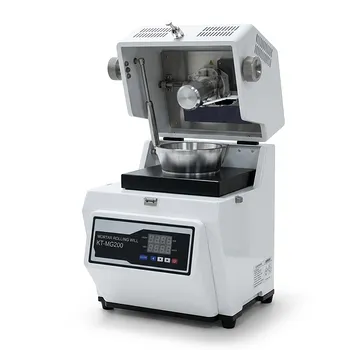
The primary function of a planetary ball mill in the preparation of LLZO (Lithium Lanthanum Zirconium Oxide) is to execute high-energy mechanical grinding that simultaneously homogenizes the raw material powders and drastically reduces their particle size.
This process transforms coarse precursor powders (such as lithium, lanthanum, and zirconium compounds) into a highly reactive, microscopically uniform mixture. This mechanical activation is a prerequisite for the solid-state reaction method, as it creates the necessary surface area and contact points for the material to crystallize correctly during subsequent heating.
Core Takeaway In solid-state synthesis, chemical reactions are limited by the physical diffusion of atoms between solid particles. The planetary ball mill overcomes this barrier by pulverizing ingredients into a fine, intimate blend, maximizing the "reaction surface area" to ensure the formation of a pure, conductive garnet phase.
The Mechanics of Precursor Preparation
Achieving Deep Homogenization
The solid-state reaction method relies on the physical contact of solid particles to drive chemical changes. If the raw materials—typically Lithium Carbonate/Hydroxide, Lanthanum Hydroxide, and Zirconium Oxide—are not mixed perfectly, the final product will contain impurities or secondary phases.
A planetary ball mill utilizes high-energy impact and shear forces to mix these multi-component powders at a microscopic scale. This ensures that every granule of the resulting powder contains the correct stoichiometric ratio of ingredients.
Increasing Reaction Surface Area
The primary reference highlights that reducing particle size is essential for increasing the reaction surface area.
By grinding powders down to the micro- or nanoscale, the total surface area available for contact increases exponentially. This allows for efficient solid-phase diffusion, where atoms move across particle boundaries to form the new crystal structure.
Enhancing Reactivity and Lowering Temperatures
Fine, uniform powders are more chemically "active" than coarse powders.
By creating a highly reactive precursor mixture, the planetary ball mill facilitates the formation of the cubic garnet phase. This mechanical refinement can allow the subsequent synthesis to occur at significantly lower temperatures or with greater efficiency, as the diffusion distances for the atoms are much shorter.
Critical Role in Doping
Uniform Distribution of Dopants
LLZO electrolytes are frequently doped with elements like Aluminum (Al) or Gallium (Ga) to stabilize the cubic structure and enhance conductivity.
Because dopants are added in very small quantities compared to the main ingredients, manual mixing is insufficient. The high-energy grinding of the ball mill ensures these dopants are distributed uniformly at the atomic or microscopic level, preventing "hotspots" of dopant concentration that could degrade performance.
Understanding the Trade-offs
The Risk of Contamination
While high-energy grinding is effective, it introduces wear on the grinding media (the jars and balls).
- Abrasive Wear: Debris from the balls can contaminate the mixture.
- Mitigation: In LLZO synthesis, Zirconium Oxide (ZrO2) balls are often used so that any wear debris simply becomes part of the Zirconium component of the electrolyte, or Alumina (Al2O3) jars are used if Aluminum doping is desired.
Mechanochemical Side Effects
In some contexts, the energy in a planetary ball mill is high enough to trigger chemical reactions (mechanochemistry) prematurely or amorphize the structure. While this is sometimes the goal (as seen in sulfide electrolytes), in the solid-state reaction method for oxides, the goal is usually physical refinement. Users must calibrate speed and time to avoid altering the chemical state of precursors unpredictably before the sintering stage.
Making the Right Choice for Your Goal
When optimizing your ball milling parameters for LLZO synthesis, consider your specific end-goals:
- If your primary focus is Phase Purity: Prioritize longer milling times or higher speeds to ensure the absolute homogeneity of dopants, which stabilizes the cubic crystal structure.
- If your primary focus is Sintering Efficiency: Focus on achieving the smallest possible particle size to maximize surface energy, which drives densification during the final heat treatment.
- If your primary focus is Reproducibility: Standardize the milling speed (e.g., 400 r/min) and duration to ensure the precursor reactivity remains consistent across different batches.
Summary: The planetary ball mill acts as the mechanical catalyst for the solid-state reaction, bridging the gap between raw chemical powders and a high-performance ceramic electrolyte.
Summary Table:
| Feature | Function in LLZO Preparation | Impact on Solid-State Synthesis |
|---|---|---|
| High-Energy Impact | Microscopic homogenization of precursors | Ensures correct stoichiometric ratio and phase purity |
| Particle Size Reduction | Increases reaction surface area | Facilitates solid-phase diffusion and lowers sintering temp |
| Dopant Distribution | Uniformly disperses Al, Ga, etc. | Stabilizes cubic garnet phase and enhances conductivity |
| Mechanical Activation | Creates highly reactive precursor mix | Accelerates crystallization during subsequent heating |
Elevate Your Battery Research with KINTEK Precision
Ready to optimize your LLZO solid-state electrolyte synthesis? KINTEK specializes in high-performance laboratory equipment designed for the rigorous demands of battery research. From our advanced planetary ball mills for deep homogenization to precision high-temperature muffle and tube furnaces for sintering, we provide the tools necessary to achieve superior phase purity and conductivity.
Our value to you:
- Precision Grinding: High-energy milling systems to ensure micro/nano-scale uniformity.
- Comprehensive Range: Crushing systems, vacuum furnaces, hydraulic pellet presses, and zirconia/alumina consumables to prevent contamination.
- Expert Solutions: Tailored equipment for battery research, cooling (ULT freezers), and material processing.
Contact KINTEK today to discover how our specialized laboratory solutions can enhance your research efficiency and material performance!
Related Products
- High Energy Planetary Ball Mill for Laboratory Horizontal Tank Type Milling Machine
- Mini Planetary Ball Mill Machine for Laboratory Milling
- High-Energy Omnidirectional Planetary Ball Mill Milling Machine for Laboratory
- High Energy Planetary Ball Mill Milling Machine for Laboratory
- Laboratory Horizontal Planetary Ball Mill Milling Machine
People Also Ask
- What is the role of a planetary ball mill in sulfide-based solid-state batteries? Engineer High-Performance Cathodes
- What are the parameters of a planetary ball mill? Master Speed, Time, and Media for Perfect Grinding
- What is the function of a planetary ball mill for nanostructured eutectic steel? Essential Prep for High-Strength Alloys
- What role does a planetary ball mill play in the preparation of NASICON-type solid electrolytes like LATP and LAGP?
- What is the function of a planetary ball mill in solid-state electrolyte prep? Milling vs. SDS Methods Explained