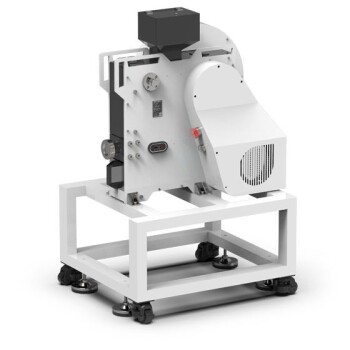
The primary objective of using industrial crushing equipment to reduce Giant King Grass to a 1.0 mm particle size is to maximize the specific surface area of its internal cellulose and hemicellulose components. This physical modification is a critical first step designed to break down the biomass's naturally resistant (recalcitrant) structure, ensuring that subsequent chemical or enzymatic processes can function effectively.
Mechanical size reduction is not merely about handling convenience; it is a strategic method to increase reaction potential. By exposing more surface area, you facilitate a higher frequency of contact between the biomass and catalysts, directly resulting in improved overall conversion efficiency.
The Mechanics of Surface Area Expansion
Exposing Critical Components
The core purpose of crushing Giant King Grass is to expose the cellulose and hemicellulose macromolecules. In their raw state, these components are often shielded by the plant's rigid structural architecture.
Crushing the material to 1.0 mm disrupts this architecture physically. This exposes the valuable polymers that are required for downstream conversion, making them accessible rather than locking them inside larger fiber bundles.
Overcoming Biomass Recalcitrance
Biomass possesses a "recalcitrant" structure, meaning it naturally resists biological and chemical degradation. This is an evolutionary defense mechanism that hinders industrial processing.
By targeting a 1.0 mm particle size, you mechanically weaken this natural defense. The physical stress applied during crushing acts as a preliminary disruption, effectively priming the material for the next stage of treatment.
Catalytic and Enzymatic Efficiency
Enhancing Contact Frequency
The efficiency of any chemical reaction relies heavily on how often the reactants meet. By increasing the specific surface area, you statistically increase the contact frequency between the biomass and the treatment agents.
Whether you are using chemical catalysts or biological enzymes, they require physical contact with the substrate to work. A 1.0 mm particle offers significantly more "landing sites" for these agents compared to larger, untreated stalks.
Driving Conversion Efficiency
The ultimate metric for this process is conversion efficiency. The breakdown of the recalcitrant structure allows enzymes and chemicals to penetrate deeper and work faster.
This leads to a more complete utilization of the Giant King Grass. Without this initial size reduction, downstream reactions would be sluggish and incomplete, leaving valuable resources unreacted.
Understanding the Trade-offs
The Balance of Size and Energy
While reducing particle size is beneficial for reactivity, it requires energy input. The target of 1.0 mm represents a specific operational choice to balance reactivity with processing effort.
Diminishing Returns
It is important to note that while "smaller is better" for surface area, extremely fine grinding can lead to excessive energy costs and handling issues, such as dust generation or filter clogging. The goal is to achieve sufficient surface area to break recalcitrance without incurring unnecessary mechanical overhead.
Making the Right Choice for Your Goal
To maximize the value of your pretreatment process, consider how particle size interacts with your specific conversion method.
- If your primary focus is maximizing reaction speed: Ensure your equipment consistently achieves the 1.0 mm target to guarantee maximum enzyme accessibility and rapid conversion.
- If your primary focus is process consistency: Monitor the output for uniformity, as variations in particle size can lead to uneven reaction rates and incomplete breakdown of the recalcitrant structure.
By strictly controlling particle size at this stage, you transform raw Giant King Grass from a resistant plant material into a highly reactive feedstock ready for efficient conversion.
Summary Table:
| Objective | Impact on Process | Key Benefit |
|---|---|---|
| Surface Area Expansion | Increases exposure of cellulose and hemicellulose | Maximizes reactive "landing sites" for catalysts |
| Recalcitrance Reduction | Physically disrupts the plant's rigid structural defense | Lowers resistance to chemical/biological degradation |
| Contact Frequency | Ensures higher interaction rates between substrate and agents | Significantly improves overall conversion efficiency |
| Size Optimization (1.0 mm) | Balances mechanical energy input with reactivity | Prevents diminishing returns while ensuring uniform reaction |
Elevate Your Biomass Processing with KINTEK Precision
Unlock the full potential of your raw materials with KINTEK’s industry-leading industrial crushing and milling systems. Whether you are processing Giant King Grass or complex lignocellulosic feedstocks, our equipment ensures consistent 1.0 mm particle sizing to maximize surface area and overcome biomass recalcitrance.
From high-performance crushing and milling systems and sieving equipment to specialized high-temperature reactors and autoclaves for downstream conversion, KINTEK provides the comprehensive tools needed for advanced lab and industrial research.
Ready to optimize your conversion efficiency? Contact our experts today to find the perfect laboratory equipment and consumables tailored to your specific research goals.
References
- Nicola Di Fidio, Claudia Antonetti. Multi-Step Exploitation of Raw Arundo donax L. for the Selective Synthesis of Second-Generation Sugars by Chemical and Biological Route. DOI: 10.3390/catal10010079
This article is also based on technical information from Kintek Solution Knowledge Base .
Related Products
People Also Ask
- What role do laboratory crushers and standard sieves play in Datura stramonium pretreatment? Optimize Your HTL Yield
- What is a laboratory crusher? The First Step to Accurate Sample Analysis
- What is the primary function of a laboratory crusher? Optimize Biomass & Coal Co-Gasification Efficiency
- What is a jaw crusher for labs? The Essential First Step for Accurate Sample Analysis
- How does a jaw crusher contribute to the primary processing of slate waste? Optimize Your Size Reduction Workflow