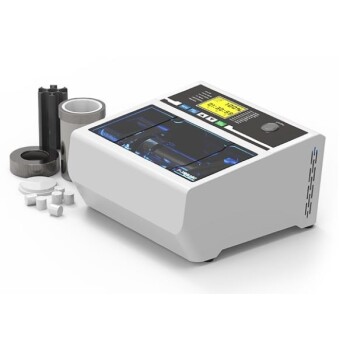
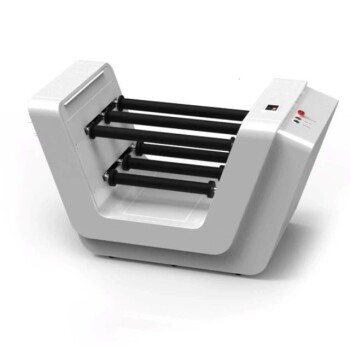
The primary function of high-hardness Tungsten Carbide (WC) media is to deliver intense kinetic energy while preserving chemical purity. By using WC milling jars and grinding balls, you generate the extreme impact energy and shear forces required to mechanically alloy Tungsten and Titanium Carbide powders. Furthermore, because the milling tools share similar material properties with the matrix, any wear debris generated is compatible with the composite, preventing the introduction of harmful non-refractory metal impurities.
Core Insight: Successful Mechanical Alloying relies on a balance of aggression and precision; you must subject the powder to violent plastic deformation to refine grain size without contaminating the mixture with foreign elements that would degrade performance in radiation environments.
The Mechanics of High-Energy Milling
Delivering Impact and Shear Forces
To create a high-quality W-TiC composite, the precursor powders must undergo intense plastic deformation. High-hardness WC grinding balls are heavy and dense, allowing them to impart significant kinetic energy during collisions.
This energy is converted into shear forces that fracture and cold-weld the powder particles repeatedly. This process is essential for breaking down the initial particle structures.
Achieving Micro-Nanoscale Mixing
The goal of using such hard media is to facilitate deep mixing beyond a simple macroscopic blend. The high-energy collisions drive the tungsten and titanium carbide particles to mix at the micro-nanoscale level.
This creates a homogeneous alloy where the constituent elements are uniformly distributed. Without this level of force, the material would remain a mixture of distinct powders rather than a true composite.
Refining Grain Size
The impact energy provided by WC media significantly refines the grain size of the powder. By continuously fracturing the particles, the process reduces grains to the required microscopic dimensions.
Controlling this grain size is a prerequisite for the subsequent sintering phases (such as Hot Isostatic Pressing), ensuring the final material possesses superior mechanical strength.
The Critical Importance of Purity
Minimizing Non-Refractory Impurities
In mechanical alloying, wear of the grinding media is inevitable. If steel balls were used, iron contamination would degrade the high-temperature capabilities and radiation resistance of the W-TiC composite.
By using WC jars and balls, you utilize wear-resistant materials that are chemically similar to the tungsten matrix.
Ensuring Compatibility in Extreme Environments
The W-TiC composites are often destined for extreme radiation environments. Impurities introduced during the milling phase can act as weak points or sites for radiation-induced defects.
Using WC media ensures that any material eroded from the balls or jars simply adds more tungsten and carbon—elements already present in the matrix—thereby maintaining the strict chemical purity required for nuclear or aerospace applications.
Understanding the Trade-offs
The Cost of Hardness
While WC media is superior for performance, it represents a significant upfront cost compared to steel or ceramic alternatives. It is a premium choice reserved for applications where material integrity is non-negotiable.
Impact on Stoichiometry
Although WC media prevents foreign contamination, the wear debris does add extra tungsten and carbon to the mixture. This can slightly alter the stoichiometric ratio of the final composite.
Engineers must account for this potential increase in tungsten/carbon content when calculating the initial powder ratios to ensure the final product meets exact specifications.
Making the Right Choice for Your Goal
When preparing Tungsten-Titanium Carbide composites, your choice of milling media dictates the final quality of the material.
- If your primary focus is Chemical Purity: Use Tungsten Carbide media to ensure that inevitable tool wear does not introduce non-refractory metals that compromise radiation resistance.
- If your primary focus is Grain Refinement: Rely on the high density and hardness of WC balls to generate the shear forces necessary to reduce particle size to the micro-nanoscale.
- If your primary focus is Process Efficiency: Utilize WC media to achieve deep mixing and plastic deformation more rapidly than lighter, softer milling alternatives.
High-hardness media is the only viable path to achieving the structural integrity required for extreme-environment composites.
Summary Table:
| Feature | Benefit of Tungsten Carbide (WC) Media | Impact on W-TiC Composites |
|---|---|---|
| Hardness & Density | High kinetic energy transfer during collisions | Facilitates intense plastic deformation and grain refinement |
| Chemical Compatibility | Shares properties with the W-TiC matrix | Prevents harmful non-refractory impurities (e.g., iron) |
| Shear Force | Generates extreme impact and shear | Ensures micro-nanoscale mixing and homogeneous alloying |
| Wear Resistance | Minimizes material loss from tools | Maintains strict stoichiometry and material integrity |
| Application Focus | Optimized for extreme environments | Ensures superior radiation resistance and thermal stability |
Elevate Your Material Research with KINTEK Precision
Achieving the perfect balance of purity and grain refinement in W-TiC composites requires the highest quality milling tools. KINTEK specializes in high-performance laboratory equipment, offering premium Tungsten Carbide (WC) milling jars and grinding balls alongside our advanced crushing and milling systems and hot isostatic presses.
Whether you are developing materials for aerospace, nuclear, or advanced battery research, our comprehensive portfolio—including high-temperature furnaces, vacuum systems, and ceramic consumables—is designed to meet your most rigorous specifications. Ensure your composites can withstand extreme radiation and heat by choosing media that guarantees chemical integrity.
Ready to optimize your mechanical alloying process? Contact KINTEK today to discuss your laboratory requirements and find the ideal solution for your next breakthrough.
References
- Eiichi Wakai. Titanium/Titanium Oxide Particle Dispersed W-TiC Composites for High Irradiation Applications. DOI: 10.31031/rdms.2022.16.000897
This article is also based on technical information from Kintek Solution Knowledge Base .
Related Products
- Laboratory Single Horizontal Jar Mill
- Laboratory Jar Mill with Agate Grinding Jar and Balls
- Laboratory Ball Mill Jar Mill with Metal Alloy Grinding Jar and Balls
- Laboratory Micro Horizontal Jar Mill for Precision Sample Preparation in Research and Analysis
- Laboratory Four-Body Horizontal Jar Mill
People Also Ask
- Why is a ball mill jar lined with Y-ZrO2 required for Na3PS4 synthesis? Ensuring Purity in Sulfide Electrolytes
- What are the different types of laboratory mills? Choose the Right Grinder for Your Sample Material
- Why is a laboratory ball mill required for Fe-Cr-Mn-Mo-N alloy powders? Unlock High-Performance Alloy Synthesis
- What is use for grinding in the laboratory? Select the Right Mill for Accurate Sample Prep
- What environmental conditions must a ball mill jar meet? Prevent Fe3Al Oxidation with Advanced Sealing