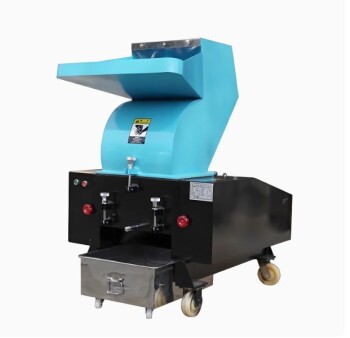
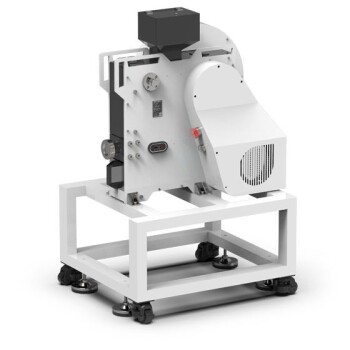
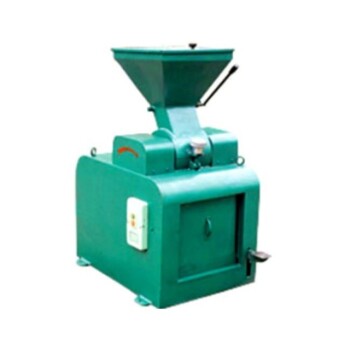
The primary role of a mechanical crushing system in furfural production is to apply physical shear force to biomass materials, reducing them to a precise particle size, such as 40 mesh. This reduction creates a significantly larger specific surface area, which is the critical prerequisite for effective chemical interaction.
Mechanical crushing transforms the physical state of biomass to maximize the interface between the solid material and liquid reagents. By pulverizing the raw material, the system ensures that dilute acid can penetrate deeply into the lignocellulose structure, directly enhancing the wettability of hemicellulose and the overall efficiency of the hydrolysis reaction.
The Mechanics of Physical Pretreatment
Generating Specific Surface Area
The crushing system utilizes mechanical means, such as grinding or milling, to break down raw biomass like Camellia oleifera shells.
The goal is to achieve a specific mesh size—often targeting 40 mesh—which exponentially increases the material's specific surface area.
Enabling Acid Penetration
Biomass in its raw state is resistant to chemical absorption.
By increasing the surface area, the crushing process creates pathways for dilute hydrochloric acid to penetrate the complex lignocellulose structure.
This ensures the acid reaches the internal components rather than just reacting with the outer shell.
The Chemical Impact on Furfural Yield
Improving Hemicellulose Wettability
Furfural is derived from the hydrolysis of hemicellulose.
Mechanical crushing alters the physical form of the biomass to improve the wettability of this specific component.
When the hemicellulose is thoroughly wetted by the acid catalyst, the chemical conversion process becomes feasible and efficient.
Enhancing Contact Efficiency
The ultimate objective of this pretreatment is contact efficiency.
The reduction in particle size ensures that a higher percentage of the biomass comes into direct contact with the hydrolysis agent.
This maximizes the reaction rate and ensures consistent processing of the raw material.
Understanding the Operational Variables
The Importance of Mesh Size Consistency
It is not enough to simply crush the material; achieving the correct particle size is paramount.
The primary reference highlights a target of 40 mesh for specific biomass types.
Deviating significantly from this target can lead to suboptimal acid penetration or inconsistent hydrolysis rates.
Physical Changes vs. Chemical Changes
It is important to distinguish that mechanical crushing is strictly a physical preparation.
While supplementary data suggests this process may reduce cellulose crystallinity, its main function in this context is accessibility.
It does not produce furfural directly but creates the necessary physical environment for the subsequent chemical reaction to occur.
Making the Right Choice for Your Goal
To optimize your biomass pretreatment strategy, consider the following based on your specific production targets:
- If your primary focus is Reaction Speed: Prioritize a crushing system that consistently produces finer particle sizes (e.g., 40 mesh) to maximize immediate acid accessibility.
- If your primary focus is Reagent Efficiency: Ensure your mechanical process achieves uniform particle distribution to prevent the waste of dilute acid on chemically inaccessible biomass chunks.
Effective furfural production begins with the precise physical destruction of the raw material's resistance to chemical agents.
Summary Table:
| Parameter | Role in Pretreatment | Impact on Furfural Production |
|---|---|---|
| Physical Action | High-shear force grinding | Reduces biomass to precise sizes (e.g., 40 mesh) |
| Surface Area | Specific area expansion | Maximizes contact between solid biomass and liquid reagents |
| Acid Interaction | Deep penetration | Ensures dilute acid reaches internal hemicellulose structures |
| Wettability | Material transformation | Improves hemicellulose contact for efficient hydrolysis |
| Consistency | Uniform particle distribution | Prevents reagent waste and ensures stable reaction rates |
Revolutionize Your Biomass Processing with KINTEK
Successful furfural production depends on precision at the very first step. At KINTEK, we understand that high-performance mechanical crushing is the foundation of effective chemical hydrolysis. Our specialized crushing and milling systems and sieving equipment are engineered to deliver the exact particle sizes needed to maximize the specific surface area of your biomass feedstocks.
Whether you are refining your pretreatment strategy or scaling up laboratory research, KINTEK offers a comprehensive suite of laboratory equipment—from high-pressure reactors and autoclaves for hydrolysis to pellet presses and cooling solutions—designed to optimize your workflow.
Ready to enhance your reaction speed and reagent efficiency? Contact our technical experts today to find the perfect equipment solution for your laboratory needs.
References
- Mingyang Hu, Yun Liu. Towards furfural and biomass char production from <i>Camellia oleifera</i> husks using dilute hydrochloric acid pretreatment: a comprehensive investigation on adsorption performance. DOI: 10.1039/d3su00181d
This article is also based on technical information from Kintek Solution Knowledge Base .
Related Products
- Powerful Plastic Crusher Machine
- Laboratory Jaw Crusher
- Sealed Jaw Crusher High Efficiency Environmental Protection Safe and Reliable
- Laboratory Sealed Hammer Crusher for Efficient Sample Preparation
- Laboratory Disc Cup Vibratory Mill for Sample Grinding
People Also Ask
- What is the primary purpose of using an industrial-grade grinder for flax straw? Optimize Biomass Pretreatment Now
- What is the primary function of a crushing system? Optimize Rice Husk Fractionation with Precise Size Reduction
- What is the primary function of industrial crushers in battery dismantling? Optimize Your Recovery Feedstock
- What are the contaminants in plastic pyrolysis oil? Manage Impurities for Commercial Success
- Why is it necessary to use an ultrasonic cell disruptor before yeast flow cytometry? Ensure Data Accuracy