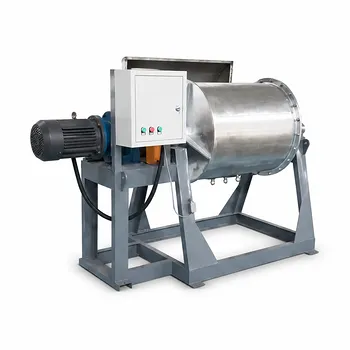
The primary role of a stirred ball mill in this context is to drive high-energy mechanical alloying. By generating intense impact and shear forces, the mill facilitates a solid-state reaction between elemental Nickel (Ni) and Aluminum (Al) powders to synthesize NiAl intermetallic compounds. Simultaneously, it ensures the Aluminum Oxide (Al2O3) reinforcement phase is uniformly embedded into this matrix while refining the grain size to a micrometer scale.
The stirred ball mill serves as a high-energy kinetic reactor that transforms elemental powders into a composite material through mechanical force. It enables the simultaneous synthesis of the NiAl matrix and the uniform dispersion of the Al2O3 reinforcement phase without the need for melting.
Mechanisms of Powder Transformation
To understand why a stirred ball mill is used over simple mixing methods, one must look at the specific physical changes occurring at the particle level.
Inducing Solid-State Reactions
The mill does not merely mix the powders; it forces them to react.
Through high-energy collisions, the mill inputs enough mechanical energy to trigger a reaction between pure Ni and Al powders.
This results in the formation of NiAl intermetallic compounds entirely in the solid state, avoiding the complexities of liquid-phase processing.
Embedding the Reinforcement Phase
Achieving a homogenous composite requires more than just blending ingredients.
The intense shear forces generated by the stirred media effectively break up agglomerates of Al2O3.
Crucially, the process ensures these ceramic reinforcements are physically embedded into the metallic matrix, preventing segregation during later processing stages.
Microstructural Refinement
The performance of the final composite relies heavily on grain size.
The continuous impact of the grinding balls fractures the powder particles repeatedly.
This refines the grain size of the composite mixture down to the micrometer scale, which is essential for the material's mechanical strength.
Understanding the Trade-offs
While stirred ball milling is effective for synthesizing NiAl-Al2O3 composites, it involves specific operational considerations.
Energy and Time Intensity
This process relies on high-energy input to achieve mechanical alloying.
It often requires extended processing times to ensure the solid-state reaction between Ni and Al is fully completed.
Potential for Contamination
The same forces that grind the powder also impact the grinding media and vessel lining.
There is an inherent risk of trace contamination from the grinding balls (e.g., steel or ceramic wear debris) entering the composite powder.
Making the Right Choice for Your Goal
The decision to use a stirred ball mill depends on the specific microstructural requirements of your final application.
- If your primary focus is Matrix Synthesis: The mill provides the necessary kinetic energy to convert elemental Ni and Al into a stable NiAl intermetallic compound without melting.
- If your primary focus is Microstructural Homogeneity: The mill offers the shear force required to break down ceramic agglomerates and uniformly embed Al2O3 into the metal matrix.
By leveraging the high-energy impact of a stirred ball mill, you bridge the gap between loose elemental powders and a high-performance, structurally sound composite material.
Summary Table:
| Key Role | Functional Mechanism | Impact on Composite |
|---|---|---|
| Mechanical Alloying | High-energy solid-state reaction | Synthesizes NiAl matrix from elemental powders |
| Reinforcement Embedding | Intense shear forces | Uniformly disperses Al2O3 without segregation |
| Microstructural Refinement | Repeated particle fracture | Achieves micrometer grain size for higher strength |
| Homogenization | Constant impact and mixing | Breaks up ceramic agglomerates for a stable matrix |
Elevate Your Advanced Material Synthesis with KINTEK
Achieving the perfect balance of grain refinement and phase homogeneity in NiAl-Al2O3 composites requires precision-engineered equipment. KINTEK specializes in high-performance laboratory solutions, providing the crushing and milling systems necessary for high-energy mechanical alloying, as well as high-temperature furnaces and hydraulic presses for subsequent sintering and consolidation.
Whether you are refining microstructures or scaling up battery research, our comprehensive portfolio—from ceramic crucibles and grinding media to isostatic presses—is designed to meet the rigorous demands of material science.
Ready to optimize your powder processing workflow? Contact KINTEK today to discover how our expertise can drive your research success!
Related Products
- Stainless Steel Laboratory Ball Mill for Dry Powder and Liquid with Ceramic Polyurethane Lining
- Laboratory Ball Mill Jar Mill with Metal Alloy Grinding Jar and Balls
- High Energy Vibratory Ball Mill for Lab Use
- Laboratory Jar Ball Mill with Alumina Zirconia Grinding Jar and Balls
- High Energy Vibratory Laboratory Ball Mill Grinding Mill Single Tank Type
People Also Ask
- How do laboratory ball mills facilitate the mechanochemical synthesis of ZIF-8? Solvent-Free Synthesis Explained
- What is the primary function of a laboratory ball mill in the modification of sulfide-based solid electrolytes with LiPO2F2?
- How does a laboratory ball mill ensure the mixing quality of Mn3Zn0.8Sn0.2N and Ti? Achieve Perfect Homogeneity
- What is the function of a laboratory ball mill in the preparation of AMMCs? Optimize Dispersion & Grain Refinement
- In what way does a laboratory ball mill affect material properties when modifying PHBV/pulp fiber composites?