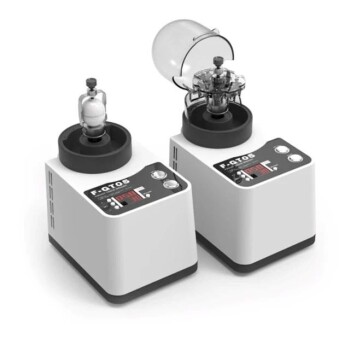
The primary role of a wet planetary ball mill in this context is to mechanically activate and homogenize the raw materials at a molecular level. By utilizing a liquid phase medium during high-energy grinding, the mill refines sodium carbonate, ferrous oxalate, and ammonium dihydrogen phosphate into a uniformly dispersed mixture, thereby significantly reducing the energy barrier required for the subsequent formation of the NaFePO4 (Maricite) crystal phase.
The wet planetary ball mill acts as a catalyst for solid-state reactions by transforming a physical mixture of powders into a highly reactive, molecularly uniform precursor, ensuring the final material achieves the desired phase purity during thermal treatment.
The Mechanics of Wet Milling
High-Energy Mechanical Activation
The planetary ball mill does not simply mix ingredients; it subjects them to intense impact and shear forces.
This high-energy grinding physically breaks down the raw materials—sodium carbonate, ferrous oxalate, and ammonium dihydrogen phosphate—refining them beyond simple powder mixing.
The Function of the Liquid Medium
Unlike dry milling, wet milling occurs within a liquid phase medium.
This liquid prevents the re-agglomeration of fine particles, allowing the system to maintain a smaller particle size and ensuring a more intimate, molecular-level contact between the reactants.
Impact on Synthesis Efficiency
Molecular-Level Uniform Dispersion
The critical advantage of this process is the achievement of uniform dispersion throughout the mixture.
By ensuring that the specific reaction components are mixed homogeneously at the molecular level, the process eliminates "hot spots" or areas of unreacted material during heating.
Reducing the Energy Barrier
Solid-state reactions rely on diffusion, which can be slow and energy-intensive.
The wet milling process creates a high contact area between particles, which effectively lowers the activation energy required for the reaction to proceed, making the subsequent thermal treatment more efficient.
Promoting Crystal Phase Formation
The ultimate goal of the precursor preparation is to facilitate the correct crystallization during calcination.
By establishing a uniform foundation and reactive state, the milling process promotes the precise formation of the desired NaFePO4 (Maricite) phase, minimizing the risk of impurities.
Understanding the Trade-offs
Process Time vs. Material Quality
Wet planetary ball milling is an intensive process, often requiring extended durations to achieve the necessary refinement.
While this increases the preparation time compared to simple dry mixing, the trade-off is often necessary to achieve the high-activity powders required for advanced applications.
Complexity of Liquid Handling
Introducing a liquid medium adds variables to the synthesis, such as the need for subsequent drying and the selection of a compatible solvent.
However, omitting the liquid phase (dry milling) often leads to particle agglomeration, which sacrifices the molecular-level uniformity that is the hallmark of high-performance NaFePO4 precursors.
Making the Right Choice for Your Goal
To optimize your synthesis strategy, consider your specific purity and performance requirements.
- If your primary focus is Phase Purity: Utilize wet planetary ball milling to ensure molecular-level dispersion, which is critical for minimizing impurities in the final crystal structure.
- If your primary focus is Reaction Kinetics: Rely on the high-energy grinding of the ball mill to maximize surface area and reduce the thermal energy required during calcination.
By prioritizing uniform dispersion and mechanical activation, you ensure the successful synthesis of high-quality Maricite NaFePO4.
Summary Table:
| Feature | Impact on NaFePO4 Synthesis |
|---|---|
| High-Energy Impact | Breaks down raw materials for mechanical activation |
| Liquid Medium | Prevents re-agglomeration & ensures molecular-level contact |
| Homogenization | Eliminates 'hot spots' to ensure phase purity |
| Kinetic Activation | Lowers the energy barrier for solid-state diffusion |
Elevate Your Material Research with KINTEK Precision
Achieving the perfect Maricite phase requires more than just mixing—it demands the superior mechanical activation of KINTEK’s crushing and milling systems. Whether you are synthesizing advanced battery materials like NaFePO4 or developing high-performance ceramics, our planetary ball mills and specialized laboratory equipment provide the uniformity and energy efficiency your research deserves.
From high-temperature calcination in our muffle and tube furnaces to final phase analysis, KINTEK supports every stage of your workflow with premium consumables like PTFE products, ceramics, and crucibles.
Ready to optimize your precursor preparation? Contact our experts today to find the ideal milling and thermal solution for your laboratory.
Related Products
- Laboratory Planetary Ball Mill Cabinet Planetary Ball Milling Machine
- High Energy Planetary Ball Mill for Laboratory Horizontal Tank Type Milling Machine
- Laboratory Horizontal Planetary Ball Mill Milling Machine
- Mini Planetary Ball Mill Machine for Laboratory Milling
- Laboratory Planetary Ball Mill Rotating Ball Milling Machine
People Also Ask
- Why is a laboratory ball mill required for ultra-fine fly ash? Unlock Nano-Scale Adsorption Power
- What is the function of a laboratory ball mill in the preparation of AMMCs? Optimize Dispersion & Grain Refinement
- How do laboratory ball mills facilitate the mechanochemical synthesis of ZIF-8? Solvent-Free Synthesis Explained
- What is the primary function of a laboratory ball mill in the modification of sulfide-based solid electrolytes with LiPO2F2?
- What is the function of a laboratory ball mill in the pretreatment of waste tire char (WTC)? Optimize Material Reactivity