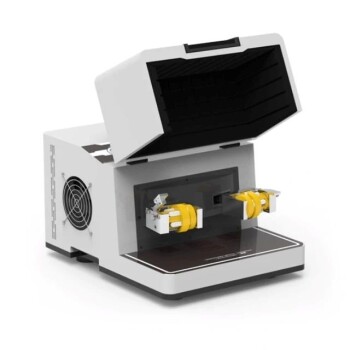
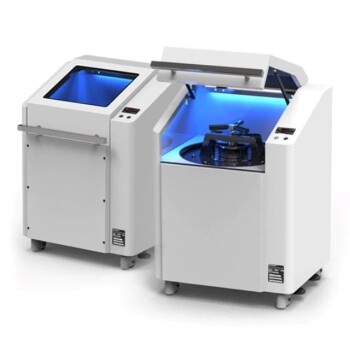
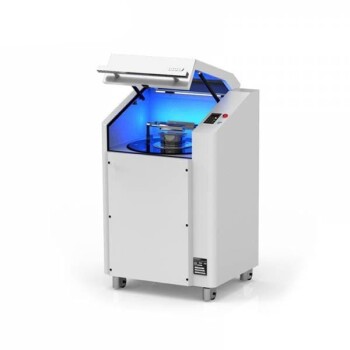
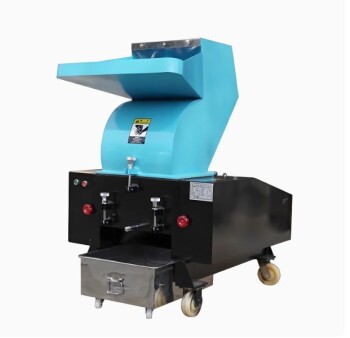
Industrial grinding mills are the essential catalyst for material transformation, reducing raw coal and poplar wood into fine particles to maximize specific surface area. This physical reduction ensures that subsequent thermal processes, such as pyrolysis and devolatilization, are governed by the material's intrinsic chemical properties rather than heat transfer limitations, while also providing the necessary surface activity for chemical modification.
The primary role of industrial grinding is to transform bulk feedstock into a high-surface-area powder that enables accurate kinetic characterization, uniform heat transfer, and enhanced chemical reactivity for downstream processing.
Enhancing Thermal Analysis and Kinetic Accuracy
Maximizing Specific Surface Area
Grinding raw coal and poplar wood significantly increases the specific surface area available for reaction. This allows heat and chemical reagents to interact with the material more efficiently, accelerating the rate of devolatilization and pyrolysis.
Ensuring Uniform Heat Transfer
Fine particles facilitate faster and more uniform heat transfer throughout the material. By minimizing temperature gradients within individual particles, researchers can ensure that experimental data accurately reflects the material's intrinsic kinetic properties rather than physical size constraints.
Improving Analytical Precision
Standardizing particle size to 1 mm or less is critical for the accuracy of thermogravimetric and elemental analyses. A uniform powder ensures that the small samples used in laboratory testing are truly representative of the bulk material.
Driving Chemical and Physical Modification
Facilitating Chemical Oxidation
Ultra-fine grinding, which reduces coal to a median particle size of 20 micrometers or less, creates a surplus of reaction sites. This increased surface activity makes it easier for reagents to interact with the coal and introduce oxygen-containing functional groups during oxidation.
Standardizing Feed for Biomass Processing
For poplar wood, mechanical grinding provides a standardized feed necessary for secondary processes like torrefaction and pelletizing. Uniformity in the feed material leads to higher quality pellets and more predictable energy yields in biomass applications.
Utilizing Mechanochemical Forces
The grinding process employs mechanochemical forces that do more than just reduce size; they physically modify the surface of the coal powder. This physical modification directly improves the primary pyrolysis characteristics, making the fuel more reactive.
Understanding the Trade-offs
Energy Intensity vs. Reactivity
Achieving ultra-fine particle sizes, particularly those below 20 micrometers, requires significant mechanical energy. Operators must balance the cost of intensive milling against the performance benefits of increased surface activity in the final product.
Material Degradation Risks
Excessive grinding can lead to unintended chemical alterations or the degradation of heat-sensitive components in biomass. Over-processing may introduce structural changes that deviate from the raw material's natural state, potentially skewing research results.
Equipment Wear and Maintenance
Processing abrasive materials like coal at high speeds leads to accelerated wear on grinding media and liners. This necessitates a robust maintenance schedule to prevent contamination of the pulverized wood or coal with metallic debris from the mill itself.
How to Apply This to Your Project
Before selecting a milling specification, define the specific requirements of your downstream application to avoid over-processing.
- If your primary focus is accurate kinetic research: Prioritize particle size reduction and uniformity to eliminate internal heat transfer resistance during thermal decomposition.
- If your primary focus is chemical modification: Aim for ultra-fine grinding (D50 < 20 micrometers) to maximize surface activity and the density of available reaction sites.
- If your primary focus is industrial biomass production: Target a consistent particle size of 1 mm or less to ensure stable operation during torrefaction or pelletizing.
Properly calibrated grinding transforms raw solids into high-performance powders, unlocking the full chemical and energy potential of coal and wood feedstocks.
Summary Table:
| Key Role | Primary Benefit | Research/Industrial Application |
|---|---|---|
| Surface Area Maximization | Faster pyrolysis & devolatilization | Thermal analysis & kinetic studies |
| Heat Transfer Uniformity | Eliminates internal temperature gradients | Precise thermogravimetric analysis |
| Surface Activation | Increases density of reaction sites | Chemical oxidation & modification |
| Feed Standardization | Predictable energy yields & quality | Biomass pelletizing & torrefaction |
| Mechanochemical Force | Improved primary pyrolysis characteristics | High-performance fuel development |
Elevate Your Material Research with KINTEK Precision
Unlock the full potential of your coal and biomass feedstocks with KINTEK’s advanced preparation solutions. Whether you require ultra-fine crushing and milling systems for kinetic accuracy or high-temperature furnaces and reactors for downstream analysis, KINTEK provides the industrial-grade reliability your laboratory demands.
Why choose KINTEK?
- Comprehensive Range: From planetary ball mills to specialized sieving equipment and hydraulic presses.
- End-to-End Solutions: We support your entire workflow with high-temperature high-pressure reactors, autoclaves, and essential consumables like ceramics and crucibles.
- Expert Support: Tailored equipment configurations to prevent material degradation and optimize energy intensity.
Ready to achieve superior particle uniformity and reactivity? Contact KINTEK today to consult with our experts on the perfect milling and thermal processing setup for your project!
References
- R. Lemaire, Sébastien Menanteau. Kinetic Modeling of the Devolatilization of Pulverized Coal, Poplar Wood, and Their Blends in a Thermogravimetric Analyzer and a Flat Flame Reactor. DOI: 10.1021/acsomega.3c03110
This article is also based on technical information from Kintek Solution Knowledge Base .
Related Products
- Laboratory High Throughput Tissue Grinding Mill Grinder
- Laboratory Grinding Mill Mortar Grinder for Sample Preparation
- Laboratory Hybrid Tissue Grinding Mill
- Laboratory Jar Mill with Agate Grinding Jar and Balls
- Vibrating Disc Mill Small Laboratory Grinding Machine
People Also Ask
- What is the purpose of using a laboratory grinder and standard sieves? Unlock Precise Rice Husk Pretreatment
- What is the purpose of using a laboratory grinder with specific mesh sieves for oat straw? Optimize Pellet Quality
- What is the role of laboratory-grade grinders and sieves in sample prep? Ensure High-Precision Corrosion Analysis
- How do laboratory grinders and standard sieving systems ensure the quality of feedstock for torrefaction?
- What does a grinder do in a laboratory? Achieve Homogeneous Sample Preparation for Accurate Analysis