Knowledge What is the purpose of processing dried Aluminum Nitride mixed powder with a 200-mesh standard sieving system?
Author avatar

Tech Team · Kintek Solution

Updated 3 days ago

What is the purpose of processing dried Aluminum Nitride mixed powder with a 200-mesh standard sieving system?


Processing dried Aluminum Nitride (AlN) powder through a 200-mesh sieve is primarily done to eliminate soft agglomerates. These clumps inevitably form during the drying phase and must be broken down to restore the powder's uniformity. This step ensures the material flows correctly when loaded into a mold, which is essential for consistent pressing.

Core Takeaway While drying is necessary to remove solvents, it creates physical inconsistencies in the powder. Sieving is the critical corrective step that ensures flowability and uniform particle size, directly preventing density variations and structural defects in the final sintered ceramic.

The Role of Sieving in AlN Processing

Addressing the Byproducts of Drying

Vacuum drying is used to remove solvents like anhydrous ethanol from the AlN slurry. While this effectively protects the powder from oxidation at low temperatures (around 80°C), it has a physical side effect.

The drying process naturally causes particles to bind together, forming soft agglomerates. If left untreated, these clumps act as irregularities that compromise the material's consistency.

Ensuring Uniform Particle Size

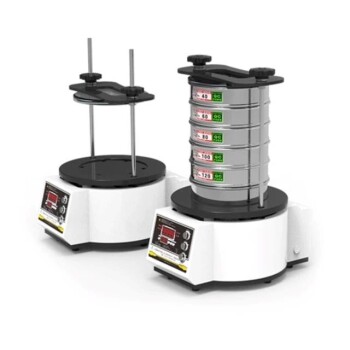
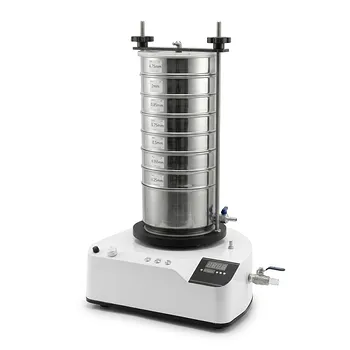
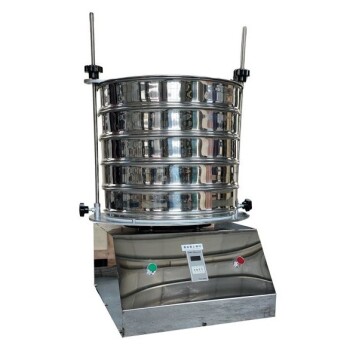
Passing the powder through a 200-mesh standard sieve acts as a mechanical reset. It gently breaks apart these soft agglomerates without damaging the fundamental particle structure.

This results in a homogenized powder where particles are distinct and uniform in size.

Optimizing Powder Flowability

For a ceramic to be pressed correctly, the powder must behave almost like a fluid. Sieved powder possesses excellent flowability, allowing it to fill the mold evenly.

Poor flowability leads to air pockets and uneven distribution within the die, which are catastrophic for high-performance ceramics.

Impact on the Final Ceramic Product

Minimizing Density Variations

The quality of the "green body" (the pressed, unfired part) is determined by how evenly the powder packs together.

Sieving ensures consistent packing density throughout the mold. This prevents density gradients, where some areas of the part are denser than others.

Preventing Structural Defects

Density variations in the green stage magnify into structural failures during the sintering (firing) process.

By ensuring a uniform starting mix, sieving prevents internal stresses that lead to cracks and warping in the final product.

Eliminating Porosity

Aluminum Nitride is valued for its high thermal conductivity, which is drastically reduced by air pockets (pores).

Breaking down agglomerates allows for tighter particle packing. This minimizes the formation of pores in the sintered ceramic, ensuring maximum density and performance.

Critical Considerations and Risks

The Risk of Re-Oxidation

While the previous vacuum drying step prevents oxidation, the sieving process exposes the powder to the manufacturing environment.

Because AlN fine powder is highly active, sieving should ideally be conducted in a controlled environment to prevent it from reacting with moisture in the air.

Contamination Potential

The physical act of sieving involves contact between the abrasive ceramic powder and the sieve mesh.

Care must be taken to ensure the sieve material does not wear down and introduce impurities into the high-purity AlN, which would degrade its thermal properties.

Ensuring Process Integrity

The sieving process is the bridge between raw material preparation and final forming. Depending on your specific quality metrics, consider the following:

  • If your primary focus is Structural Integrity: Prioritize sieving to eliminate all agglomerates, as these are the primary initiation sites for cracks in the final ceramic.
  • If your primary focus is Dimensional Accuracy: Ensure the flowability is maximized, as this dictates how evenly the mold fills and how predictable the shrinkage will be during sintering.

Sieving is not merely a sorting step; it is a fundamental prerequisite for achieving a defect-free, high-density Aluminum Nitride component.

Summary Table:

Process Phase Primary Goal Impact on AlN Quality
Sieving Mechanism Breaks down soft agglomerates Restores powder uniformity after drying
Flowability Improvement Optimizes mold filling Prevents air pockets and uneven distribution
Density Control Eliminates density gradients Ensures a uniform green body and minimal warping
Structural Integrity Minimizes porosity Maximizes thermal conductivity and material strength

Elevate Your Material Consistency with KINTEK

Precision in ceramic manufacturing starts with the right tools. KINTEK specializes in high-performance laboratory equipment, offering a comprehensive range of sieving equipment, crushing and milling systems, and hydraulic presses (pellet, hot, and isostatic) tailored for advanced material research.

Whether you are processing active Aluminum Nitride or developing complex ceramic components, our solutions—from vacuum and atmosphere furnaces to high-temperature high-pressure reactors—ensure the purity and density your applications demand.

Ready to optimize your powder processing workflow? Contact us today to discuss your project requirements!

Related Products

People Also Ask

Related Products

Advanced Engineering Fine Ceramics Low Temperature Alumina Granulation Powder

Advanced Engineering Fine Ceramics Low Temperature Alumina Granulation Powder

Low temperature alumina granulation powder is a kind of alumina particles produced by a special low temperature process, designed to meet the needs of temperature sensitive applications. This material has excellent low temperature performance and good processing characteristics, suitable for a variety of industries that require low temperature processing and treatment.

XRF & KBR plastic ring lab Powder Pellet Pressing Mold for FTIR

XRF & KBR plastic ring lab Powder Pellet Pressing Mold for FTIR

Get precise XRF samples with our plastic ring lab powder pellet pressing mold. Fast tableting speed and customizable sizes for perfect molding every time.

Vacuum Induction Melting Spinning System Arc Melting Furnace

Vacuum Induction Melting Spinning System Arc Melting Furnace

Develop metastable materials with ease using our Vacuum Melt Spinning System. Ideal for research and experimental work with amorphous and microcrystalline materials. Order now for effective results.

1400℃ Laboratory High Temperature Tube Furnace with Alumina Tube

1400℃ Laboratory High Temperature Tube Furnace with Alumina Tube

Looking for a tube furnace for high-temperature applications? Our 1400℃ Tube Furnace with Alumina Tube is perfect for research and industrial use.

Laboratory Sealed Hammer Crusher for Efficient Sample Preparation

Laboratory Sealed Hammer Crusher for Efficient Sample Preparation

Discover the Laboratory Sealed Hammer Crusher for efficient sample preparation. Ideal for coal, metallurgy, and research, this crusher ensures high production efficiency and environmental friendliness.

Custom PTFE Teflon Parts Manufacturer Grinding Bowl

Custom PTFE Teflon Parts Manufacturer Grinding Bowl

PTFE is renowned for its exceptional chemical resistance, thermal stability, and low friction properties, making it a versatile material in various industries. The PTFE grinding bowl, specifically, finds applications where these properties are crucial.

Square Lab Press Mold for Laboratory Applications

Square Lab Press Mold for Laboratory Applications

Create uniform samples easily with Square Lab Press Mold - available in various sizes. Ideal for battery, cement, ceramics, and more. Custom sizes available.

Engineering Advanced Fine Ceramics Aluminium Oxide Al2O3 Ceramic Washer for Wear-Resistant Applications

Engineering Advanced Fine Ceramics Aluminium Oxide Al2O3 Ceramic Washer for Wear-Resistant Applications

Alumina wear-resistant ceramic washer are used for heat dissipation, which can replace aluminum heat sinks, with high temperature resistance and high thermal conductivity.

Customer Made Versatile CVD Tube Furnace Chemical Vapor Deposition Chamber System Equipment

Customer Made Versatile CVD Tube Furnace Chemical Vapor Deposition Chamber System Equipment

Get your exclusive CVD furnace with KT-CTF16 Customer Made Versatile Furnace. Customizable sliding, rotating, and tilting functions for precise reactions. Order now!

Square Bidirectional Pressure Mold for Lab Use

Square Bidirectional Pressure Mold for Lab Use

Discover precision in molding with our Square Bidirectional Pressure Mold. Ideal for creating diverse shapes and sizes, from squares to hexagons, under high pressure and uniform heating. Perfect for advanced material processing.

High Performance Laboratory Freeze Dryer

High Performance Laboratory Freeze Dryer

Advanced lab freeze dryer for lyophilization, preserving biological & chemical samples efficiently. Ideal for biopharma, food, and research.

Special Shape Press Mold for Lab

Special Shape Press Mold for Lab

Discover high-pressure special shape press molds for diverse applications, from ceramics to automotive parts. Ideal for precise, efficient molding of various shapes and sizes.

Cylindrical Resonator MPCVD Machine System Reactor for Microwave Plasma Chemical Vapor Deposition and Lab Diamond Growth

Cylindrical Resonator MPCVD Machine System Reactor for Microwave Plasma Chemical Vapor Deposition and Lab Diamond Growth

Learn about Cylindrical Resonator MPCVD Machine, the microwave plasma chemical vapor deposition method used for growing diamond gemstones and films in the jewelry and semi-conductor industries. Discover its cost-effective advantages over traditional HPHT methods.

Cylindrical Press Mold with Scale for Lab

Cylindrical Press Mold with Scale for Lab

Discover precision with our Cylindrical Press Mold. Ideal for high-pressure applications, it molds various shapes and sizes, ensuring stability and uniformity. Perfect for lab use.

Vacuum Arc Induction Melting Furnace

Vacuum Arc Induction Melting Furnace

Discover the power of Vacuum Arc Furnace for melting active & refractory metals. High-speed, remarkable degassing effect, and free of contamination. Learn more now!

Inclined Rotary Plasma Enhanced Chemical Vapor Deposition PECVD Equipment Tube Furnace Machine

Inclined Rotary Plasma Enhanced Chemical Vapor Deposition PECVD Equipment Tube Furnace Machine

Upgrade your coating process with PECVD coating equipment. Ideal for LED, power semiconductors, MEMS and more. Deposits high-quality solid films at low temps.

HFCVD Machine System Equipment for Drawing Die Nano-Diamond Coating

HFCVD Machine System Equipment for Drawing Die Nano-Diamond Coating

The nano-diamond composite coating drawing die uses cemented carbide (WC-Co) as the substrate, and uses the chemical vapor phase method ( CVD method for short ) to coat the conventional diamond and nano-diamond composite coating on the surface of the inner hole of the mold.

RF PECVD System Radio Frequency Plasma-Enhanced Chemical Vapor Deposition RF PECVD

RF PECVD System Radio Frequency Plasma-Enhanced Chemical Vapor Deposition RF PECVD

RF-PECVD is an acronym for "Radio Frequency Plasma-Enhanced Chemical Vapor Deposition." It deposits DLC (Diamond-like carbon film) on germanium and silicon substrates. It is utilized in the 3-12um infrared wavelength range.

Multi-Punch Rotary Tablet Press Mold Ring for Rotating Oval and Square Molds

Multi-Punch Rotary Tablet Press Mold Ring for Rotating Oval and Square Molds

The multi-punch rotary tablet press mold stands as a pivotal component in pharmaceutical and manufacturing industries, revolutionizing the process of tablet production. This intricate mold system comprises multiple punches and dies arranged in a circular fashion, facilitating rapid and efficient tablet formation.


Leave Your Message