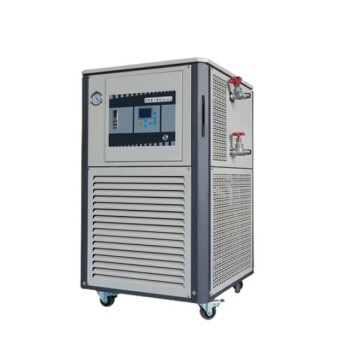
The primary function of an industrial high-temperature circulating oven is to execute a critical post-curing treatment for composite materials. By rigidly controlling heating curves and isothermal holding times, the oven finalizes the chemical reaction within the resin matrix, transforming a shaped part into a high-performance structural component.
While molding gives a composite its shape, post-curing determines its endurance. This thermal treatment is essential for maximizing molecular cross-linking and eliminating manufacturing stresses, ensuring that hybrid systems—such as Kevlar and basalt—maintain stability under extreme service conditions.
Optimizing the Resin Matrix
The initial molding process rarely achieves the full chemical potential of a composite's resin. The circulating oven bridges the gap between a formed part and a finished material.
Achieving Maximum Cross-Linking
The oven applies heat to drive the polymerization reaction to completion.
This promotes maximum cross-linking within the resin matrix, ensuring the polymer chains are tightly bound. Without this step, the material remains chemically incomplete and weaker than its theoretical limit.
Eliminating Residual Stresses
During the initial molding phase, materials often cool unevenly or under pressure, locking in internal forces known as residual stresses.
The controlled heat of the circulating oven relaxes the material. This process eliminates residual stresses, preventing the composite from warping or failing prematurely when subjected to physical loads.
Measurable Performance Gains
The effective use of a circulating oven directly impacts the specific mechanical properties required for high-performance applications.
Boosting Glass Transition Temperature (Tg)
One of the most critical metrics for thermal performance is the Glass Transition Temperature (Tg).
Post-curing significantly improves the Tg, raising the temperature threshold at which the material begins to soften. This ensures the composite remains rigid and stable even in high-temperature service environments.
Improving Interlaminar Shear Strength (ILSS)
Hybrid fiber systems, such as those combining Kevlar and basalt, rely heavily on the bond between layers.
The post-curing process significantly improves Interlaminar Shear Strength (ILSS). This strengthens the adhesion between fiber layers, reducing the risk of delamination under stress.
Critical Operational Considerations
While the benefits of post-curing are clear, the process requires strict adherence to protocol to avoid compromising the material.
The Necessity of Precise Control
The "circulating" aspect of the oven is vital for maintaining uniform temperature distribution.
Any deviation in the heating curves or isothermal holding times can lead to inconsistent curing. If the temperature ramps up too quickly or fluctuates, you risk inducing thermal shock rather than relieving stress, potentially degrading the matrix you intended to strengthen.
Making the Right Choice for Your Goal
To maximize the utility of your hybrid fiber composites, you must tailor the post-curing cycle to your specific performance requirements.
- If your primary focus is thermal resistance: Configure the heating curve to aggressively target the maximum Glass Transition Temperature (Tg) to prevent softening in hot environments.
- If your primary focus is structural integrity: Prioritize extended isothermal holding times to ensure complete relaxation of residual stresses and maximum Interlaminar Shear Strength (ILSS).
Refining your post-curing strategy is the single most effective way to unlock the full potential of high-performance hybrid composites.
Summary Table:
| Key Function | Impact on Composite Material | Primary Benefit |
|---|---|---|
| Post-Curing | Finalizes chemical polymerization | Maximizes molecular cross-linking |
| Stress Relief | Relaxes internal manufacturing forces | Prevents warping and premature failure |
| Thermal Control | Raises Glass Transition Temp (Tg) | Ensures stability in high-temp environments |
| Bonding | Improves Interlaminar Shear Strength | Reduces delamination risk in hybrid systems |
Elevate Your Material Performance with KINTEK
Unlock the full potential of your hybrid composites with KINTEK’s precision thermal solutions. Whether you are aiming for maximum cross-linking or superior interlaminar shear strength, our high-temperature circulating ovens provide the uniform heating and precise control necessary for critical post-curing processes.
As specialists in laboratory and industrial equipment, KINTEK offers a comprehensive range of solutions, including:
- High-Temperature Ovens & Muffle Furnaces for rigorous thermal cycles.
- Crushing, Milling & Sieving Systems for material preparation.
- Hydraulic Presses (Pellet, Hot, Isostatic) for composite forming.
- Advanced Reactors & Autoclaves for specialized chemical synthesis.
Contact KINTEK today to consult with our experts and find the perfect equipment to ensure your structural components maintain stability under the most extreme service conditions.
References
- Abdulhammed K. Hamzat, Ramazan Asmatulu. Fiber-reinforced composites for aerospace, energy, and marine applications: an insight into failure mechanisms under chemical, thermal, oxidative, and mechanical load conditions. DOI: 10.1007/s42114-024-01192-y
This article is also based on technical information from Kintek Solution Knowledge Base .
Related Products
- High Temperature Constant Temperature Heating Circulator Water Bath Chiller Circulator for Reaction Bath
- High Temperature Muffle Oven Furnace for Laboratory Debinding and Pre Sintering
- 1700℃ Muffle Oven Furnace for Laboratory
- 1400℃ Muffle Oven Furnace for Laboratory
- 1400℃ Laboratory High Temperature Tube Furnace with Alumina Tube
People Also Ask
- What is the necessity of a circulating water bath in chlorate production? Optimize Yield & Purity with Precision
- How do constant temperature circulators impact weight-loss immersion tests? Ensure Precision in Corrosion Analysis
- How does a constant temperature circulator support the leaching reaction of gold scrap? Optimize Gold Recovery Results
- Why is a constant temperature water bath used for precursor storage in CVD? Achieve Stable Nanocrystalline SiC Deposition
- Why is a high-precision constant temperature water bath necessary for anaerobic digestion? Ensure Success at 37±0.02°C