Knowledge What is the role of a ball mill and corundum grinding balls in boron carbide ceramic preparation? Ensure High Purity
Author avatar

Tech Team · Kintek Solution

Updated 3 days ago

What is the role of a ball mill and corundum grinding balls in boron carbide ceramic preparation? Ensure High Purity


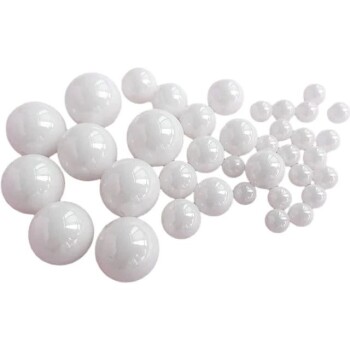
The primary function of a ball mill and corundum grinding balls in boron carbide ceramic preparation is to achieve a uniform, highly active powder mixture while rigorously maintaining chemical purity. Through a mechanical grinding process lasting between 3 and 48 hours, this equipment breaks down powder agglomerates and homogenizes the boron carbide matrix with essential sintering aids.

The combination of high-energy ball milling and wear-resistant corundum media solves the dual challenge of activating inert boron carbide particles for sintering while preventing the metallic contamination that commonly degrades ceramic performance.

The Mechanics of Preparation

Breaking Down Agglomerates

Raw boron carbide powder often forms clusters or "agglomerates" that hinder densification.

The mechanical energy generated by the ball mill effectively shatters these agglomerates. This ensures the material is reduced to a consistent, fine state suitable for high-performance applications.

Uniform Mixing of Sintering Aids

Boron carbide is difficult to sinter alone and requires additives like alumina, rare earth oxides, and activated carbon.

The milling process disperses these aids evenly throughout the boron carbide matrix. Uniform distribution is critical for consistent chemical reactions during the subsequent heating phases.

Enhancing Surface Activity

Beyond simple mixing, the impact of the grinding balls alters the surface state of the particles.

This mechanical action enhances the "surface activity" of the powder. Higher surface activity promotes more efficient sintering reactions, leading to the development of an ideal, dense ceramic microstructure.

The Strategic Choice of Corundum Media

Minimizing Metallic Impurities

Boron carbide is highly sensitive to impurities, which can severely degrade the mechanical properties of the final product.

Standard steel grinding balls introduce iron contamination during long milling sessions. By using corundum (alumina) balls, manufacturers eliminate the introduction of metallic iron into the powder mixture.

Ensuring Chemical Compatibility

Corundum balls are composed of alumina, which is frequently used as a sintering aid for boron carbide anyway.

Consequently, any minor wear debris from the grinding media is often compatible with the ceramic formulation. This preserves the high purity required for advanced technical ceramics.

Understanding the Trade-offs

The Balance of Milling Duration

While extended milling (up to 48 hours) improves mixture homogeneity and particle activation, it increases the risk of media wear.

Operators must balance the need for high surface activity against the potential for introducing excessive alumina content from the wearing down of the grinding balls.

Containment Materials

Using corundum balls alone is not enough; the milling jar itself plays a role in purity.

To fully prevent contamination, polyurethane milling jars are typically used in conjunction with corundum balls. This ensures that neither the grinding media nor the container introduces metallic elements into the sensitive boron carbide powder.

Making the Right Choice for Your Goal

To optimize your boron carbide preparation, align your process parameters with your specific performance targets:

  • If your primary focus is mechanical strength: Prioritize the use of corundum media and polyurethane jars to eliminate iron impurities that create structural weak points.
  • If your primary focus is sintering density: Ensure the milling duration is sufficient (approaching the 48-hour range) to fully break agglomerates and maximize particle surface activity.

High-quality boron carbide ceramics depend not just on the raw materials, but on the precise, impurity-free delivery of mechanical energy during preparation.

Summary Table:

Feature Role/Benefit in Preparation
Equipment Ball Mill & Polyurethane Jars
Grinding Media Corundum (Alumina) Balls
Process Time 3 to 48 Hours
Key Outcome High Surface Activity & Uniform Mixing
Contamination Control Eliminates Iron/Metallic Impurities
Sintering Aid Integration Homogeneous dispersion of Alumina/Carbon

Elevate Your Advanced Ceramic Production with KINTEK

Precision in boron carbide preparation requires equipment that balances mechanical energy with chemical purity. KINTEK specializes in high-performance laboratory solutions designed for the most demanding material science applications.

Our extensive portfolio includes:

  • Crushing and Milling Systems: High-efficiency ball mills and wear-resistant corundum grinding media.
  • Sieving & Processing: Equipment to ensure consistent particle size distribution.
  • Sintering Solutions: Advanced high-temperature muffle, vacuum, and atmosphere furnaces for dense ceramic development.
  • Sample Preparation: Hydraulic presses and precision crucibles for flawless sintering cycles.

Don't let metallic contamination compromise your material's strength. Partner with KINTEK for reliable, high-purity laboratory equipment and consumables tailored to your research needs.

Optimize Your Lab's Efficiency—Contact KINTEK Today!

Related Products

People Also Ask

Related Products

Laboratory Ten-Body Horizontal Jar Mill for Lab Use

Laboratory Ten-Body Horizontal Jar Mill for Lab Use

The Ten-body horizontal jar mill is for 10 ball mill pots (3000ml or less). It has frequency conversion control, rubber roller movement, and PE protective cover.

Precision Machined Zirconia Ceramic Ball for Engineering Advanced Fine Ceramics

Precision Machined Zirconia Ceramic Ball for Engineering Advanced Fine Ceramics

zirconia ceramic ball have the characteristics of high strength, high hardness, PPM wear level, high fracture toughness, good wear resistance, and high specific gravity.

Arc-Shaped Alumina Ceramic Crucible High Temperature Resistant for Engineering Advanced Fine Ceramics

Arc-Shaped Alumina Ceramic Crucible High Temperature Resistant for Engineering Advanced Fine Ceramics

In the journey of scientific exploration and industrial production, every detail is crucial. Our arc-shaped alumina ceramic crucibles, with their excellent high temperature resistance and stable chemical properties, have become a powerful assistant in laboratories and industrial fields. They are made of high-purity alumina materials and manufactured through precision processes to ensure excellent performance in extreme environments.

High Quality Alumina Ceramic Screw for Engineering Advanced Fine Ceramics with High Temperature Resistance and Insulation

High Quality Alumina Ceramic Screw for Engineering Advanced Fine Ceramics with High Temperature Resistance and Insulation

Alumina ceramic screws are fastening components made of 99.5% alumina, ideal for extreme applications requiring excellent thermal resistance, electrical insulation and chemical resistance.

Laboratory Disc Rotary Mixer for Efficient Sample Mixing and Homogenization

Laboratory Disc Rotary Mixer for Efficient Sample Mixing and Homogenization

Efficient Laboratory Disc Rotary Mixer for Precise Sample Mixing, Versatile for Various Applications, DC Motor and Microcomputer Control, Adjustable Speed and Angle.

Laboratory Jaw Crusher

Laboratory Jaw Crusher

Discover the small jaw crusher for efficient, flexible, and affordable crushing in labs and small mines. Ideal for coal, ores, and rocks. Learn more now!

Dental Porcelain Zirconia Sintering Ceramic Vacuum Press Furnace

Dental Porcelain Zirconia Sintering Ceramic Vacuum Press Furnace

Get precise dental results with Dental Vacuum Press Furnace. Automatic temperature calibration, low noise tray, and touch screen operation. Order now!

High Temperature Wear-Resistant Alumina Al2O3 Plate for Engineering Advanced Fine Ceramics

High Temperature Wear-Resistant Alumina Al2O3 Plate for Engineering Advanced Fine Ceramics

High temperature wear-resistant insulating alumina plate has excellent insulation performance and high temperature resistance.

Engineering Advanced Fine Ceramics Alumina Crucibles (Al2O3) for Thermal Analysis TGA DTA

Engineering Advanced Fine Ceramics Alumina Crucibles (Al2O3) for Thermal Analysis TGA DTA

TGA/DTA thermal analysis vessels are made of aluminum oxide (corundum or aluminum oxide). It can withstand high temperature and is suitable for analyzing materials that require high temperature testing.

Copper Nickel Foam Metal Sheet

Copper Nickel Foam Metal Sheet

Discover the benefits of foam metal sheets for electrochemical tests. Our foam copper/nickel sheets are ideal for current collectors and capacitors.

Graphite Vacuum Continuous Graphitization Furnace

Graphite Vacuum Continuous Graphitization Furnace

High-temperature graphitization furnace is a professional equipment for graphitization treatment of carbon materials. It is a key equipment for the production of high-quality graphite products. It has high temperature, high efficiency and uniform heating. It is suitable for various high-temperature treatments and graphitization treatments. It is widely used in metallurgy, electronics, aerospace, etc. industry.

304 316 Stainless Steel Vacuum Ball Valve Stop Valve for High Vacuum Systems

304 316 Stainless Steel Vacuum Ball Valve Stop Valve for High Vacuum Systems

Discover 304/316 stainless steel vacuum ball valves, Ideal for high vacuum systems, Ensure precise control and durability. Explore now!

Electric Rotary Kiln Continuous Working Small Rotary Furnace Heating Pyrolysis Plant

Electric Rotary Kiln Continuous Working Small Rotary Furnace Heating Pyrolysis Plant

Efficiently calcine and dry bulk powder and lump fluid materials with an electric heating rotary furnace. Ideal for processing lithium ion battery materials and more.

Electric button battery sealing machine

Electric button battery sealing machine

The electric button battery sealing machine is a high-performance packaging equipment designed for mass production of button batteries (such as CR series, LR series, SR series, etc.), suitable for electronic manufacturing, new energy research and development, and industrial automation production lines.

Graphite Vacuum Furnace Negative Material Graphitization Furnace

Graphite Vacuum Furnace Negative Material Graphitization Furnace

Graphitization furnace for battery production has uniform temperature and low energy consumption. Graphitization furnace for negative electrode materials: an efficient graphitization solution for battery production and advanced functions to enhance battery performance.

Benchtop Laboratory Freeze Dryer for Lab Use

Benchtop Laboratory Freeze Dryer for Lab Use

Premium benchtop laboratory freeze dryer for lyophilization, preserving samples with ≤ -60°C cooling. Ideal for pharmaceuticals & research.

High Temperature Alumina (Al2O3) Furnace Tube for Engineering Advanced Fine Ceramics

High Temperature Alumina (Al2O3) Furnace Tube for Engineering Advanced Fine Ceramics

High temperature alumina furnace tube combines the advantages of high hardness of alumina, good chemical inertness and steel, and has excellent wear resistance, thermal shock resistance and mechanical shock resistance.

Lab Blown Film Extrusion Three Layer Co-Extrusion Film Blowing Machine

Lab Blown Film Extrusion Three Layer Co-Extrusion Film Blowing Machine

Lab blown film extrusion is mainly used to detect the feasibility of film blowing of polymer materials and the colloid condition in the materials, as well as the dispersion of colored dispersions, controlled mixtures, and extrudates;

Hexagonal Boron Nitride HBN Thermocouple Protection Tube

Hexagonal Boron Nitride HBN Thermocouple Protection Tube

Hexagonal boron nitride ceramics is an emerging industrial material. Because of its similar structure to graphite and many similarities in performance, it is also called "white graphite".

Engineering Advanced Fine Ceramics Aluminum Oxide Al2O3 Heat Sink for Insulation

Engineering Advanced Fine Ceramics Aluminum Oxide Al2O3 Heat Sink for Insulation

The hole structure of the ceramic heat sink increases the heat dissipation area in contact with the air, which greatly enhances the heat dissipation effect, and the heat dissipation effect is better than that of super copper and aluminum.


Leave Your Message