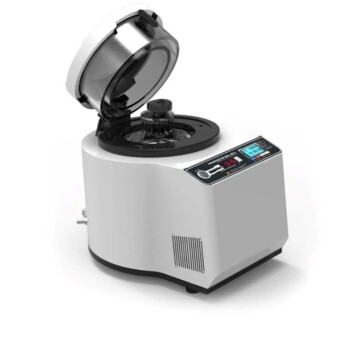
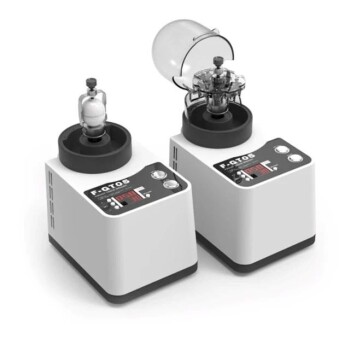
High-energy ball milling acts as the fundamental mechanical activation step in the synthesis of Ga-LLZO solid electrolytes. It is primarily responsible for the intensive grinding and homogenous mixing of raw material powders—specifically LiOH·H2O, La2O3, ZrO2, and Ga2O3—typically over a duration of approximately 12 hours.
Core Takeaway The process does more than simply blend ingredients; it drastically refines particle size to increase specific surface area. This physical alteration creates a highly reactive, uniform precursor mixture that is essential for driving the subsequent solid-phase reactions required to form a pure, high-performance electrolyte.
The Mechanics of Pretreatment
Achieving Chemical Uniformity
The synthesis of Ga-LLZO involves a complex multi-component system utilizing lithium, lanthanum, zirconium, and gallium sources.
High-energy ball milling ensures these distinct powders are mixed at a microscopic scale. This uniformity is critical because the gallium dopant (Ga2O3) must be evenly distributed throughout the matrix to stabilize the desired cubic crystal structure in the final product.
Increasing Specific Surface Area
Raw oxide and hydroxide powders often exist as large particles or agglomerates with limited reactive surface area.
Through high-frequency mechanical impacts, the ball mill pulverizes these powders. This refinement significantly increases the specific surface area of the particles, creating more points of contact between the reactants.
Facilitating Solid-Phase Reactions
The ultimate goal of this pretreatment is not the reaction itself, but the preparation for it.
By reducing particle diffusion distances and increasing contact area, the milling process reduces the energy barrier for the subsequent solid-phase reaction. This ensures that when the material is later heated (calcined/sintered), the reaction proceeds efficiently to form the correct chemical phase.
Operational Considerations
The Role of Impact Energy
Standard mixing methods are insufficient for hard oxide materials like Zirconia (ZrO2).
High-energy milling utilizes intense centrifugal or planetary forces to generate the kinetic energy required to break down hard agglomerates. This intensity ensures that even the most resilient components are refined to a compatible size for reaction.
Utilizing Correct Grinding Media
To maintain the integrity of the Ga-LLZO chemical composition, the choice of grinding media is paramount.
Zirconia grinding balls are typically used due to their high hardness and chemical inertness. This prevents the introduction of metallic impurities (such as iron from steel balls), which would be detrimental to the electrochemical stability and ionic conductivity of the final electrolyte.
Understanding the Trade-offs
Contamination Risks
While high energy is necessary for refinement, it introduces a risk of contamination from the milling jar and balls.
If the milling duration is excessive or the media quality is poor, abrasive wear can introduce foreign particulates into the precursor. This necessitates a balance between sufficient milling time (e.g., the standard 12 hours) and media durability.
Over-Milling and Amorphization
In some contexts, excessive mechanical energy can trigger premature amorphization or unintended mechanochemical reactions at room temperature.
For standard Ga-LLZO solid-state synthesis, the goal is usually physical refinement rather than full mechanochemical synthesis. Operators must control speed and duration to ensure the powder is activated for sintering, not necessarily fully reacted in the pot.
Making the Right Choice for Your Goal
To maximize the effectiveness of your Ga-LLZO pretreatment, align your milling parameters with your specific quality targets:
- If your primary focus is Phase Purity: Ensure the milling duration is sufficient (around 12 hours) to achieve absolute homogeneity of the Gallium dopant, preventing secondary phases during sintering.
- If your primary focus is Electrochemical Performance: strictly utilize high-grade Zirconia grinding media to eliminate iron contamination that could short-circuit the electrolyte's insulating properties.
Ultimately, the high-energy ball mill transforms inert raw powders into a highly active precursor, laying the physical foundation for a successful solid-state electrolyte.
Summary Table:
| Process Step | Primary Function | Impact on Ga-LLZO Quality |
|---|---|---|
| Mechanical Activation | High-frequency impact & grinding | Increases specific surface area for faster reactions |
| Microscopic Mixing | Homogenization of Li, La, Zr, Ga | Ensures uniform Ga-doping and stable cubic phase |
| Particle Refinement | Breaking hard ZrO2 agglomerates | Reduces diffusion distance for efficient sintering |
| Contamination Control | Use of Zirconia media | Prevents metallic impurities for better ionic conductivity |
Elevate Your Battery Research with KINTEK Precision
Achieving the perfect Ga-LLZO solid electrolyte starts with superior material preparation. KINTEK specializes in high-performance laboratory equipment designed for the rigorous demands of battery research and material science.
Our advanced high-energy crushing and milling systems, including planetary ball mills and high-purity Zirconia grinding media, ensure the chemical uniformity and microscopic refinement your precursors require. Whether you are scaling up solid-state electrolyte synthesis or refining electrode materials, our comprehensive portfolio—from hydraulic pellet presses and high-temperature furnaces to high-pressure reactors and PTFE consumables—provides the reliability and precision your lab needs.
Ready to optimize your synthesis process? Contact our technical experts today to find the ideal milling and sintering solutions for your research goals.
Related Products
- High Energy Planetary Ball Mill Milling Machine for Laboratory
- High-Energy Omnidirectional Planetary Ball Mill Milling Machine for Laboratory
- High Energy Planetary Ball Mill Milling Machine for Laboratory
- High Energy Planetary Ball Mill for Laboratory Horizontal Tank Type Milling Machine
- High Energy Vibratory Ball Mill for Lab Use
People Also Ask
- How does a planetary ball mill provide mechanical activation for scandium recovery? Maximize Your Leaching Efficiency
- What role do planetary ball mills and zirconia media play in LLZT preparation? Optimize Your Solid Electrolyte Research
- What is the function of a planetary ball mill in the preparation of high-entropy rare earth silicate multi-phase ceramics?
- What is the purpose of using a planetary ball mill for cathode material regeneration? Achieve Atomic-Level Mixing
- What is the primary function of a planetary ball mill? Mastering SiC/Al Composite Mixing for Homogeneity